
As pro-Palestinian activists were shut out of the former Buchenwald concentration camp this weekend, a timeworn fight about the site’s history resurfaced.
That dispute, which dates back to the camp’s liberation in 1945, centers on how the victims of Buchenwald wanted to be remembered. The activists, a group called Kufiyas in Buchenwald, said their fight for Palestinians upheld a pledge made by thousands of Buchenwald survivors days after they were freed.
The inmates swore to punish the guilty, destroy Nazism and create a new world of peace. That promise, known as the “Oath of Buchenwald,” has been invoked by varying regimes and political movements ever since it was uttered.
Kufiyas in Buchenwald was blocked from holding a pro-Palestinian vigil at the Buchenwald memorial on Sunday after a court in the nearby city of Weimar upheld a police ban. The planned event would have marked the 81st anniversary of Buchenwald’s liberation by U.S. troops — and the day before the Jewish world observes Yom HaShoah, Holocaust memorial day.
Judges decided that the rally would likely “violate the dignity of victims” of the Nazis. The activists were offered the alternative of protesting in downtown Weimar, which they refused.
Buchenwald was one of the largest concentration camps on German soil, holding Jews along with political prisoners, Roma, gay people and prisoners of war. Roughly 56,000 people were killed there, among them some 11,000 Jews.
Kufiyas in Buchenwald argued that their protest would honor the memory of Buchenwald’s victims together with all “victims of genocide and fascism.” The campaign was formed after a German court ruled that Buchenwald could refuse entry to visitors who wear a Palestinian keffiyeh, which has been adopted by left-wing anti-Israel protesters. The memorial foundation argued that in some contexts, the symbol could be disruptive and undercut the memorial’s purpose. Its critics said the foundation was suppressing speech that criticized Israel — and fell in line with the mission of Holocaust remembrance.
By not addressing “the genocide in Gaza,” Kufiyehs in Buchenwald said the memorial became “a place of historical revisionism and genocide denial.”
The memorial site said that Kufiyas in Buchenwald were the ones abusing history.
“This is a completely inappropriate instrumentalization of the memory of the victims of National Socialism for one’s own political, misanthropic agenda,” Rikola-Gunnar Lüttgenau, a spokesperson for the memorial foundation, told the German broadcaster Mitteldeutscher Rundfunk. The planned rally was also excoriated by the European Jewish Congress, the Conference of European Rabbis and other groups.
Two people stand at a plaque at the Buchenwald concentration camp memorial near Weimar, Germany, Jan. 26, 2018. (Jens Schlueter/Getty Images)
Current-day atrocities have been invoked at Buchenwald before, according to William Niven, an emeritus professor of Nottingham Trent University who teaches German history.
In 1993, about 3,000 people demonstrated on the site against the ethnic cleansing of Bosniaks in Bosnia and Herzegovina. Marek Edelman, the last surviving leader of the Warsaw Ghetto Uprising during the Holocaust, said in a speech, “Europe has learnt nothing since the Holocaust. Nothing was done to stop the murdering. What happened in Bosnia and Herzegovina is a posthumous victory for Hitler.”
But Niven said he viewed the planned pro-Palestinian rally as problematic because it would have interrupted the anniversary of the camp’s liberation, a program that annually draws descendants of Buchenwald victims and a dwindling number of survivors. That risked both upsetting the visitors and hijacking their mourning, he said.
“If you’ve got a group of people standing there with political placards or making political statements, then they are transforming that commemorative event into a political act,” Niven said. “They are using it because they’ll get media attention.”
Tair Borchardt, an organizer for the campaign who is Jewish, countered that the activists include a substantial proportion of Jews, among them children and grandchildren of Nazi victims. She said that drawing a direct line between Buchenwald inmates and the Palestinians was their form of commemoration.
“I think that honoring the victims of Nazi fascism also really should be principled in making sure that it doesn’t happen again,” said Borchardt. “And this is what’s happening right now. So drawing these connections, I don’t think it’s a contradiction in honoring the victims at all.”
Kufiyas in Buchenwald is a leftist alliance that includes activists from communist, anti-fascist and Jewish anti-Zionist organizations. The group collaborated in its campaign with the International Jewish Anti-Zionist Network and the German group Jewish Voice for a Just Peace in the Middle East.
Rachel Shapiro, an organizer with the International Jewish Anti-Zionist Network, said in a statement that the memorial foundation’s “insistence on the singularity and exceptionalism of the Nazi genocide of European Jews” served to “actively provide cover for Germany’s participation in and funding of the mass murder of Palestinians.”
Shapiro argued that state-funded institutions like the Buchenwald memorial should not singularly decide how Nazi victims are remembered, saying that anti-fascist Jews “wholeheartedly reject the German state dictating conditions around commemoration.”
That is exactly what states do, according to James E. Young, a Holocaust scholar and professor emeritus of Judaic Studies at the University of Massachusetts, Amherst.
“The irony is that by definition, in all national memorial sites everywhere, including Buchenwald, the state always dictates ‘the conditions of commemoration.’ That’s the point,” Young said in an interview.
Since the day Buchenwald was liberated, meanings of the place — and interpretations of what happened there — have shifted under changing regimes.
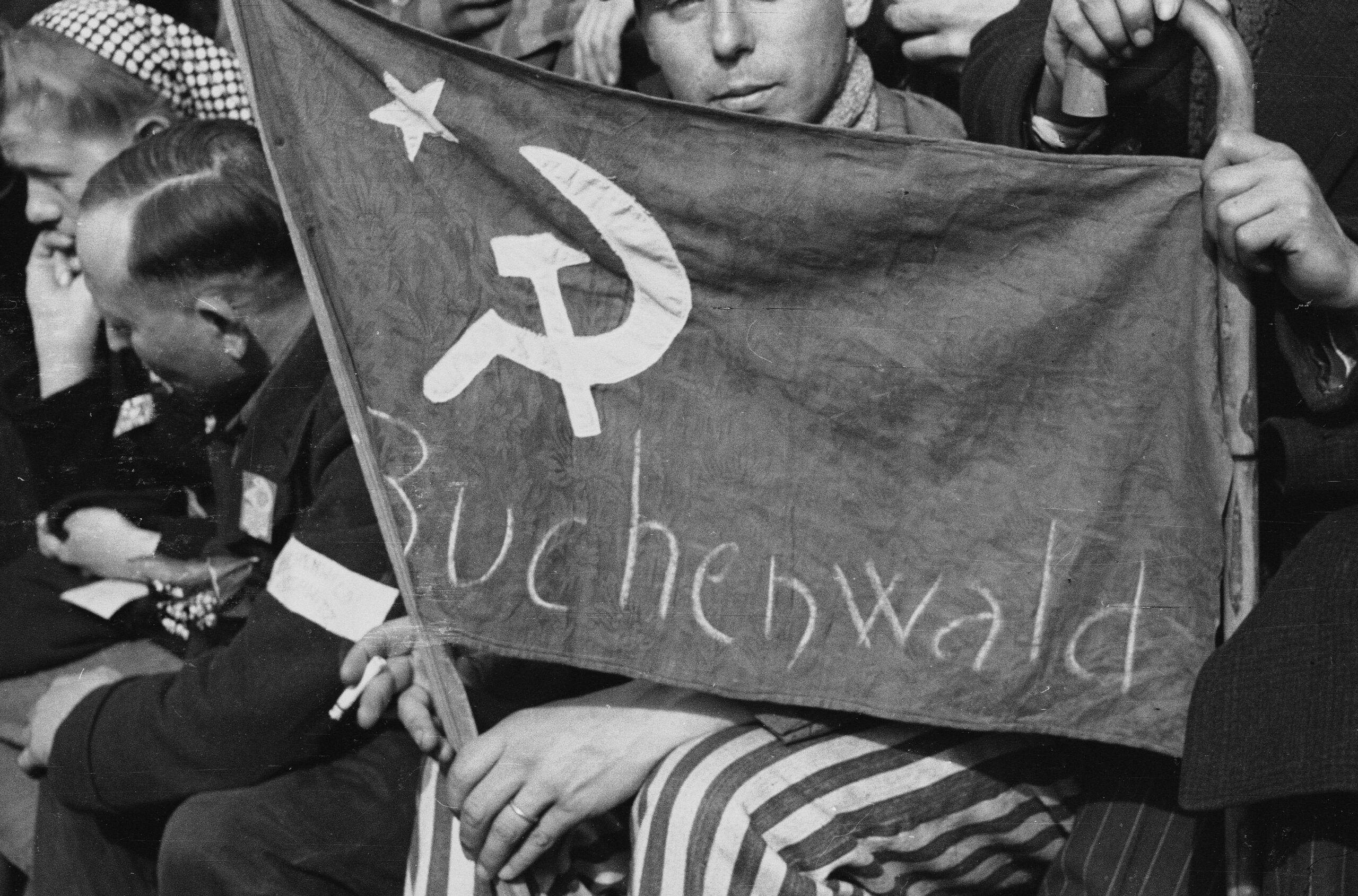
Kufiyas in Buchenwald said its demands from the memorial site were faithful to the Oath of Buchenwald, a pledge made by 21,000 survivors of the camp on April 19, 1945. That day, the freed inmates marched onto the roll call square and surrounded Buchenwald’s first memorial monument, a wooden obelisk made in the camp’s wood shop. They read a memorial address in Russian, Polish, German, French, Czech and English, ending with the jointly spoken oath.
“We will only give up the fight when the last guilty has been judged by the tribunal of all nations,” they said. “The absolute destruction of Nazism is our motto. The building of a new world of peace and freedom is our ideal.”
Just a few days later, the oath was revised. A new version swore to pursue the destruction of Nazism “down to its roots.” That addition had a clear meaning for communist survivors, a meaning solidified when Buchenwald came under Soviet-occupied East Germany: The “roots” of fascism were understood as capitalism and the West.
In 1958, the German Democratic Republic unveiled Buchenwald’s first state memorial, a path linking mass graves to a bell tower where the oath was inscribed.
“It was politicized during the GDR as an anti-capitalist, anti-imperialist, anti-West message. Pretty much up to 1990, that’s how it was framed,” said Nevin.
Buchenwald became a monument to the communist-led struggle and ultimate victory over fascism, a site symbolizing solidarity across national boundaries. For decades, wide gaps remained in this history, such as the Hitler-Stalin pact and the fate of Jewish inmates.
After the fall of the Soviet Union and the reunification of Germany, Buchenwald was reconceptualized. In 1991, an independent historical commission recommended an array of changes, including emphasizing the concentration camp and installing memorials for groups that had not yet been commemorated.
A memorial was also installed for the “special camp” that the Soviets set up from 1945 to 1950. The regime used this camp to intern Nazis, along with numerous perceived enemies who were not Nazis. An estimated 7,000 people who died there were buried in a forest near the camp, their graves kept a state secret. Now, Nazis are remembered among the victims in mass graves.
In the 1990s and 2000s, a new doctrine shaped Germany’s memory of the past: its special responsibility to Israel. During the process of “Vergangenheitsbewältigung,” or reckoning with the Nazi era, the robustness of the State of Israel became key to Germany’s rehabilitation.
“Just as the Holocaust did justify the birth of the State of Israel, in Germany’s eyes, part of the reason for the memorial is to commemorate the reason that Jews must never be attacked again — or, there must never be another genocide of Jews, in particular,” said Young.
Still, the Oath of Buchenwald has been invoked throughout the 2000s with a globalized urgency. During the 70th anniversary of liberation in 2015, survivor Bertrand Herz pleaded with young people around the world to defend human rights and fight racism. As long as repression persisted in the world, he said, the oath would not be fulfilled.
That commemoration came in the midst of terrorist attacks on Jews in Europe and a Syrian refugee crisis that changed the makeup of Germany. Beside Herz, the politician Martin Schulz said Buchenwald’s victims left behind a moral compass to navigate these challenges. Their memory obligated Europe to “fight the return of demons that we thought were overcome but which still show their ugly face — racism, anti-Semitism, ultra-nationalism and intolerance,” said Schulz.
Kufiyas in Buchenwald is not the only group to object to the Buchenwald memorial in recent years. Thuringia, the state housing the memorial, is a stronghold for the far-right Alternative for Germany party. The party received 38.6% of the vote there in last year’s federal elections, more than in any other German state.
The leader of AfD in Thuringia, Bjoern Hoecke, has urged Germany to break with its culture of repentance for Nazism. He has called Berlin’s Holocaust memorial a “monument of shame.” In 2021, AfD election posters in the Buchenwald parking lot advertised “courage to speak the truth.” The site has seen attacks from graffiti of swastikas to people cutting down trees planted in memory of survivors.
The AfD’s takeover of Thuringia in 2024 prompted an outcry from the International Committee Buchenwald-Dora and Kommados, founded in 1952 to preserve the memory of Buchenwald’s resistance.
“The ICBD thanks all the people in politics and civil society who fought fiercely in Thuringia and Saxony to defend our values — the values of the Buchenwald Oath,” the group said.
The AfD, predicted to surge in the region in September’s election, has presented an agenda to overhaul German life toward social conservatism and drive out immigrants and refugees.
Borchardt, the Kufiyas in Buchenwald organizer, said the memorial recently published a handout that placed images of a keffiyeh, a watermelon (a symbol of Palestinian solidarity) and the words “ceasefire now” next to swastikas, all shown as examples of antisemitism. She repudiated that comparison.
For her, there is no confusion in the Oath of Buchenwald, which she said “stands for itself.”
“It’s not very hard to understand that the current genocide happening in Palestine, the imprisonment of political prisoners — who are imprisoned, lots of them, without any court hearing or right to defend themselves — that this was probably meant by the Oath of Buchenwald, too,” said Borchardt.
Reporting the stories that define our era. When history unfolds in real-time, the Jewish world turns to JR. Your support ensures we can document the complexities of war and the resilience of Jewish communities with integrity.