

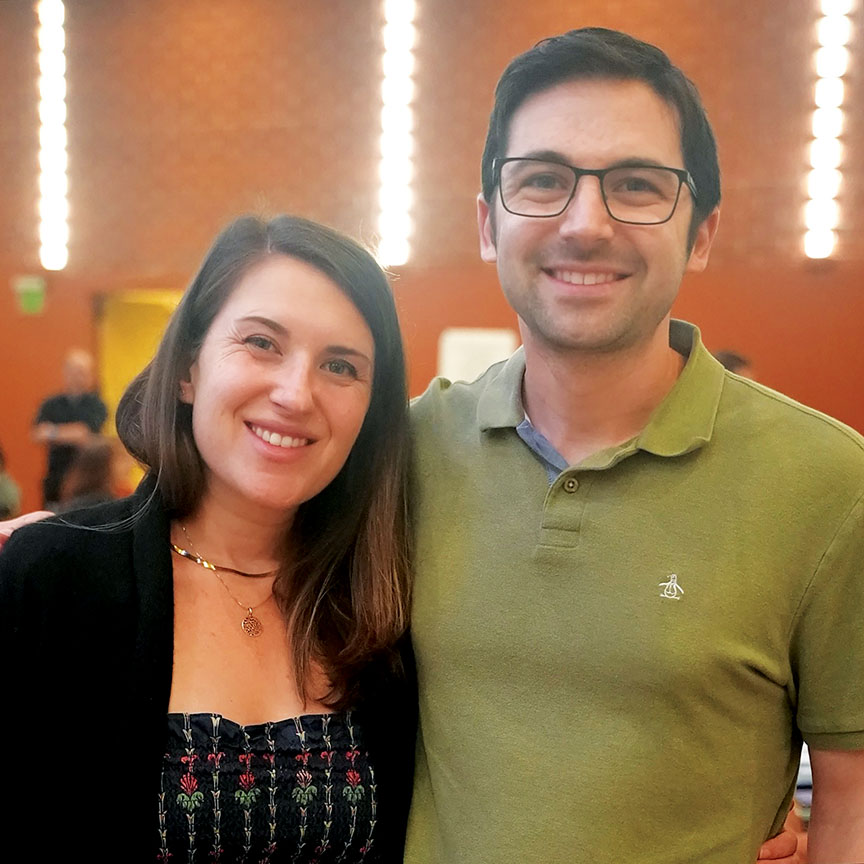
Visiting Rabbi Liora Alban and Rabbi Daniel Freedman in their Mid City home, it’s possible to believe they’re newlyweds, even though they’ve been married for four years and it’s been 11 and a half years since they met.
“What’s special about being married to a rabbi,” Rabbi Freedman said, “is that we aren’t able to just provide support for each other – in terms of the general way a partner would support a spouse. We are able to go deeper because we really understand what each other is doing and what the other person is facing.”
Rabbi Alban was asked how being married to a fellow rabbi is distinct from other relationships. She grew up in the Valley, he’s from St. Louis and they met as incoming freshmen before classes began at Hebrew Union College, Jerusalem. “I was not specifically looking,” she said. “A lot of couples are formed that first year (at HUC). Out of 35 students, we are the only couple still together.”
Geography is one example of their relationship’s intentional design. They reside about equidistant from her assistant rabbi position at Temple Emanuel of Beverly Hills and his position at Temple Akiba in Culver City.
Rabbi Alban explained why a marriage between rabbis is unique. “Our conversations at dinner,” she said, “are about our jobs. I know other couples do, but we really understand what the other person is doing. A lot of times we will be teaching the same classes, we will utilize the same notes, be studying the same things and have tips for the other person. The beautiful part is we really understand each other. We can support each other. We get each other’s schedules. The hard part is it makes it even harder to separate from the job, and our jobs in general are very hard. Not only does it take up your whole life but it takes up your whole couple life. We end up talking about our jobs and Judaism most of the time.”
He noted that both oversee Religious Schools and both teach adult education. “We both have a spectrum of students from four years old all the way up to mature adults,” he said. “His school is much larger than mine,” she said, “and I probably work with more adults.”
In retrospect, it seemed like a needless question: Does having similar/identical careers enrich your marriage? “We really understand and support each other,” Rabbi Alban said. “I think it definitely is a way in which we bring the work home,” said Rabbi Freedman. “It is not just bringing it home, but there is a partner to bounce ideas off of. It’s not just like ‘Oh, what are you working on?’ It’s sharing an idea. It means the space here also is a space for support, reflection, creativity.”
”We will talk about what we are working on,” Rabbi Alban explained, ”and one will say, ‘Oh, I did that before. Let me tell you how I did it.’ We’ll bounce ideas off each other.” When they were students, she said, “we did a lot of studying together. Now, because we are both deeply involved in our jobs, it’s not as if we sit down and study together but we might. If I’m having trouble writing a lesson, I might ask him for ideas. But we don’t usually sit down and study texts together.”
“This is something we used to do when we were in school,” he said. “It would be nice if we could carve out time for that.” Eventually? “One day,” she says with a laugh. “Studying texts together was something we did when we got together,” he said. “I remember having a Shabbat lunch picnic where we would study the Parsha HaShavuah (the weekly Torah portion). That was really nice.”
Jewish Journal: Your favorite Shabbat moment?
Rabbi Alban: We both lead Shabbat services. Then we’ll come home and have a later Shabbat dinner together around 9 p.m. I cook, he cleans.
Rabbi Freedman: I look forward to that same moment each week. It’s something we count on each week.
J.J.: Your favorite vacation destination?
RF: We got married in Southern California and took a trip up the Coast. We had a really nice time exploring the Coast together. We both liked it so much we did it for our fourth anniversary. We enjoy being in a place where it’s not so difficult to get around so we can focus on enjoying our time together. Liora inspired in me a sense of travel I don’t think I had.
RA: The Coast is a special place to us.
J.J. What are your career goals?
RA: It’s not just about what would be my dream job but how would that fit into our life. Before rabbinical school, I had an idea of what a successful rabbinic career would look like. Now I realize there are many ways to be a rabbi. There is a lot that measures success, and it’s not just the title.
RF: I think the way we do that together is that we are constantly helping each other to reflect on our experiences. That helps me to learn what feels good about a job or not as fitting. It helps to think more about where do you want to go since you have a partner who has helped you reflect on what is working, what could be better.