
For the third straight year, Robert Kraft’s anti-antisemitism foundation is airing an ad during the Super Bowl, trying to bring the message of tolerance to the masses.
Several things have changed since the first ad in 2024: This year, Kraft’s New England Patriots are competing, too.
His foundation has changed its name, from the Foundation to Combat Antisemitism to the Blue Square Alliance.
And in the most recent development, a sharp backlash has emerged against the brand of advocacy that Kraft has undertaken, with voices on the right lately decrying efforts to combat antisemitism as ineffective and misguided.
“What we call the fight against antisemitism, which consumes tens of millions of dollars every year in Jewish philanthropy and has become an organizing principle across Jewish organizations, is a well-meaning, but mostly wasted effort,” the center-right commentator Bret Stephens said in a major “State of World Jewry” address on Sunday in New York.
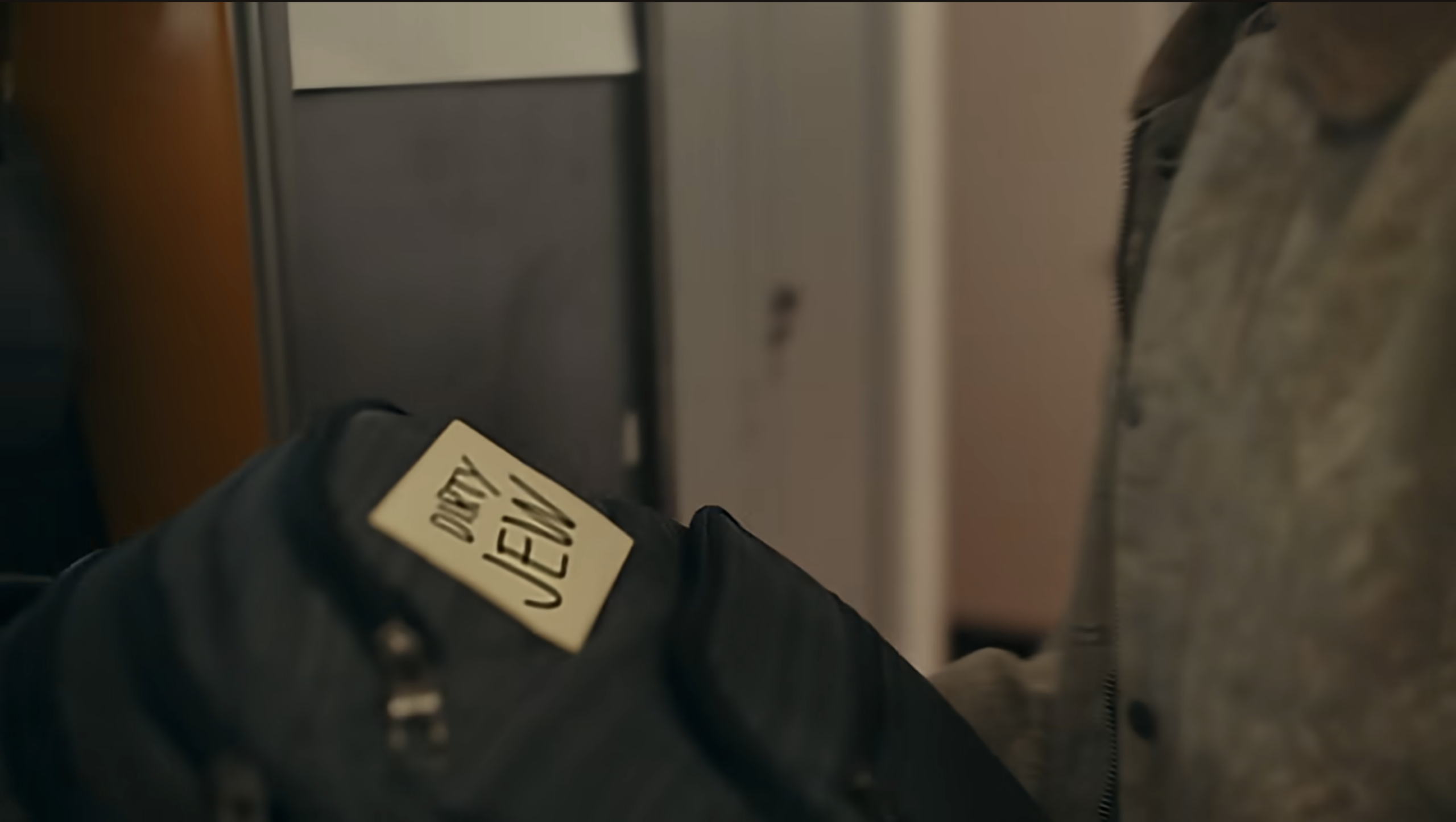
It is into this context that the ad “Sticky Note” — a $15 million spend — is landing. In the ad, a teenager walks through the halls of his high school as his classmates snicker and whisper. Arriving at his locker, he sees that someone has stuck a note to his backpack. “DIRTY JEW,” it reads.
The boy startles and freezes. Just then, a hand places a blue square over the offending note. A much taller boy, Black with an afro, has stepped in, and he has a message: “Do not listen to them.”
The Jewish boy expresses his gratitude, and the classmate continues: “I know how it feels.” He puts a blue sticky note on his own shirt. Then, as the Jewish boy balls his fists and considers taking on the bullies, the classmate urges him to turn around and head the other direction, saying, “They’re not worth it, bro.” The pair walk away arm in arm, introducing themselves. The Jew is David, and his new friend is Bilal.
Words on the screen convey a startling statistic, followed by a call to action: “2 in 3 Jewish teens have experienced antisemitism. Share the #🟦 and show you care.”
The ad has elicited excoriating reactions since it premiered online this week, with a range of commentators panning it as “disconnected” from the real experiences of contemporary Jewish teens, who more frequently encounter antisemitism online and in the context of anti-Israel activism; a “waste of money”; and a cliched portrayal of Jewish weakness.
Liel Liebowitz, the Tablet columnist, wrote that while he respects Kraft, “it’s almost impossible to imagine a more retarded ad.” (The epithet, which had fallen out of favor, has recently resurged on the right, dismaying people with disabilities and their advocates.) He suggested Jews should instead be projecting a message of strength and resilience.
“If I had ten million dollars to spend on a Super Bowl ad, I’d just show a bunch of exploding beepers, dead Hamas and Hezbollah leaders, hot Israeli girls with guns, and the caption ‘F–k Around, Find Out,’” Liebowitz wrote on X, in comments he expanded into an essay. “But hey, why go with Jewish power and pride when quivering victimhood mixed with the worse of social media clicktivism is exactly what some committee of overpaid PR pros and professional Jewish org types thought would work wonders.”
Shabbos Kestenbaum, a Harvard alum who became an outspoken conservative Jewish voice after Oct. 7, dinged the ad along the lines of Stephens’ speech.
“American Jews: If you are spending millions to ‘fight antisemitism’ instead of building Jewish life, you are both out of touch with the needs of Gen Z Jews and have not learned the lessons of post-October 7th Jewry,” Kestenbaum wrote on social media. “Fund Jewish Day Schools, not Super Bowl ads.”
Others took aim at the ad’s message — and in turn with the mission of Kraft’s organization, which distributes blue-square pins that allow wearers to signal opposition to antisemitism. “All you have to do is post a blue square, and you’re good. You don’t have to confront anti-Zionism or the neo-Nazi right. All you have to do is post a square that says literally nothing,” tweeted the pro-Israel influencer Isaac de Castro. “How does this help combat antisemitism?”
The Patriots-Seattle Seahawks matchup is the third straight Super Bowl to feature an ad from Kraft’s organization. In 2024 the group’s 30-second spot, featuring a speechwriter for Martin Luther King Jr., was believed to be the first-ever Super Bowl ad to focus on antisemitism. Last year, it returned with a commercial starring Tom Brady and Snoop Dogg encouraging viewers to stand up to “all hate,” with no reference to Jews. (It ran alongside an ad by the rapper Ye as he hawked swastika T-shirts.)
Kraft’s ads have drawn mixed reviews from Jewish groups and leaders. Jewish conservatives have criticized prior ads for not focusing enough on Jews, even as some voices including the American Jewish Committee have called the messaging powerful.
Not everyone is totally down on this year’s ad. Some have noted that even as online antisemitism may be more prevalent, the real-life version can indeed be palpable in schools.
“It isn’t perfect, but at least it’s clear about the issue it’s addressing (unlike previous years’ attempts),” Rachel Steinhardt, a Jewish mother of children who attend public school in California, wrote on Instagram. “Jewish kids deal with antisemitism often in public schools. This ad represents that (even if unrealistically). People should know.”
Others who may have been inclined to criticize the ad have instead scoured “Sticky Note” for a narrative they can get endorse. “When I first watched this commercial I was annoyed. ‘Oh great, another example of wasted Jewish philanthropy and off-target Jewish activism,’” tweeted Jake Donnelly, an influencer who identifies as “Irish-Jewish-American-Israeli.” But then he remembered that David had in fact been gearing up to take on his bullies.
“There was no pleading for help from the Jewish student. There was no groveling. And there wasn’t even a sign that the student couldn’t take the hate. Nah. He stood in the pocket, ready for the fight,” Donnelly wrote. “That’s a message I’m down with. That’s a message I can get behind. American Jews are done with the bulls–t and we’re ready for the fight. Allies or not, we’re ready for the fight.”