
BERLIN — He had wild hair and wore jeans. He was American — and Jewish. He had a camera.
That was enough to trigger surveillance by the notorious secret police of communist Romania, the Securitate.
Now, 41 years after photojournalist Edward Serotta boldly stepped behind the Iron Curtain, we can see just how obsessed the Romanians were with him, thanks to a short documentary by renowned Romanian director Radu Jude and historian Adrian Cioflâncă.
“Plan contraplan/Shot Reverse Shot,” which had its world premiere at the Berlinale international film festival last month, gives equal time to Serotta’s reminiscences about Romania in the 1980s, and to the Securitate’s observations of him.
And of course, to the photos: After his Romania adventure, Serotta put down new roots in Europe, and has spent decades documenting the Jewish life that was nearly obliterated in the Holocaust. He has published several books of photographs documenting Jewish communities. He also documented the fall of the communist regimes in which he’d set foot as a young man.
Twenty-two minutes long, the film was one of several shown at the festival with themes related to Jewish life and history, or to the Israeli-Palestinian conflict.
The obsessive spying of the communist regime, as documented here, appears absurd today. But it was fully serious at the time.
In his narration, Serotta — born in 1949 in Atlanta — recalls how communist authorities in 1985 “had given me the permission to come to Romania under the idea that they would have glowing and fine articles and positive articles about Romania.” His stated intention was to document World War II memorials, of which at the time there were only a handful. Today, there are many more.
“He will be put under surveillance,” declares the spy, narrated in the film’s second half by Romanian political scientist Diana Mărgărit, “in order to prevent contact with parasitic protest elements.”
While Serotta was aiming his lens, the informants were sneaking around, snapping quick shots and jotting down observations. They also slipped into his hotel room one day, and exposed a roll of film.
The things they frantically recorded are “funny right now,” a reminder of a bygone regime that at the time was deadly serious, said Cioflâncă in an interview. Cioflâncă is on the advisory college of the National Council for the Study of the Securitate Archives, a state institution that deals with the history of communism. “I lived for 15 years when I was a child under communism. And it was not fun.”
For 41 years, until the regime’s fall and the execution of president Nikolae Ceaușescu and his wife, Elena, in 1989, the Securitate spied on and terrorized citizens of Romania, suppressing dissent. According to the virtual Cryptomuseum, based in the Netherlands, the Securitate had up to 11,000 agents and 500,000 informants monitoring a population of 22 million.
Photographer Edward Serotta takes a self-portrait in a hotel room during his efforts to document Romania in the 1980s. (Courtesy Serotta)
In 2006, a governmental commission reported that more than 600,000 Romanians — and potentially around 2 million — were incarcerated for political crimes, and more than 100,000 died.
Western journalists, though suspect and surveilled, were to some extent wooed — at least in the 1980s. When Serotta requested to visit in 1985, Ceaușescu had been president for some 11 years (after heading the communist party from 1965). Ceaușescu was seen as more friendly to the west: He had refused to contribute troops to invade former Czechoslovakia in 1968; and he kept up relations with Israel when other communist countries severed their ties.
At the time, the regime wanted to gain “most favored nation” economic status from the United States, which depended on their allowing some freedom of movement to its population.
“There were 855 western journalists coming to Romania during the Ceaușescu period, and 80 of them were American,” said Cioflâncă, who also directs the Bucharest-based Center for the Study of Jewish History, under the Federation of Jewish Communities in Romania.
“Many of these visits were organized as a propaganda instrument. In all the cases, they wanted to interfere with the journalist and to influence his work. They tried something similar with Edward when he came,” he added.
“They felt that the Jews are so influential, especially in the relationship with the United States,” Serotta said in an interview.
“In their mind, everything that was Israeli, Jewish, or American Jewish was deemed like an important piece of influence to use for their political PR at that time,” said Serotta, who eventually moved to Europe and in 2000 founded the Centropa nonprofit archive aimed at preserving Jewish memory in Central and Eastern Europe, the Balkans, the Baltics, and the former Soviet Union.
Centropa was purchased by the US Holocaust Memorial Museum in 2024.
Given Serotta’s obsession with documenting history, Cioflâncă said he was surprised to learn that his friend had never viewed his Securitate files. Several years ago, he asked Serotta if he’d like to see them.
“The funny thing is, I didn’t think I was important enough to have any,” Serotta recalled.
Cioflâncă found some 300 pages of documents. The informants had tried to influence the photojournalist, saying that the World War II killings of Jews in the region were “a marginal moment,” Cioflâncă noted. “They wanted to make sure that their reputation remained clean, that they were not collaborators” with the Nazis.
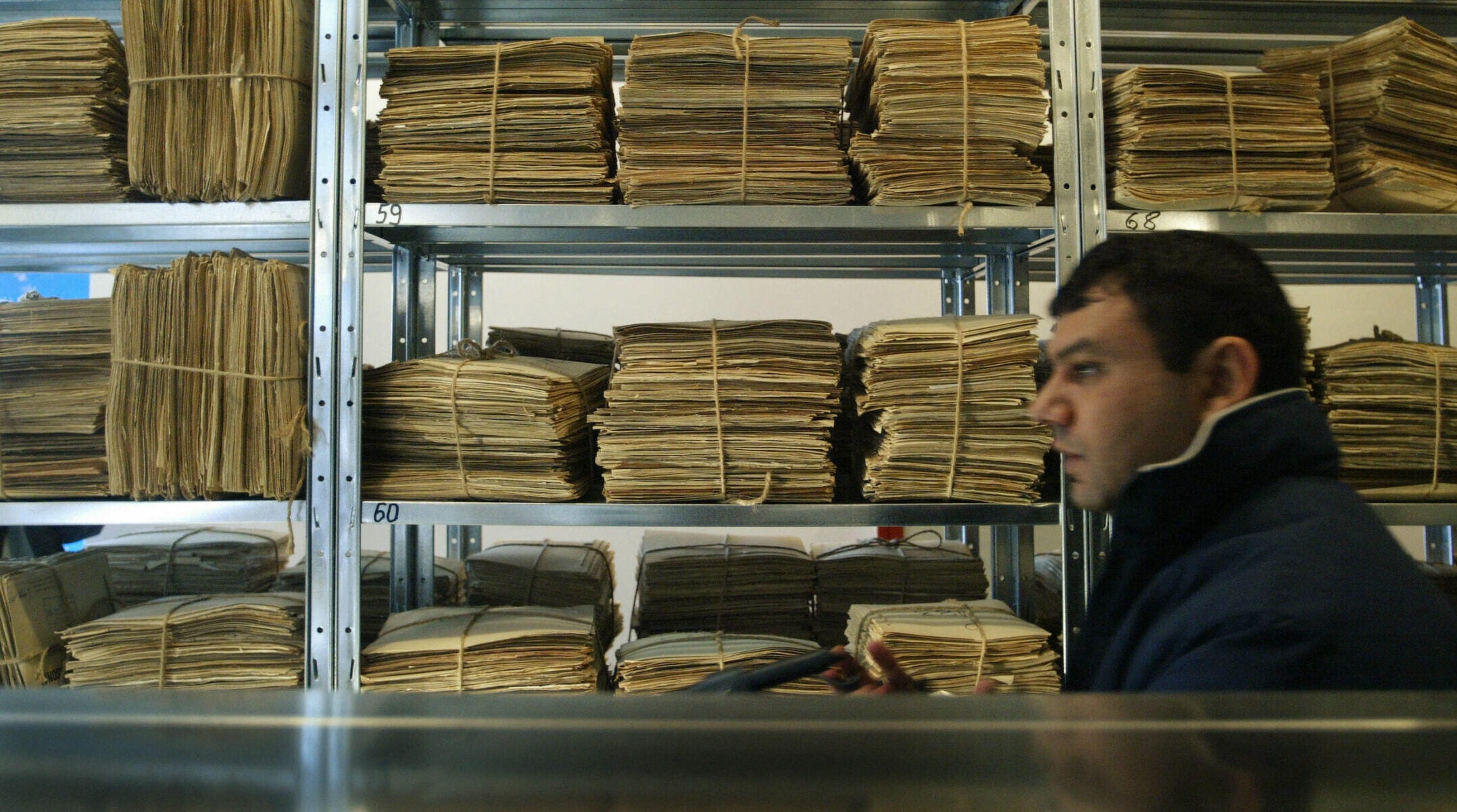
A man walks past shelves of files compiled by Romania’s former Communist regime’s Securitate secret police in Bucharest, March 10 2005. (Daniel Mihailescu/AFP via Getty Images)
According to the US Holocaust Memorial Museum and Yad Vashem, at least 380,000 Romanian Jews were killed during the Holocaust.
“I was there for a matter of several weeks,” Serotta said. He recalled “a very tense atmosphere. Nothing worked properly. We barely found food in stores. It was awful.”
And he is still astonished that the Securitate spent so much time following him. “It’s funny stuff.”
“Many Securitate officers were pretty stupid,” Serotta said in the interview. “They were so distorted in doing their job that they didn’t have this sense of [the] ridiculous and humor.”
Moreover, “their [photo] equipment, first of all, was not very good. Secondly, they were usually doing it surreptitiously: behind a wall or a door or something or something like that. But as the old expression goes, the pictures are great because I look young. I look like a casting reject from ‘Flashdance.’”
Serotta, for the most part, ignored or was unaware of the surveillance, except for when the only two cars on remote roads, hour after hour, were his and that of a spy on his tail.
And yet the trip to Romania was priceless. On one of his first visits to a Jewish community in Romania, he said to himself, “Wow, this is interesting. This is like the old country.”
“Then I said, ‘It’s not like the old country. It is the old country, and I’m in it,’” he added. “From that moment on, I felt like I had opened a door, and I’ve never come back through it.”
Reporting the stories that define our era. When history unfolds in real-time, the Jewish world turns to (JR). Your support ensures we can document the complexities of war and the resilience of Jewish communities with integrity.