

Let’s talk about hindsight, about expectations and actuality, about adaptation, about adjustments. Let’s talk about three theaters of war: Gaza, Lebanon, Iran. And let’s admit that an uncomfortable situation is still very much the reality in all three theaters. Two months after the Gaza war ended, the Israeli public is well aware that total victory was never achieved. It was promised – but did not materialize. It was not achieved in Lebanon, where the likelihood of sudden escalation is increasing by the day. Last year, Lebanon seemed like a great Israeli success. It was a great Israeli success. And yet, Hezbollah doesn’t disarm, and the Lebanese authorities don’t seem ready to eliminate the threat.
Success can be measured against prior expectations, it can be measured against prior predictions, it can be measured against the bombastic statements of politicians, it can be measured against a more modest yardstick of realistic possibilities. If the war on the Lebanese front is measured against doomsday scenarios that were widespread before the eruption of this front, then the battle was a dramatic triumph. If it is measured against the empty declarations of success-drunk leaders, there’s the usual hangover. The IDF did well in its fight against Hezbollah. It did not do well enough to eradicate the challenge. It did not do well enough to make all Israel’s dreams come true.
Turn to Iran, and the script is similar. Half a year had passed since the 12 days’ war with Iran. And yes – it feels like ancient history. And yet, there’s hangover. Right after the war, only 16% of Israelis said (in a JPPI survey) that Iran is still “very much” an existential threat on Israel. Weeks after the tantalizing attack, Israelis were elated as if a real regional power such as Iran can be tamed from the air in a couple of days. But as the dust settled, we all came back to our senses. Was the attack an impressive operational success? No doubt it was. Did it manage to cause real damage to Iran’s nuclear program? It seems as if the answer is yes. Does Iran no longer deserve to be called an existential threat? Well – thinking about it half a year later, we – Israelis – were probably rash when we declared victory. The share of Israelis who now call Iran an existential threat doubled. And it’s been only half a year.
Then, there’s Gaza. Total victory proved elusive in that theater too. And as Israel and the U.S. look to implement the next “phase” on the long path to a peaceful Gaza Strip, two visible obstacles didn’t yet meet a convincing remedy. The first, and probably the more formidable of the two, is the demand for a disarmament of Hamas. Facing Hamas’ refusal to hand over its arms, and with it, its core identity – Hamas is a fighting organization – some mediators are attempting to peddle an idea they see as compromise: Hamas will begin by surrendering some”offensive” weapons (such as rockets) while keeping, for now, its “defensive” gear. As a supposed compromise, this might work to satisfy the desire of President Trump to move forward, disregarding annoying details. Israelis will see through the façade. It isn’t compromise, it is capitulation. Hamas gets to live another day, weaker but still armed and menacing. Just like Hezbollah.
The second unbridgable gap between plan and implementation is the deployment of a multinational force in Gaza. At the moment, the idea is hitting a wall of reality: the slated countries have little appetite for sending troops when Hamas is still in power, and oppose the initiative. They might be willing to send peace-keeping forces when there’s peace – they will not be sending them to bring about peace. Here too, a compromise may be in the offing. A small force of limited symbolic value. More to save face than to save us all from Hamas.
An alternative government to Hamas proved to be an elusive target. Could we imagine an alternative government that isn’t called Hamas as the alternative? Yes – but only in case this is not Hamas by name only. Meaning: Call it PPP – Palestinian Peace Platoons – or whatever name – declare victory – pretend an alternative to Hamas was created – ignore the obvious fact: PPP is cover for the same old Hamas. Or – another possibility the Israeli government opposes – a cover for Hamas and the Palestinian Authority.
Israelis expected the war would end when Hamas is eradicated. They now have to face a different reality. After two years of blood, sweat and many tears, the enemy is still out there, lurking in the dark, waiting to fight another day.
Such a situation is a strategic challenge. Such a situation is no less a psychological challenge. The war to end all wars, or at least all wars against certain enemies, ended as war to reignite the next cycle of potential wars. Failing to acknowledge certain realities was the root cause of the October 2023 war. Failing to acknowledge current realities is not an option.
Something I wrote in Hebrew
On Netanyahu’s possible pardon:
Such a move carries a risk for both sides. Herzog risks granting a pardon, only to find out later that the conditions he set were easily ignored by the Knesset. He does not want to be in that situation. He does not want his main decision as president to be remembered as a farce. Netanyahu risks agreeing to conditions he intends to break, only to find out later that breaking them is harder than he thought. He does not want to be in that situation. If there is one thing we have understood about Netanyahu, it is that he has no intention of stepping down anytime soon.
A week’s numbers
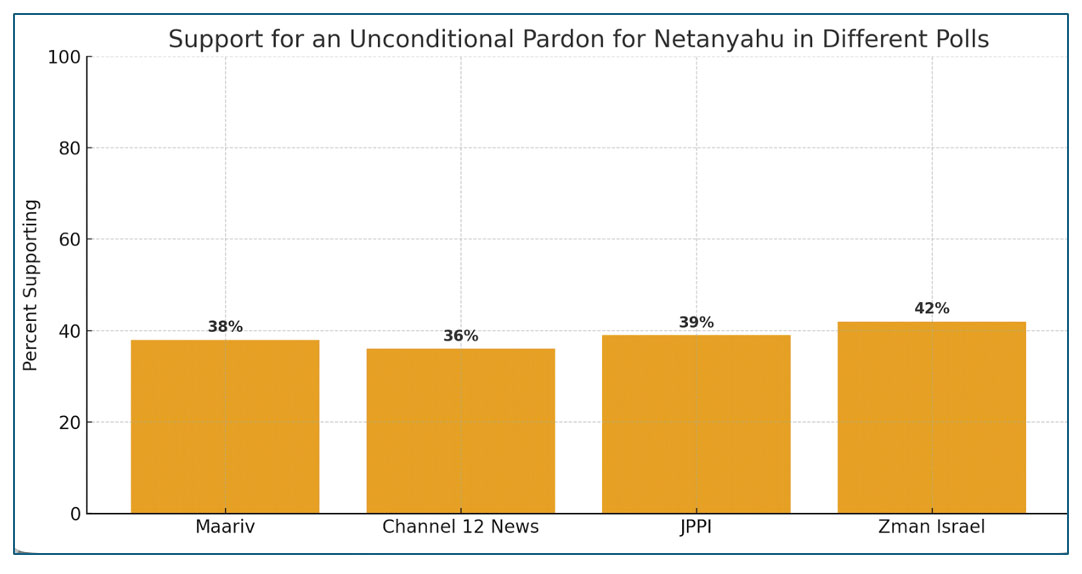
Unconditional pardon for the PM? Sure – if you ask Israelis who support the coalition. The rest of us would expect something in return.
A reader’s response
Arthur Benzur asks: “Can you pleae clarify when is Israel’s next election?” My response: Yes and no. The slate date is fall of 2026. The actual date is all dates between 90 days from now (if the government loses its majority tomorrow) and the fall of 2026.
Shmuel Rosner is senior political editor. For more analysis of Israeli and international politics, visit Rosner’s Domain at jewishjournal.com/rosnersdomain.