
I was on my way to pick up my daughters from school when it happened.
In the middle of the main street, in broad daylight, a young man on a motorcycle pulled out a gun and fired into the air. I froze. Around me were parents just like me, walking to collect their children. People were shocked and frightened — but not surprised.
This is Nazareth, the northern Israel city where I live. Guns are everywhere. Crime and violence are all-pervasive. I am not being dramatic: People from Palestinian communities inside Israel go to the hospital for gunshot wounds at a rate that is six times higher than their Jewish neighbors. In just the first six weeks of 2026, 42 people have been murdered; that’s nearly one a day.
This is not because Arab communities are more “violent” by nature or because we are poor. It is a symptom of a political reality in which Palestinian citizens of Israel — more than 20% of the country’s population — have been abandoned by their government, left to the mercy of illegal weapons, extortion, drugs and organized crime. Personal security ought not be a radical demand. It is the most basic condition of citizenship.
The crisis stems from long years of Arab citizens being denied opportunities offered to their Israeli fellow-citizens. Arab men face far higher unemployment so that our youth — especially young men — are often left without prospects. There is no social safety net to catch them. And so their hopelessness — at ever making money, getting married, building a life for themselves — leaves them vulnerable to criminal recruitment.
For our community, there is, at long last, some momentum around breaking our own internal silences, strengthening our sense of agency, and building our own power and be resilient in the face of our sense of abandonment and despair.
For Americans, Israel is usually discussed through the lens of Israeli occupation of the West Bank and the war in Gaza, and indeed, these are the great nightmares of our time. Far less visible is what happens inside Israel’s own borders, where Palestinian citizens are being left to fend for themselves with no functioning police force against criminal networks armed with military-grade weapons. In other words, on top of policies enabling settler violence and annexation of new West Bank territories, and on top of continuing to bomb Gaza intermittently despite the ceasefire, there appears to be a deliberate policy to weaken, exhaust, and kill the Palestinian community inside of Israel itself.
Yes, we are at the mercy of a racist minister of national security, Itamar Ben Gvir — the Israeli lawmaker convicted on counts of incitement to (Jewish) racism and support for a (Jewish) terrorist group — who has told the police force to deprioritize our community’s safety. But it goes so much deeper than that.
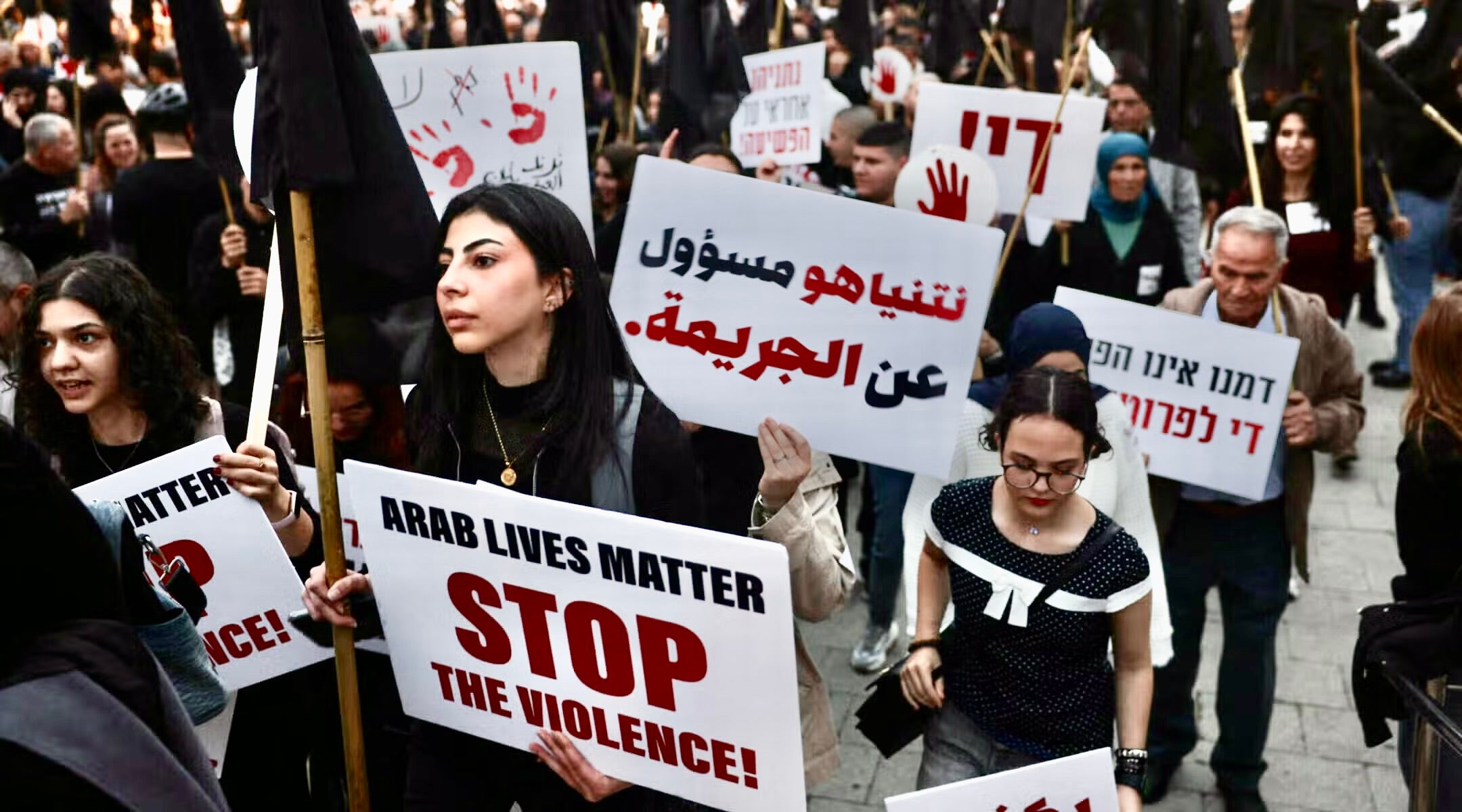
In the face of all of this, less than two weeks ago, tens of thousands of Jews and Arabs filled the streets of Tel Aviv in a protest that should not have been necessary. Not because it wasn’t justified — but because in a functioning state, citizens should not have to demonstrate to demand protection for their lives.
When Jewish and Palestinian citizens stood together to remind the government, loudly and peacefully, that enforcing the law is its responsibility, I felt something I hadn’t felt in a long time: hope. If the Jewish community truly stands with the Arab one, we might finally build the pressure necessary for real, much more significant change — not just for one protest, but for a shared future.
The scale of the crisis is staggering. In 2025 alone, 252 Palestinian citizens of Israel were killed. It was the deadliest year on record. This, as homicide rates among the Jewish population remain far, far, lower. In 2024, the Arab population saw 220 homicides; the Jewish community — which is roughly four times the size of the Arab one — saw just 58. The rate is obscene — there are 14 Arab murders for every 1 Jewish one. This gap cannot be explained away as cultural or inherent — it reflects disparities in policing, investment, and pure attention.
In towns and cities like mine, everyone already knows what the police claim is impossible to track. People know who was murdered, why, who threatened whom, and where the weapons are. The information is open, shared, visible. The only actor choosing not to act is the state — through a police force weakened, politicized and, too often, indifferent to Palestinian lives.
Arab murders are simply not investigated with the same rigor as are Jewish murders. In 2025, fewer than 10% of cases were solved — compared with roughly 65% for murders of Jewish Israelis.
The violence in Arab communities is not limited to deaths. Hundreds are wounded every year by shootings, car bombs, and assassination attempts. Last year, this violence turned 231 children into orphans. And thousands live under constant threat: business owners, teenagers, teachers, municipal workers, and elected officials. Arab mayors warn they cannot govern without basic protection. Some are extorted. Some are threatened. Entire towns have seen criminal networks fill the enforcement void while the state stands by.
Take the case of Ali Zbeidat, a grocery store owner in Sakhnin, who helped ignite the current wave of protests. After criminals riddled his shop with bullets and sent him repeated death threats and demands for “protection” money, he made an extremely courageous choice: He publicly shut down his business and called for a general strike of Arab workers. He told the Israeli press something that I believe: “People’s safety is more important than money.” And his call took off. Shops, schools and institutions closed in solidarity, and tens of thousands marched demanding action.
The result is a deadly feedback loop: Violence grows, trust in authorities collapses, and citizens are told — implicitly and explicitly — that their safety matters less.
For Americans who see Israel as a democracy committed to equality, this should be deeply unsettling. Citizenship is not real if protection is selective. Democracy cannot survive if a fifth of the population is treated as a security problem rather than as people entitled to security.
What makes this moment different is that the silence is breaking. The question now is whether Israel’s government will listen — and whether Israel’s friends abroad, especially in the United States, will notice that this struggle is not peripheral, but central to what it means for Israel to call itself a democracy.
A country ought to be judged, first and foremost, by how it treats those who live under its own flag. Abandoning Palestinian citizens to organized crime is a moral, civic and democratic failure at the heart of the state. This is not the shared future for Jews and Arabs that I work for; it is the present that Itamar Ben-Gvir has given us.
The gunshots I saw and heard on my way to pick up my daughters were not random. They were political. They were the sound of a government withdrawing from its responsibility to protect all its people.
This needs to change. And if Arabs and Jews — and all those around the world who care about Israel — work together, it will.
is the co-director of programs at the New Israel Fund. She is a Palestinian citizen of Israel and a longtime activist for equality and democracy. She lives in Nazareth with her two daughters.
The views and opinions expressed in this article are those of the author and do not necessarily reflect the views of (JEWISH REVIEW) or its parent company, 70 Faces Media.