
TEL AVIV — It was the moment Samy Yecutieli had been anticipating for years, though he didn’t expect it to happen quite like this.
Born and raised in Caracas, the security expert and now real-estate agent followed last week’s dramatic news of Venezuelan strongman Nicolás Maduro’s abduction by U.S. forces and subsequent court appearance in New York from his home in the Tel Aviv suburb of Kfar Saba.
Now, he is watching as U.S. President Donald Trump vows an extended presence in the oil-rich South American nation, even as Trump has signaled support for Maduro’s deputies, who are reportedly cracking down on expressions of support for Maduro’s ouster.
“Obviously, it’s the beginning of the end of the Chávez era — but the job has not been finished,” Yecutieli told the Jewish Telegraphic Agency on Tuesday. “The ministers of defense and interior are still there. These people have to be eradicated from their jobs to start the process of rebuilding the country.”
Yecutieli, 60, moved to Israel eight years ago with his wife and three children. He’s among an estimated 20,000 Venezuelan Jews who fled their oil-exporting country after Maduro’s predecessor, Hugo Chávez, came to power in 1998 and began slowly bankrupting what was once Latin America’s most prosperous economy while also adopting antisemitic rhetoric that has persisted since.
At one time, Venezuela was home to some 25,000 Jews. Today, no more than 4,000 remain — about the same number as those who moved to South Florida. A similar number moved to Israel, while the remainder — not knowing English or Hebrew — opted for Spanish-speaking countries, principally Colombia, Panama, Mexico and Spain.
They were among an estimated 8 million Venezuelans, nearly one-third of the population, who have emigrated, constituting the largest refugee exodus in modern history — even bigger than from war-torn Syria. More than 200,000 ended up in Florida alone; so many “venezolanos” reside in Weston, a suburb of Fort Lauderdale, that the city is often nicknamed “Westonzuela.”
Sammy Eppel, 78, is a Venezuelan Jew living in Aventura, Florida. (Larry Luxner)
Sammy Eppel, 78, lives in Aventura, an upper-class enclave of condominiums and townhouses along the Intracoastal Waterway north of Miami.
“Maduro was the head of an international criminal organization that not only did bad things to Jews, but to all Venezuelans,” said Eppel, who hasn’t seen his Caracas home in over 10 years. “This regime tried very hard to turn the Venezuelans into antisemites. It’s a failed state and they needed somebody to blame, and Jews were an easy target. But they didn’t succeed.”
Venezuela — where Jews have lived for at least 200 years — was among the world’s first countries to recognize Israel’s independence in May 1948. Bilateral ties were excellent until Chávez’s populist government came to power.
Soon, Venezuelan Jews joined others in the country in growing sharply concerned about a crackdown on civil liberties, the worsening economy and Chávez’s praise for despotic leaders such as Saddam Hussein. But they did not feel targeted until several years into Chávez’s reign.
Then, in a fiery 2006 speech, Chávez condemned Israel for invading Lebanon, calling it “a new Holocaust” against Palestinians and Lebanese. Three years later, he unilaterally broke off ties with Israel and gave the Israeli ambassador 72 hours to leave the country.
As Chavez ratcheted up his rhetoric against Israel, calling it a genocidal state, the official media followed suit, calling for a boycott on local Jewish businesses unless they publicly denounced Israel. Antisemitic graffiti began appearing around Caracas. A synagogue was heavily damaged when a dozen assailants broke in, overpowering security guards and desecrating holy objects. A bomb was thrown into a local Jewish community center. Even a local production of “Fiddler on the Roof” was affected when the orchestra chairman backed out, citing the political circumstances.
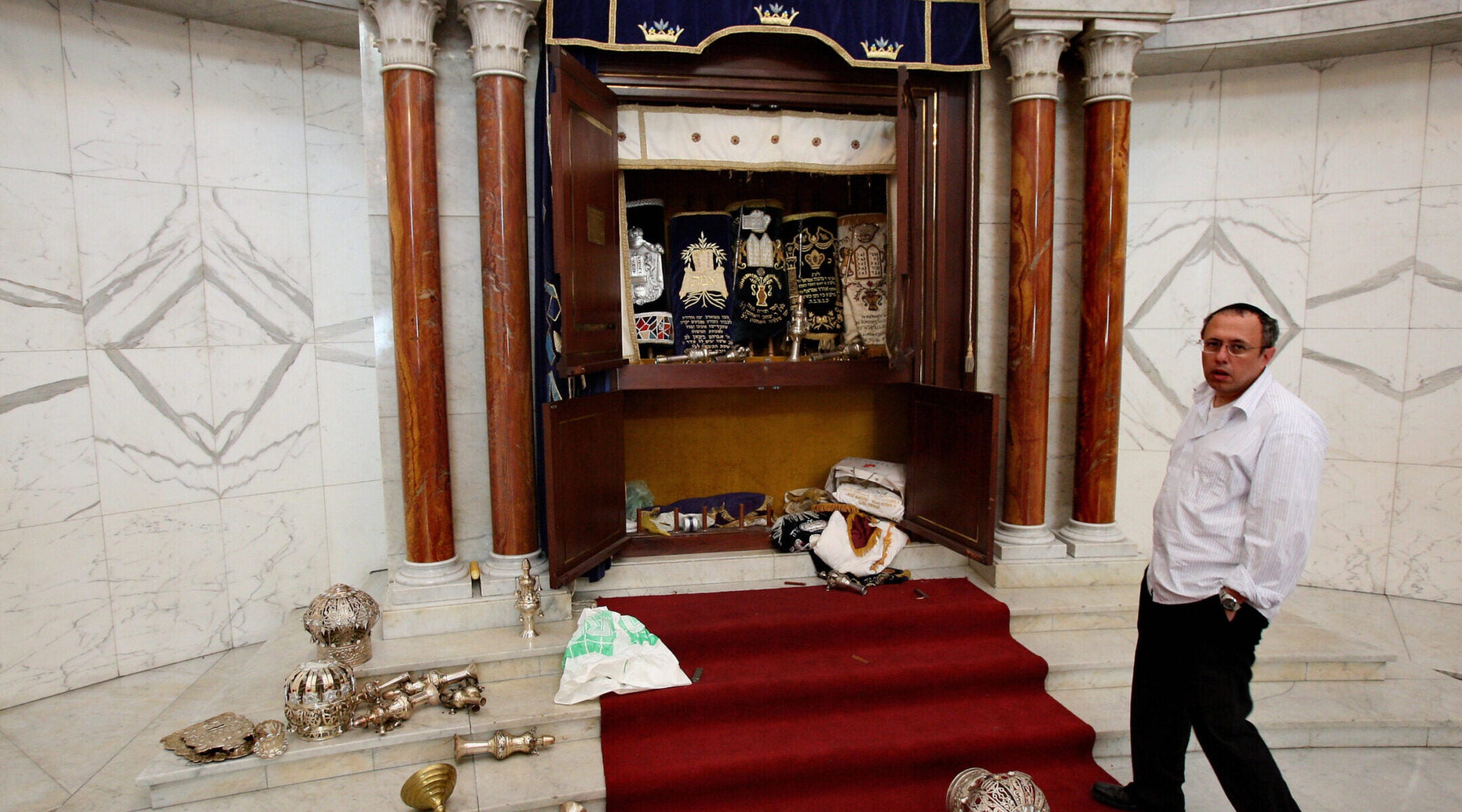
The president of the Venezuelan Jewish Association, Elias Farache, poses on Jan. 31, 2009, next to religious items and a Torah inside the main synagogue of Caracas that was desecrated during the night by an unknown group. (Thomas Coex/AFP via Getty Images)
“People are being taught to hate. Venezuela has never seen anything like this before,” Venezuelan Chief Rabbi Pynchas Brener told JR at the time. He moved to Miami two years later.
Brener was part of a broad exodus. Following Chavez’s anti-Israel turn, Venezuela’s Jews, who already had one foot out the door, left in droves.
“Our Jewish school was built for 5,000 students, and today maybe it has 400,” said Eppel, who ran a retail business as well as a call center in Caracas. “It sounds like wishful thinking to go back to old times, but I’m not sure that would ever happen because the Venezuelan people have changed after 27 years of tyranny and hardship.”
The few Jews remaining in Venezuela are reluctant to speak publicly about the situation, especially given recent government threats to expropriate Jewish properties in Caracas — not to mention the country’s strong relationships with Iran and Hezbollah.
Yecutieli makes no bones about his hatred for Maduro, who he says stole three elections in a row and “was an illegitimate president from all points of view.” Like most Venezuelan Jews, he sees Maduro as a thug who jailed thousands of political prisoners and trashed a once-booming economy.
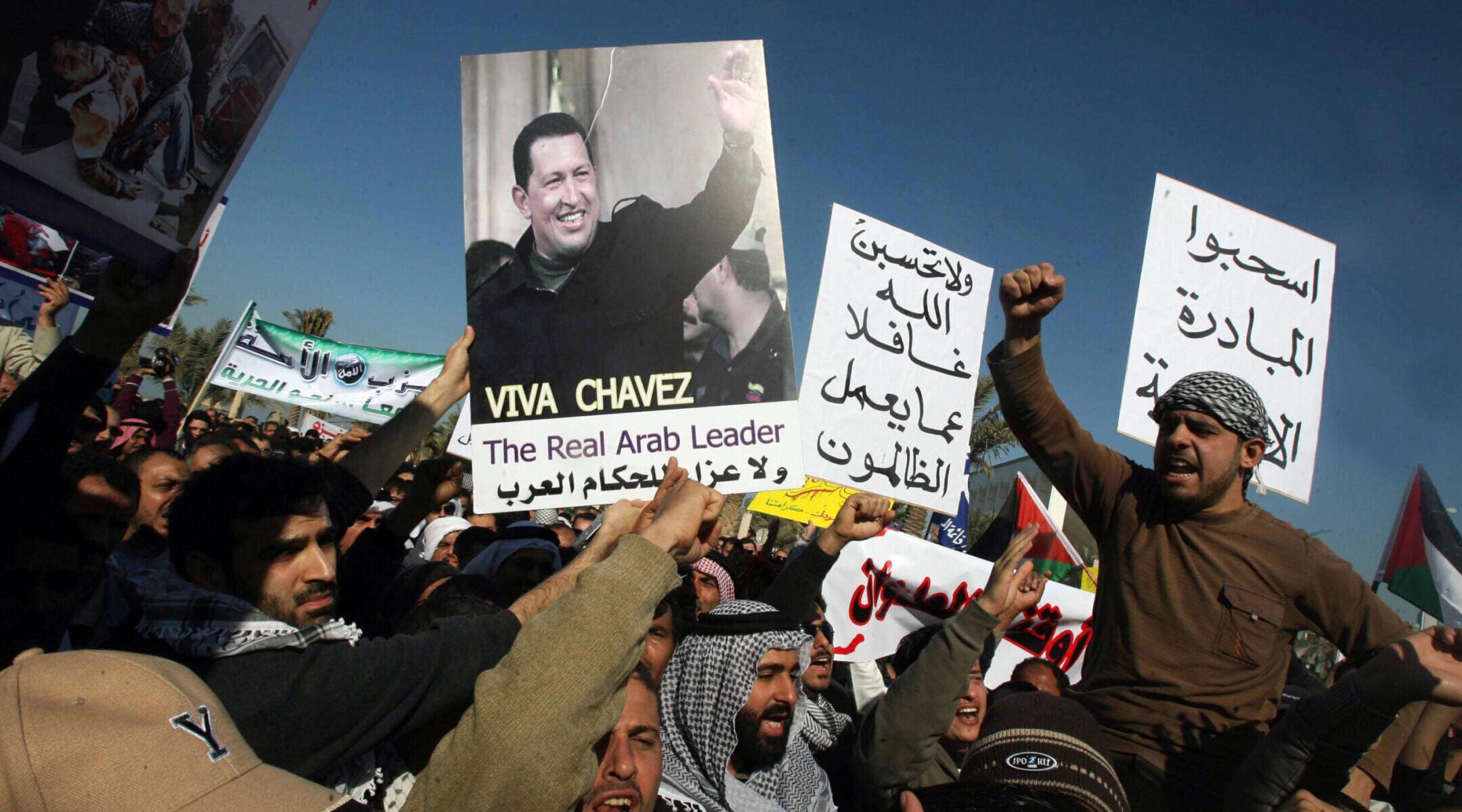
Protesters shout slogans and hold a picture of Venezuelan President Hugo Chavez during a demonstration against Israel in Kuwait City on Jan. 9, 2009. (Yasser Al-Zayyat/AFP via Getty Images)
Among other things, Yecutieli is a member of the Security Forum of the Tel Aviv-based Israel-Latin America Chamber of Commerce.
As for what happens now, he said, “there’ll be many business opportunities in Venezuela, and older people like me can go back and be part of the reconstruction. But my girls have nothing there. Two of them are in the Israeli army, and they’re building their lives here. If I took them back to Venezuela, what would their future be?”
Yecutieli said he’s personally in touch with the leader of Venezuela’s opposition, Maria Corina Machado, who last year won the Nobel Peace Prize and is currently in an undisclosed location.
“She likes Israel very much and understands the importance of Israel and has promised to re-establish diplomatic relations and put Venezuela’s embassy in Jerusalem,” he said, adding that he understands Trump’s strategy of bypassing Machado and working instead with Venezuela’s acting president, Delcy Rodríguez — despite her incendiary, antisemitic rhetoric that this week included alleging that “Zionists” had helped the Americans abduct Maduro.
“It’s a very smart decision,” Yecutieli said. “If you take them all out, there would be a vacuum, and that would create chaos. Rodríguez will stay there, but she’ll have to follow Washington’s rules.”
Roberto Avram, 42, made aliyah in 2006 from Venezuela with his wife and three children. He’s currently on assignment in Latin America on behalf of Keren Hayesod-United Israel Appeal.
“We are all very excited with the news,” said Avram, speaking to JR by phone from Peru. “Venezuela is not in a good place, and we all agree that we need to work very hard to have the Venezuela we had in the past.”
A systems engineer by profession, Avram expressed the desire to someday return to Caracas and show his kids the place he grew up. But for now, he’s happy living in Israel.
“We all wanted to see Machado take power, but I do have faith in the process,” he said. “[U.S. Secretary of State Marco] Rubio and Trump are doing the right thing. It will take some time, but if we got to this point already, we can wait a little longer for the right moment to see a peaceful transition.”
Leo Corry agrees. A prominent mathematician, Corry immigrated to Israel in 1977 — at the height of Venezuela’s glory days and decades before anybody had ever heard of Chávez or Maduro.
Corry, 70, today lives in Ramat Gan and is president of the Open University of Israel.
“This is a horrible regime that has turned Venezuela from one of the most beautiful countries in Latin America to something that is unbearable,” he said. “It’s commanded by a gang of criminals and is infiltrated by Russians, Iranians, Chinese and Cubans. People have suffered tremendously, so they’re happy that the person at the top of this pyramid is not there anymore.”
On the other hand, U.S. “disrespect for Venezuela’s sovereignty” could be a problem, said the Chilean-born scholar, who was brought to Caracas at the age of 2 and grew up in the socialist Hashomer Hatzair movement. He speculated that “Trump doesn’t want to rock the boat too much but will be happy having a servile government” led by Rodríguez.
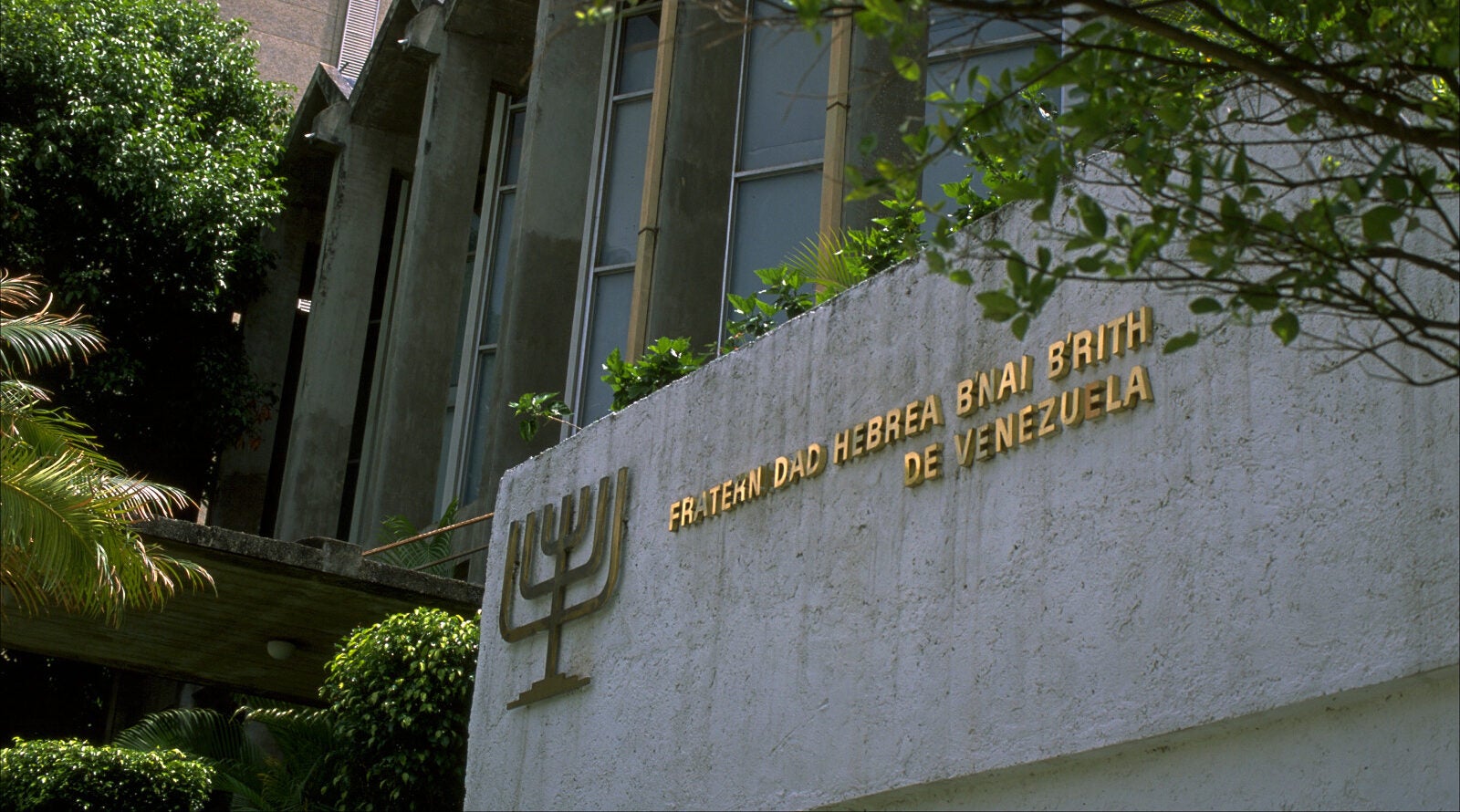
The Caracas headquarters of B’nai B’rith Venezuela. (Larry Luxner)
Despite Venezuela’s longstanding friendship with Israel prior to the Chávez era, Corry says he’s highly skeptical that large numbers of Jews — or anyone, for that matter — will rush back.
“Eight million people have left Venezuela. There’s no other example in world history like this,” he said. “At the beginning it was the elite, then the middle class, and finally everyone. Families have been completely destroyed — so it’s too early to start speaking about the idea of returning.”
Anabella Jaroslavsky, 63, moved to Israel in 2020, joining her daughter who had done so nine years before that. Her mother and two sisters still live in Venezuela.
“After 26 years, we want a change in our country,” said Jaroslavsky, a consultant with the World Zionist Organization who resides in Tel Aviv. “I’ve made my life here in Israel, but other Jews will go back. They left their apartments, their businesses, everything. And once it’s reconstructed, there will be opportunities.”
She added: “People are waiting to see what happens, but they know it’s going to be unstable for awhile. We’re all hoping something good will come out of this.”