

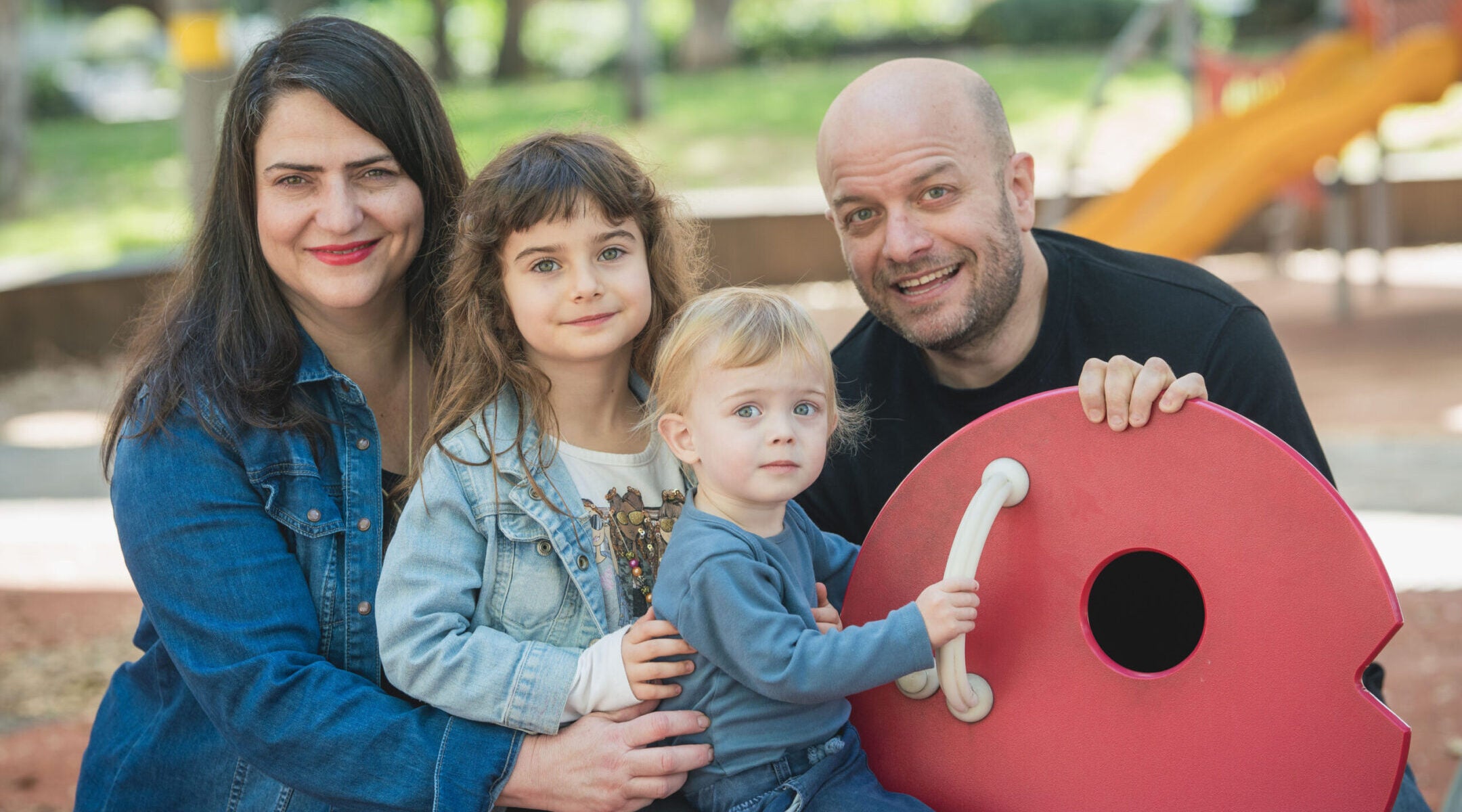
TEL AVIV — In playgrounds around this city, it’s no longer unusual to meet a child who splits time between two homes, not because their parents divorced, but because they were never a couple in the first place. In a society where having children is widely seen as non-negotiable, co-parenting, in which two people decide to have and raise a child together platonically, has become a legitimate alternative for those who haven’t found a partner but aren’t willing to give up on family.
“Every person you ask will personally know three people who have chosen to co-parent,” said Michal Biran, a former Knesset member who founded Hachasida (“The Stork”), a platform that matches aspiring co-parents. Once a fringe idea mostly associated with gay men and single women, “co-parenting by choice,” a phrase Biran’s organization says it coined, has spread. “Straight men have discovered this,” she said, estimating they now make up about half of the men entering new matches, compared with a time when almost all of the men were gay.
The model has flourished in Israel for a mix of cultural and practical reasons. Israel’s unique combination of conservatism and creativity makes it fertile ground for separating parenthood from couplehood, with publicly funded fertility treatments making it easier for would-be parents to pursue pregnancy outside a conventional relationship. “It’s the ultimate startup,” Biran said.
Biran herself is part of the trend. Approaching 40 and single, she decided to have children via co-parenting rather than waiting for “Mr. Right.” She and her co-parenting partner, Nimrod, who is gay, met through a co-parenting website and now raise two young children, a daughter, 6, and a son, 2, alternating custody every other day.
One upside, she said, is a more “balanced and flexible” life with built-in “time off,” whether that means parenting solo when Nimrod is doing army reserve duty or having space when he takes the children for a trip. The model can also accommodate different personalities and interests. “I hate camping and Nimrod loves it. He takes her camping while I stay home and watch Netflix, it’s perfect,” she said.
Surprised the idea hadn’t taken hold elsewhere in the world, especially in places where she assumed the cultural ingredients already existed, convinced Biran to export the model.
“I don’t understand how it hasn’t happened in New York, which has so many Jewish mothers and so many gays,” she quipped. She is rolling out the service abroad under the name “Nesting,” a term she prefers to Hachasida’s literal translation of “stork,” beginning in California and New York.
So far 54 babies have been born through Hachasida, with more pregnancies underway. Her core business is a paid, hands-on matching service, though she also offers an app used by a few hundred people, mostly Israelis, to connect directly without her involvement.
Prospective co-parents begin with an intake on values, lifestyle and expectations around raising children, with an emphasis on alignment that matters in a long-term parenting partnership. “Unlike in romantic partnerships, where people often fall in love with their opposites, here it’s easier to set people up if they’re similar,” she said.
Politics has become a major filter. “These days, pro-Bibi and anti-Bibi people won’t have kids together,” she said, referring to Israelis’ polarized views of Prime Minister Benjamin Netanyahu. Geography is another, she said, because ideally co-parents should live in the same vicinity for the arrangement to work.
Once she introduces a potential pair, Biran encourages them to test how they function in ordinary settings before anyone commits to fertility treatments. That can mean meeting friends and family, spending a long afternoon together, or going to IKEA to see how they handle friction.
“If one of them ends up shouting at the cashier or the waitress, it’s better to know in advance,” she said. She recalled one woman who said a man brought a bottle of wine to a picnic with her friends and later asked her to reimburse half the cost, which Biran took as a clue about how he might approach bigger child-related expenses later.
If both sides decide to proceed, they sign a detailed contract covering custody, finances and decision-making. “It’s like divorcing, but amicably. There’s no shouting,” she said. Only then do they move on to fertility treatment.
One co-parent, Jean-Marc Liling, said the arrangement in many ways felt less like a social revolution than a throwback. “Ironically, it’s almost a traditional way of doing things,” he said, likening it to the Jewish “shidduch system of the 19th century where the sole aim of meeting a woman is to create a family.”
Jean-Marc Liling became a co-parent through the Israeli organization Ono; another Israeli co-parenting firm advertises a U.S. branch, Nesting, in Williamsburg, Brooklyn, in February 2026. (Courtesy)
A lawyer and venture capitalist, Liling entered co-parenting as he approached his late 40s after struggling to find a woman he could build a life with.
“I really felt I didn’t want to miss out on being a father,” he said. “As a culture, we’re obsessed with having children,” he said, calling Israel “the mecca of co-parenting.”
Living in Jerusalem and religiously observant, Liling said the friction was not with the concept, but with some of the women he met through the process, describing what he saw as a knee-jerk reaction from secular matches who “don’t really understand the nuances of liberal Orthodox.”
He went through Oro, Israel’s only other co-parenting agency, where, after several other introductions that fell through, he was matched with his eventual co-parent, a woman in her early forties in Tel Aviv. The two met weekly for about five months before moving ahead.
“It was easy, natural,” he said. “There were a lot of instances where I thought, aha, this could work.” Now 3 years old, their daughter splits her time evenly between them. Liling keeps an apartment in Tel Aviv to make the logistics easier on her, even as he continues to live in Jerusalem.
“If someone had told me seven years ago I would become a co-parent with a secular woman in Tel Aviv, I never would have dreamed of it,” he said.
Liling said he and his co-parent tried to build something that felt like a family, not a strict division of labor. “Even using the word family is not a given for some,” he said, noting that some co-parents prefer a parallel model in which each household operates separately. In their case, he said, they try to operate as a unit around their daughter, with all three of them going to the playground together and both parents showing up for doctor’s appointments. On nights she is with him, he makes time for an evening call to her mother so she can say goodnight.
Sociologist Ya’arit Bokek-Cohen of Netanya Academic College, who has studied elective co-parenting in Israel, said there are no official statistics on how many children are born into such arrangements because no single state body systematically tracks it. Birth registrations capture “mother” and “father,” without noting whether the adults are a couple or unrelated co-parents. Still, she said the phenomenon is growing rapidly, particularly among gay couples who want to avoid the high cost of surrogacy abroad and who also prefer a setup in which a biological mother is present in the child’s life.
Early research has been cautiously reassuring. A University of Cambridge-led study cited recently by The New York Times found that children in elective, nonromantic co-parenting families “seem to be doing well and no different to other family types,” though critics such as Emma Waters of the conservative Heritage Foundation told the Times that research highlighted by the conservative Institute for Family Studies suggests children tend to do best across a range of measures when raised by their married biological parents.
Biran said half her work revolves around stopping people from “self-sabotage,” especially those who enter co-parenting while still holding out hope that a conventional relationship will arrive.
“The biggest challenge for me is someone who says they’re not ruling out a relationship,” she said. “You’re much less likely to succeed in your Plan B if you haven’t fully let go of Plan A.” She compared it to “a gym membership that you don’t use but you also won’t cancel because maybe you’ll go tomorrow.”
For that reason, romantic involvement with would-be matches is one of the only reasons for removing someone from the database. “It really harms the chances of success. They don’t need me to find a date, there are plenty of platforms for that,” she said. She recalled one match that did turn romantic, with the pair later conceiving “the old-fashioned way” while vacationing in Thailand.
Bokek-Cohen, who analyzed user-written profiles on Israeli co-parenting websites in a 2025 study, said the pull of conventional couplehood still shows up even in spaces built for parenting. “The funny thing is that they know they’re on a co-parenting website, and yet their profiles still say they’re looking for a love partner,” she said.
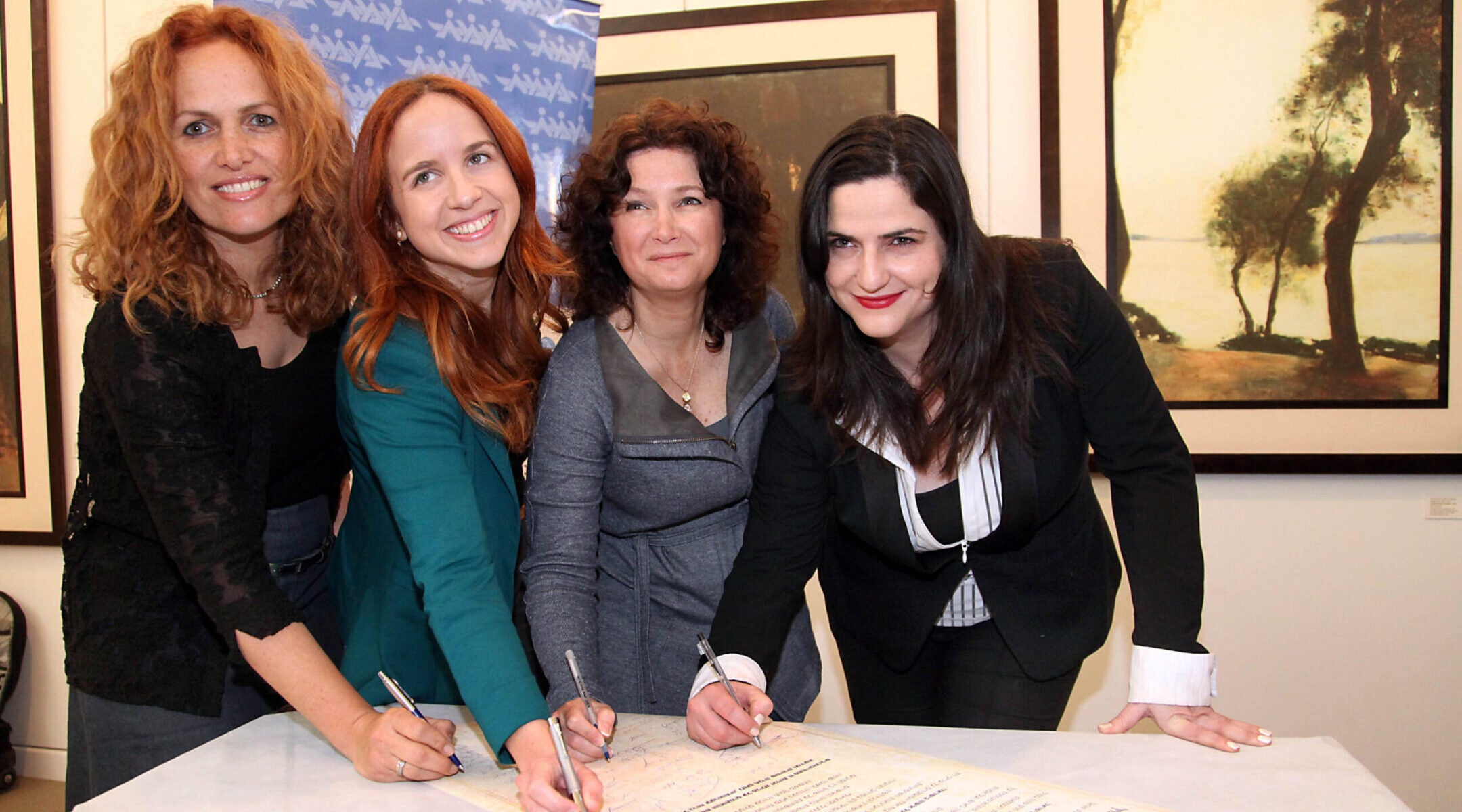
Michal Biran, at right, then a Labor MK, joins colleagues in signing a declaration of women’s rights, on International Women’s Day in Tel Aviv, March 7, 2013. (Gideon Markowicz/Flash90)
Trying to replicate the model in the United States, Biran said, has been harder than she expected, from the high cost of fertility treatments to basic logistics like geography. She recalled her short-lived delight when she found a potential match for a Florida client within the state. “And then I looked at a map and realized just how huge Florida is,” she said, laughing.
But the biggest hurdle, Biran said, is educating Americans about what she means by the concept, even as co-parenting platforms have grown (one app cited by The New York Times said it had 100,000 registered users in 2025, up from 30,000 in 2020). She pointed to Amichai Lau-Lavie, an Israeli-born LGBT rabbi in New York who fathered three children with a lesbian couple, as helping to raise the idea’s visibility, but Lau-Lavie draws a sharp distinction between his arrangement and co-parenting. While saying he is “very present in the kids’ lives,” adding that “they call me Abba,” he describes himself as an “involved known donor.”
For now, Biran said, Nesting’s U.S. outreach is aimed mainly at older single women and gay men. Rising antisemitism has made the timing feel more urgent, she said.
“This is the right time to make people understand that, if bringing children into the world from a love [relationship] doesn’t work, the most logical next step is to do it within the community,” she said. “I tell women, don’t go straight to the sperm bank. Meet a cute Jewish gay guy instead.”
In December, Nesting hosted a Zoom session for a couple dozen men, mostly Jewish gay men from California and New York, promoted through Facebook ads that asked: Are you longing for a child? Considering surrogacy but don’t want to raise a child on your own? Co-parenting by choice might be the right model for you. Another session aimed at American women is planned in the coming weeks.
Nesting’s U.S. service costs $8,000, Biran said, split into three installments tied to progress in the process, with the final payment due once an agreement is signed. (The comparable service in Israel costs around $3,000.) An app similar to the Israeli version is pending approval in Apple’s app store but already works on Android, and she also offers a more bespoke accompaniment for clients who want something more intensive.
In bookstores and pilates studios in Williamsburg, Brooklyn, for example, there are flyers with a QR code linking directly to a Nesting profile for a wealthy philanthropist looking to become a father. The profile describes him as fit and active, and willing to cover all the costs of raising a child. The catch? He’s 71. The man’s age was not, in itself, disqualifying, Biran said, adding that she has no limits for who she takes on as a client “except if they show aggression, that’s a dealbreaker.”
“Beyond that, who am I to judge? It’s a free world.”
Liling said he had one central criticism of the agencies that broker these arrangements, arguing they often step back just as clients need support most. While he credits Oro with running a supportive and professional process in finding a match, it ended once the contract was signed. “Meeting and deciding to go on this journey together I would say is the easy part.”
Beyond that, he said, co-parents need “follow up and follow on,” through the strain of fertility treatments and into the first years of raising a child with someone they are not in a relationship with. “We haven’t been spared of any of the regular challenges [of parenthood] but we don’t have the mechanism of knowing each other for years. The model requires us to be inventive of how to overcome them.”
For her part, Biran said she does try to stay in the loop beyond the signing, especially during fertility treatments, and will check back in if she has not heard from a pair for months. Part of her job, she said, is managing expectations because the fertility process is often difficult and unpredictable, adding that skills she picked up as a Knesset member have served her in that role.
“At the end of the day, I want there to be babies, not just agreements,” she said. But longer-term accompaniment is beyond a matching agency’s role, she said, pointing instead to existing support frameworks, including a co-parenting group at the Tel Aviv municipality’s LGBTQ center.
That gap left Liling and his co-parent to arrange their own follow-on support, including weekly couples therapy, which he said reflects how intentional they are about parenting.
“The attention and care we bring to our daughter is probably more than your average parent. She is lucky to have us as parents.”