
Two months after they were taken hostage, and eight months before they would be murdered, the Israelis who would later be known as the “Beautiful Six” were herded into a new section of the Hamas tunnel where they had been held.
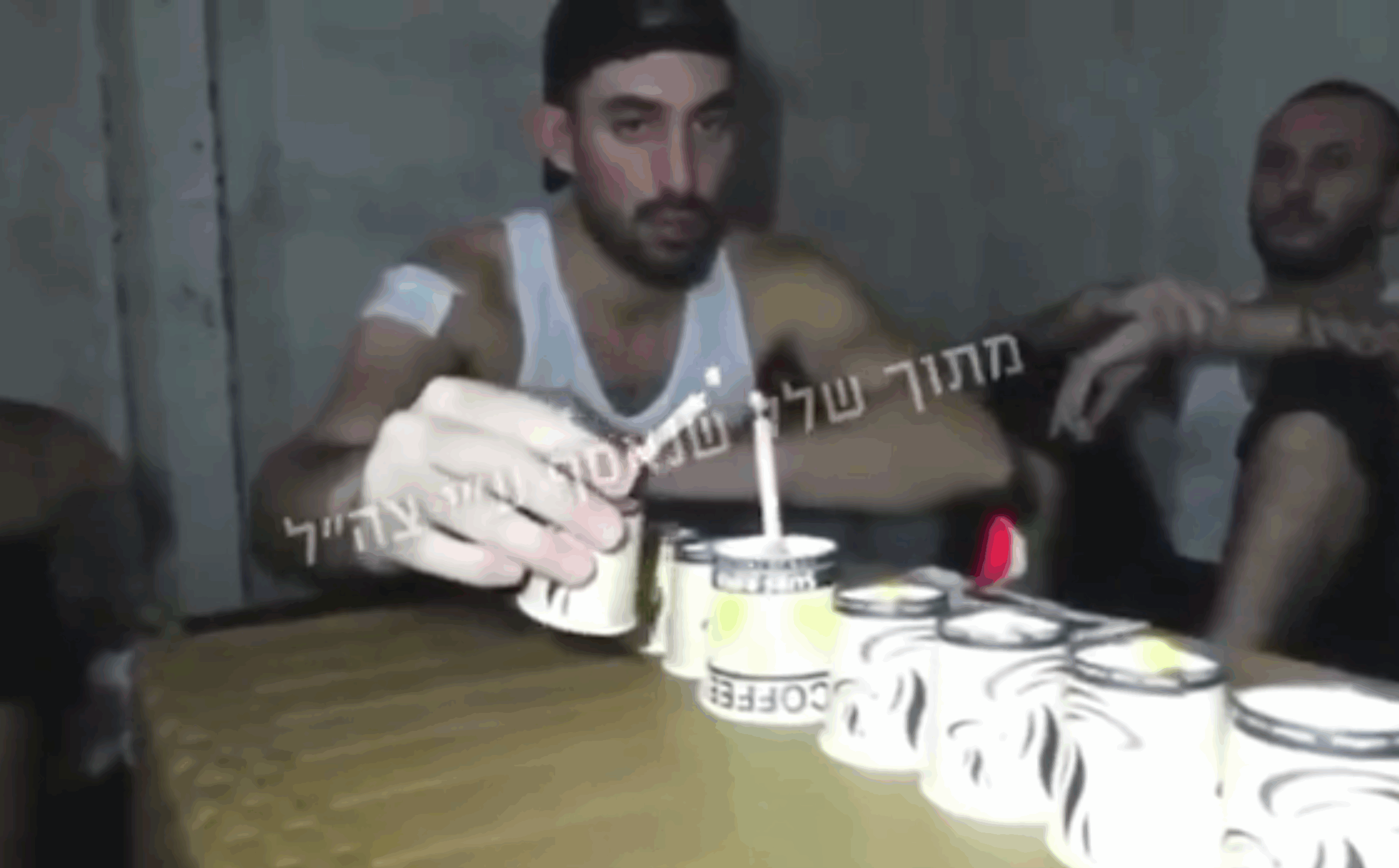
There, their captors took hours of video of the young adults as they lit a makeshift menorah, sang traditional Hanukkah songs and, after being prompted, offered holiday greetings to the camera.
“Where are the sufganiyot?” asked Eden Yerushalmi.
“We’re waiting for Roladin in the land [of Israel],” joked Hersh Goldberg-Polin, referring to one of the most prominent purveyors of Hanukkah donuts in Israel.
The other hostages — Ori Danino, Almog Sarusi, Alex Lubanov and Carmel Gat — sit with their fellow captives. Sarusi appears visibly distressed as he makes the blessing over the candles, and the cameraman captures wrenching comments as the six young adults sing the song “Maoz Tzur.”
Goldberg-Polin explains that there are six verses in the song, “one for each time they tried to kill us and failed.” Yerushalmi responds, “We need to add another verse.”
In another video, Lubanov is instructed to shave the heads of his fellow male hostages. While shaving Danino, he recalls the movie “The Pianist,” set during the Holocaust, and says he is like a barber in that setting.
“This situation is not that far from the Holocaust,” Danino replies, looking at a mirror that a third person, possibly from Hamas, is holding up.
Some of the footage appeared intended to fuel the kind of hostage videos that Hamas released intermittently during the war, but Hamas never put it out. Instead, the footage was recovered by the IDF about three months ago during a raid on a hospital in Khan Younis and was delivered to the families of the hostages about six weeks ago, according to YNet News. It was released publicly on Thursday.
The video adds to accounts that many of the hostages sought to maintain Jewish practices and traditions while in captivity, though it is the first to suggest that such practices might at times have been facilitated or coerced by their captors.
“Lighting Hanukkah candles in that dark place captures the essence of the Jewish spirit: light prevailing over darkness,” the hostages’ families said in a statement released by the Hostages and Missing Families Forum.
“Hamas filmed these videos as propaganda, but the humanity of the beautiful six shines through this footage. It is stronger than any terrorist organization. These videos bear witness to evil and failure. The entire world must see our loved ones in these moments, their unity, strength, and humanity even in the darkest times. They were taken alive, they survived in captivity, and they should have come home alive,” the statement continues. “Nothing will bring our loved ones back to life. Only bringing the truth to light, only genuine accountability at the national level, can bring justice and healing to all our hearts.”
The release of the footage has renewed grief over the murder of the hostages, which closely followed the collapse of ceasefire negotiations in July 2024. Some of the hostages, including Goldberg-Polin, who lost an arm on Oct. 7, had been on the list for release had a deal come together. Since then, Israeli officials have counted the hostages, whose bodies were retrieved soon after they were killed, among those rescued by the Israeli military.
“What heroes,” Goldberg-Polin’s mother, Rachel Goldberg-Polin, told Channel 12, according to the Times of Israel. “Six young luminous people who did everything right and they stayed alive and they did their part, and for us to claim we brought them back, in bags, bags of children to their parents, please don’t count Hersh among the people you saved.”
News of their deaths triggered mass protests in Israel opposing Israeli Prime Minister Benjamin Netanyahu’s failure to reach a deal the month before. In September 2024, Netanyahu issued an apology to the hostages’ families.
The video comes as the body of the last remaining hostage in Gaza, Ran Gvili, has yet to be returned to Israel, two months after a U.S.-brokered ceasefire deal between Israel and Hamas that required the release of all of the remaining hostages. Twenty living hostages and 27 deceased hostages, most but not all killed on Oct. 7, have since been returned.
The video appeared to be taken months before the group of six were killed in Hamas captivity in Rafah on August 29, 2024, shortly after the collapse of ceasefire negotiations with Hamas that could have led to the release of some of them.