
During the recent Conference of Presidents of Major Jewish Organizations’ mission to Israel, Prime Minister Benjamin Netanyahu demanded that Jews around the world stand strong and unified in support of Israel and against antisemitism. “Fight, fight, fight,” he told us, celebrating Jewish strength and unity in the face of existential challenge.
Indeed, since Oct. 7, Israel has waged a multifront war to defend itself against terrorists and their sponsors. Despite navigating a wide array of views among our own members about how Israel should execute the war, Diaspora communities have stood by Israel while facing resurgent and lethal antisemitism.
Yet now, forces in Israel’s own government are threatening a war on another front — against the Jewish people itself. And it is the prime minister who is silent.
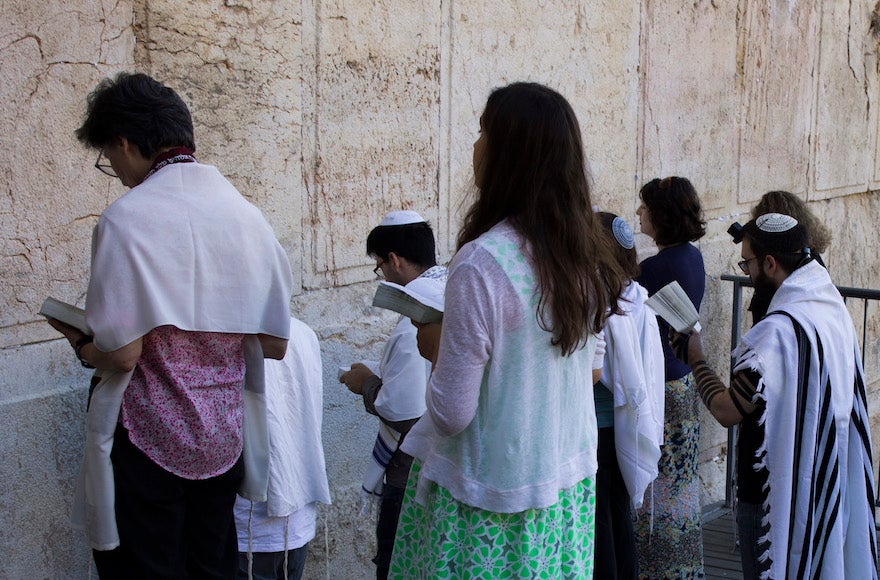
Members of his coalition are pushing legislation in the Knesset that would prohibit any religious services or activities at the Kotel that do not meet the approval of the Haredi (ultra-Orthodox) chief Rabbinate. Under the bill, anyone who publicly leads or engages in prayer contrary to the Rabbinate’s directive would face up to seven years in jail.
As leaders of two of the largest global Jewish movements, which together represent more than 3 million Jews, we know too well what would happen if this became law. Egalitarian, non-Orthodox approaches, such as mixed seating, would be banned. Women would have no space to read Torah or lead prayer. Birthright Israel and many others would no longer have a place to gather as a mixed group at Judaism’s holiest site.
Think of thousands of families from places such as Florida, New Jersey, Buenos Aires, Tel Aviv and beyond who want to celebrate their daughter’s bat mitzvah in an intergenerational moment of Jewish pride at our holiest site in our holiest city — only to face seven years in prison.
And the prime minister is silent.
This legislation is just the latest challenge in our movements’ years-long efforts to secure religious pluralism at the Kotel. We know that touching the stones and feeling closer to the ancient Holy of Holies can offer deep spiritual and religious connections. That’s why the Kotel should be a strong symbol of Jewish resilience, unity and spirit. It should reflect the diversity of our people and our approaches to prayer and Jewish life.
In 2016, a previous Netanyahu-led government approved a compromise to establish a new section of the Kotel for egalitarian prayer to recognize that pluralism. In that area, located south of the more established space run according to haredi tradition, families and groups may gather without a mechitza, or separation by gender. Liberal Jews can pray and celebrate according to our traditions and practices.
Yet, after a lengthy and challenging negotiation process in which all parties made painful compromises, Netanyahu immediately set the agreement aside, and successive governments have never fully implemented the plan.
In practice, the southern egalitarian prayer section is a vibrant space, with thousands coming daily for prayer and to celebrate b’nai mitzvah and other happy occasions. However, even as the Israeli government provides millions of shekels annually for upkeep of the northern section of the Kotel, it has refused to provide equal or adequate funding for security and upkeep to the southern section. Our space lacks full access for those with physical disabilities, its flooring is rotting, and visitors have not been able to touch the actual wall since a stone fell there seven years ago.
Last week, the Israeli Supreme Court took an important step to push the government to fulfill its 2016 commitment by directing it to stop dragging its feet and finally meet its obligations. In response, MK Avi Maoz, with the support of Justice Minister Yariv Levin and others within the current governing coalition, has sponsored the bill demanding that the entire Kotel, including the area of pluralistic Jewish expression, be brought under the Chief Rabbinate’s control.
By aligning with only the 15% of Jews worldwide who are haredi, Maoz is declaring war against the vast majority of the Jewish people. Despite the dream articulated in “Hatikvah” to be “a people living freely in their Land,” there will be no freedom of religion at Israel’s holiest site. Extremism and coercion will be the law of the land.
Maoz and his allies see the vitality of non-haredi religious expression as something to be controlled and repressed — not just at the Kotel, but throughout the State of Israel and beyond.
In contrast, we believe in religious pluralism and Jewish unity, without seeking to tell others how to “do Jewish.” We see it as a sign of strength and vibrancy and know that true Jewish unity does not require uniformity of practice or approaches to prayer.
That stance should start with the prime minister.
Our Diaspora communities have “fought, fought, fought” for Jewish strength and Israel for generations, and especially since Oct. 7. It’s time for the prime minister to “fight, fight, fight” for the unity and strength of the Jewish people, demand that members of his coalition reject this bill and respect Jewish pluralism.
is the CEO of the Rabbinical Assembly and the CEO of United Synagogue of Conservative Judaism (USCJ). Previously he served for over 20 years as founding rabbi of Shaare Torah in Gaithersburg, Maryland.
is the President of the Union for Reform Judaism, the largest Jewish movement in North America.
The views and opinions expressed in this article are those of the author and do not necessarily reflect the views of (JEWISH REVIEW) or its parent company, 70 Faces Media.