
Distance from reality is a dimension that can’t always
with great precision be by all people measured,
and since it is not physical but mental in unsmall ways,
paradoxically it’s most greatly treasured
when it is best defined as “most remote,”
identifiable as something that most people can not
identify, due to its apparent emptiness to emote,
expressing just one puzzled one word about it, “What?”
“What?” may be transformed into “How amazing!” when our eyes
respond to remote revelations with surreal surprise,
which, superseding our emotional responses, helps us rise
by finding for the revelations rationales less wry than wise.
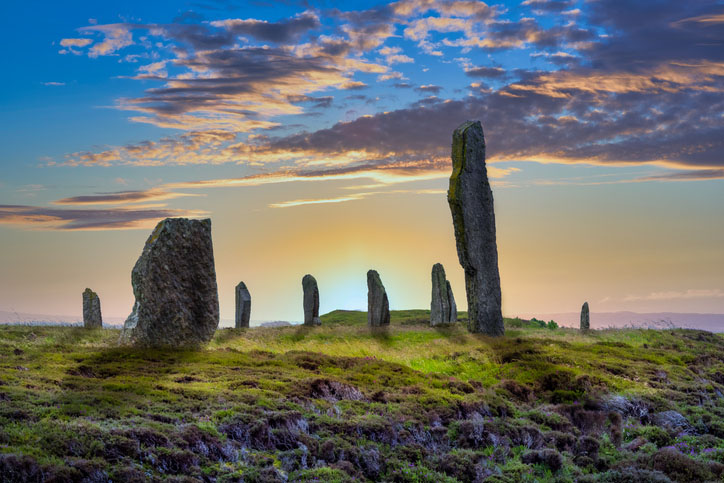
In “Northern Scotland, the Neolithic Age Never Ended; Megalithic monuments in the otherworldly Orkney Islands remain a fundamental part of the landscape,” New Yorker; 11/24/25, Alex Ross writes:
The Orkney archipelago possesses a singular aura—luminous, changeable, dreamlike. I first fell under its spell in 1985, when I visited the islands as an archeologically curious teen-ager…. At ocean’s edge.… pastoral repose gives way to geological violence. Sheets of rock crash into the water at sharp angles or plunge straight down. On the isle of Hoy, sandstone cliffs rise more than a thousand feet above the sea.
Orcadians, as residents of the islands are known, dislike hearing their world described as “remote.” They will ask, “Remote from what?” Yet they value their apartness. The genetic makeup of the population indicates extensive migrations from Scandinavia. The Norse ruled Orkney from the ninth to the fifteenth centuries A.D., when the territory passed into Scottish hands as part of a wedding-dowry transaction. Norse heritage remains popular: Viking festivals draw throngs, bushy beards are de rigueur.
The last line of Jacob’s dream, which expresses his reaction as follows in Gen. 28:17:
וַיִּירָא֙ וַיֹּאמַ֔ר מַה־נּוֹרָ֖א הַמָּק֣וֹם הַזֶּ֑ה אֵ֣ין זֶ֗ה כִּ֚י אִם־בֵּ֣ית אֱלֹהִ֔ים וְזֶ֖ה שַׁ֥עַר הַשָּׁמָֽיִם׃
Shaken, he said, “How awesome is this place! This is none other than the abode of God, and that is the gateway to heaven.”
In this response to the microlithically inspired dream, Jacob does not respond with just one word, “What?” but explains it, turning מה, meaning “what” in my poem’s response to remoteness, to an explanation preceded by two words, מַה־נּוֹרָ֖א, how awesome. This changes מה, ma, from “what,” to “how amazing!” We perform this transformation every seder night, when we transform the מה, ma, in the מה נשתנה, ma nishtanah, from a question, “what is the difference?” to an explanation, expressing the pleasure we gain by recognizing the significance of the remoteness — the very strangeness of the reality of the night.
מה, ma, thereby no longer comes to mean “why?” but “how amazing!” in an exclamation denoting “how very different!”
Gershon Hepner is a poet who has written over 25,000 poems on subjects ranging from music to literature, politics to Torah. He grew up in England and moved to Los Angeles in 1976. Using his varied interests and experiences, he has authored dozens of papers in medical and academic journals, and authored “Legal Friction: Law, Narrative, and Identity Politics in Biblical Israel.” He can be reached at [email protected].