

For many, many years, on Friday nights, my mother-in-law Becky would walk into our Los Angeles home carrying her yellow Dutch oven. The heavy pot was tightly wrapped in a towel and inside sat her red rice. She would look at Neil and say, with quiet pride, “El arroz salió uno por uno,” meaning the rice came out grain by grain. To this day, those words bring a smile to his face.
Becky’s cooking belonged to a Sephardic Los Angeles that has largely disappeared. Her mother was born in Rhodes and her father in Bulgaria. Founding members of Sephardic Temple Tifereth Israel and the Sephardic Hebrew Center, they first settled in South Central and later the Crenshaw District, when those neighborhoods were Ladino-speaking and deeply Sephardic. Food, language and synagogue life were woven together, passed from kitchen to kitchen.

Every month, Becky filled our freezer with boyos and burekas, each one perfectly shaped. There were biscochos coated in cinnamon sugar, roscas, reshas and her leek patties, keftes de prassa, for the holidays. She always counted everything. “I made 62 boyos and 76 burekas,” she would say as she handed me the bags. I never understood this need to count, until years later, when she could no longer bake and I took over. Without realizing, I heard myself say to Neil “I made 64 boyos and 72 burekas.” We both laughed out loud and in that moment, I knew I had joined the club.
Cooking was the way that Becky carried her history. Her father ran a small French food counter at Grand Central Market in downtown Los Angeles, where he fed hungry workers. During the Second World War, often there were soldiers who couldn’t afford even a few cents and he gave them credit. Later, he taught Becky how to cook dishes like sweetbreads and veal.
Becky lived a long and resilient life. Widowed young, she returned to her job at the U.S. Army Corps of Engineers, while raising Neil on her own. She held fast to her opinions and her independence, driving well into her 90s and reading the newspaper every day until her eyesight failed. She loved Los Angeles deeply,its music, its culture, its scenic drives and its once-great department stores. She would lunch at Bullock’s Wilshire and watch the fashion shows in the main dining room. The shoe salesman at Saks had her number and would call to inform her of upcoming sales.
Becky passed away two weeks before turning 102; she was still deeply herself.
Nowadays, when my daughter Rebekah (Becky) and I bake boyos or burekas, we count them. When the rice comes out “uno por uno,” I’m not just cooking, I’m holding onto a Sephardic world I knew through Becky. A world shaped by tradition, generosity and recipes passed hand to hand.
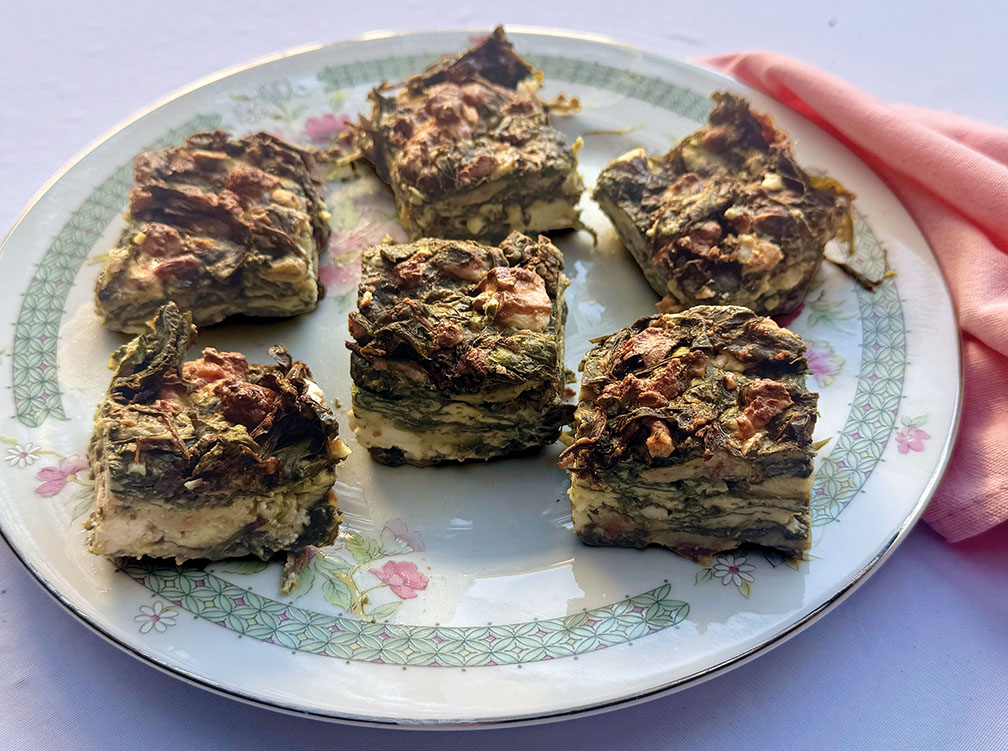
Over the years, we have shared many of Becky’s recipes with you, dear reader. Spinach quajado has always been a favorite. Becky would make them for festive brunches and dairy Shabbat lunches. She always made a few extra and we would freeze them for future meals. I soon realized that quajado is an easy recipe and now I am able to whip one up in ten minutes.
This past month, I served quajado at the shiva for my father and now my mother-in-law. Through my sadness, I knew I still had to feed family and friends. This dish is so very simple to make, always delicious and extremely comforting.
I look forward to preparing it for the coming simchas in our family.
—Rachel
(Spinach and Feta Souffle)
6 large eggs
½ cup cottage cheese
1 tsp baking powder
16 Saltine crackers, crushed or 1/2 cup matzah meal
1/2 cup milk
½ cup grated Parmesan cheese
½ cup crumbled feta cheese
1 1/2 lb fresh baby spinach, roughly chopped
Preheat the oven to 400°F.
In a large bowl, beat the eggs, then add the cottage cheese, baking powder, crackers, milk, Parmesan and feta cheeses and combine.
Add the spinach and mix well, ensuring that the spinach is thoroughly coated.
Grease a 9×13″ ovenproof dish and place in the oven for 10 minutes. Remove from the oven and pour the mixture into the hot dish.
Bake for 30 minutes, until the top and sides of quajado are dark brown and crispy.
Cut into squares before serving.
Freezes well for up to 3 months, defrost in refrigerator and warm at 400 degrees for 20 minutes.
Sharon Gomperts and Rachel Emquies Sheff have been friends since high school. The Sephardic Spice Girls project has grown from their collaboration on events for the Sephardic Educational Center in Jerusalem. Follow them
on Instagram @sephardicspicegirls and on Facebook at Sephardic Spice SEC Food. Website sephardicspicegirls.com/full-recipes.