

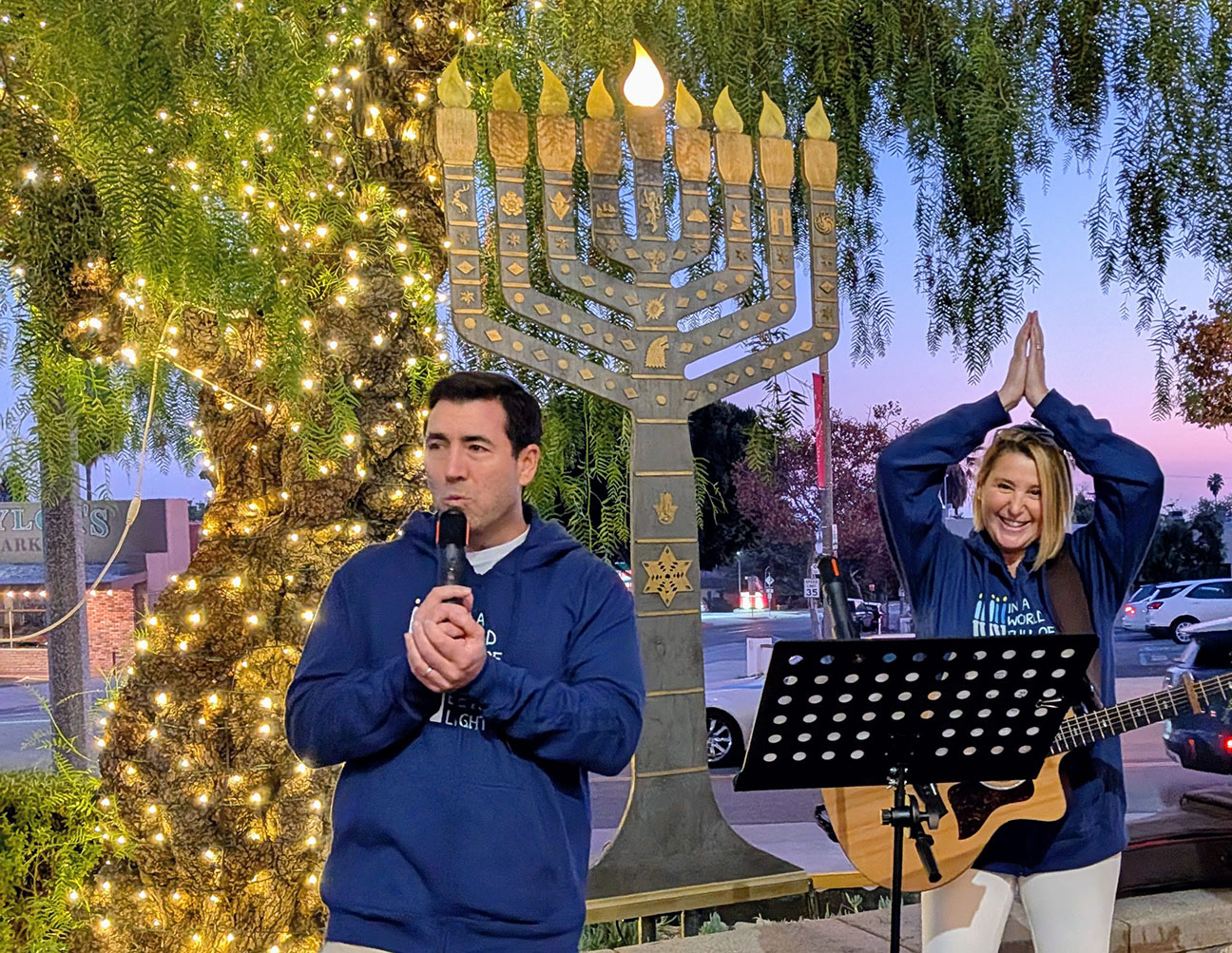
Halfway through his first year as leader of the Pasadena Jewish Temple and Center, Rabbi Josh Ratner told The Journal that “I wanted to try everything before I knew for sure what I wanted to do.” And after five less-than-fulfilling years as a commercial litigator and 14 years after his ordination, the San Diego native has found himself in a job he loves.
He found himself dissatisfied with the law pretty quickly. It was a matter of two things: “One was feeling conflicted between my Jewish self and my work requirements, not being able to navigate those two in a cohesive manner. The second was – I had started at a large New York law firm – and I found that to be a bit dehumanizing,” he said.
He was one of many lawyers, and the focus was on working as many hours as one could, doing a lot of grunt work. “It wasn’t as analytically inclined as law school had been – and as I had hoped law would be. The juicy stuff, the meatiest cases were reserved for the partners. We junior associates had to do more the scut work. It didn’t feel fulfilling to me. And I was working really long hours.” His interest in law cooled after one year, he said. “I wrestled back and forth. We were living in Connecticut at the time. My wife was in training at Yale to become a doctor. So I tried moving to a smaller firm in Connecticut to see if that would change my perspective, to see if the basic issue was working for a big firm. But I found similar issues there. It was a dramatic change he said, but one he welcomed. “Having spent eight years in New York, I was ready to see greenery, foliage, trees, those kinds of things again.”
Telling the story from his new office that offers an unimpeded view of the San Gabriel Mountains, Ratner is relaxed and all smiles. For a moment, the rabbi turned to his childhood. “We weren’t a very observant home,” he said. “My parents were inclined to empower [him and his sister] to explore Judaism more substantially than they ever had. Both of them had been raised relatively Reform in practice. They weren’t avid shul-goers. But when it was time for my slightly older sister and me to go to school, they decided it would be a good project to put us in a nearby Jewish school.” It was a good decision, he said. “They grew, too. They became more observant in some of their practices – through us in some ways.”
What changed? “I was too young to know how I was before,” he said. But he reached back for several details. As a family, they started to observe Friday night dinners more – whether with family or friends. His parents made friends with the families of other students, and it gradually became an enlarged circle. “We also started going to services a bit more on Friday nights and Saturday mornings. It’s a process,” he said.
He also spent a year in Israel studying at the Pardes Institute, something that might have influenced his later choice of career. “I loved the opportunity to be fully immersed in Jewish living,” he said. “Something about the totality of that experience spoke to me.”
He was attracted to the law, because he was “always passionate about issues of justice, equality and fighting for those who may have been marginalized or not had the opportunity to advocate for themselves,” he explained.
He also grew up during the halcyon days of legal dramas on television – “’L.A. Law,’ ‘Boston Legal’ – those kinds of shows,” he said. “I saw law as exciting, intellectually engaging and also a chance to advocate for good causes – that’s what drove me.”
But deciding on a career in law was “more a process of elimination. I knew I didn’t want to go into medicine. I don’t like blood or guts or anything internal about the body despite the fact I am married to a cancer surgeon. I knew I didn’t want to go into finance. It wasn’t appealing.”
He wasn’t sure what else to do, “I had a background where I liked writing, I liked debate and advocating for causes, a whole host of issues. Law became the logical next step after college.”
After law school, Ratner spent a year clerking for a judge in Memphis, Tenn. while his wife was finishing her last year of medical school. Then they moved to Connecticut. He realized it was time to explore other options. The rabbinate “quickly emerged as an intriguing possibility,” he said.
“As I was opening my antenna to see what else was out there, I started to meet rabbis who were doing work outside of congregations and schools – those had been the primary modalities to me of what it meant to be a rabbi, doing work in social justice organizations, at universities, at Hillel. All of this expanded my awareness of what rabbis could do. I was looking for something a bit wider, not just limiting myself to one specific avenue.” Becoming a rabbi appealed to the attorney. The issues he had encountered in law school, “advocating for justice, a vision of a moral society – was something I actually could do as a rabbi. That opened my mind to thinking that [the rabbinate] is a career I could feel passionate about.” As a bonus, it could give him “a Jewish proximity to continuing to learn and to practice and have it be a part of what I do.”
He is married to Dr. Elena Ratner, a gynecologic oncologist specializing in ovarian malignancies, and they are the parents of Dimitri, Eli, Gabby and Sasha.
“She wanted me to be happy and fulfilled,” the rabbi said. “She was supportive. She knew I wasn’t [fulfilled] in law. She had spent some of the time I was in Israel with me. She had an appreciation of how much that experience meant to me.”
He said from the time he entered rabbinical school, “I have loved every minute of it. It has been a love affair. I have been so happy to find fulfillment in what I am doing. This vocation is sacred work. Every day I feel blessed.”