

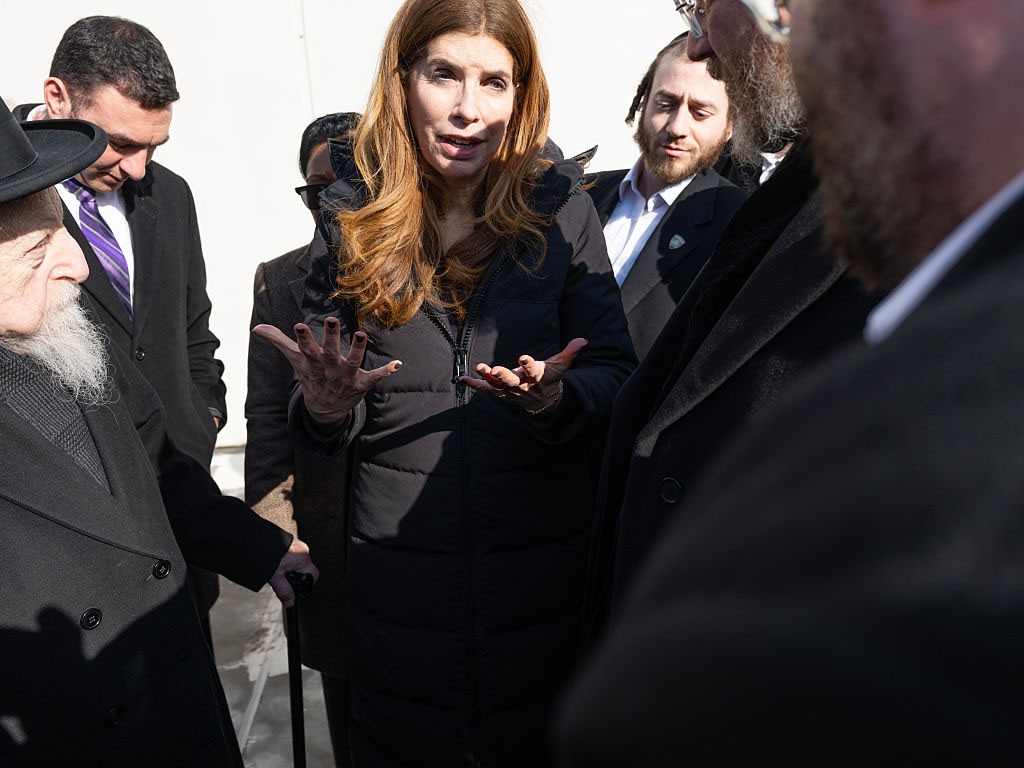
Julie Menin is the Speaker of the New York City Council, which makes her the highest-ranking Jewish official in a government headed by Mayor Zohran Mandani. As such, she may have the most complicated diplomatic challenge in American politics (Steve Witkoff and Marco Rubio run a close second and third. Rep. Mike Johnson [R-La.] and Sen. John Thune [R-S.D.] are not even close.) At this early juncture, she appears to be succeeding.
Mamdani’s problems with Israel seem to come less from any discernable knowledge of history, security or geopolitics than an affinity for progressive ideological fashion. But regardless of their origin or veracity, his beliefs are real and they tend to excite a portion of his electorate who are less enthused about his administration’s approach to snow removal, taxes and other more mundane matters. So he exercises those beliefs publicly whenever possible. His election has unexpectedly thrust Menin, who sought her office on a platform of affordable housing, healthcare costs and small business support, into the position of America’s largest city’s Zionist-in-Chief.
Not surprisingly, she and the mayor have already frequently crossed swords. She has spoken against his recent proposal for a large property tax increase, but most of their differences have been related to Israel and the city’s sizable Jewish community. After her opposition to his decisions to revoke the city’s adoption of the International Holocaust Remembrance Alliance definition of antisemitism and lift local restrictions on the BDS movement, she announced her own task force to combat antisemitism when Mamdani delayed his own appointments to a similarly-tasked mayoral commission. (Mamdani did make his appointments last week.)
Their differences have become most stark after Menin proposed a legislative package that included establishing a 100-foot perimeter at schools and houses of worship to protect students and congregants from overly aggressive protesters. She moved forward with her plan in the aftermath of ugly protests outside of an Upper East Side synagogue when demonstrators gathered there to chant epithets such as “Death to the I.D.F.” and “Globalize the intifada” and a more recent protest when demonstrators chanted their support of Hamas outside a synagogue in Queens.
Mamdani has objected to Menin’s proposal on free speech grounds, but the Speaker has picked up an even more powerful advocate in Governor Kathy Hochul (D), who has announced her own similar policy goal. (Mamdani does sensibly support an almost-identical set of protections for abortion clinics, but has not yet explained why children and worshippers should not be granted the same protection against assailants emboldened by their mayor’s indifference.)
In fairness, Mamdani is not the only person to oppose such restrictions due to First Amendment considerations. For many Jews, these questions can be complicated ones. Pro-Israel advocates frequently gather in front of the United Nations or the consulates of countries like Iran or Qatar to protest anti-Israel resolutions or state-sponsored terrorism. And one of the most successful Jewish advocacy movements in history was the Save Soviet Jewry campaign. For decades, committed activists stood directly in front of the Soviet Mission to the U.N. in New York City, chanting and holding signs to demand the release of refuseniks.
But these are government buildings, not religious sanctuaries or schools, and the distinction between utilizing political protest to obstruct government work and shutting down a child’s education or religious services is an important one. Distinguishing between the right of protesting a government action and attacking a worshipper’s religious belief should be even less difficult. Unless it requires an elected official to stand up to their most fervent supporters.
Menin has also pushed to expand the city’s reimbursement program for security guards and private and religious schools by providing access to security cameras. Her other proposals include mandating and funding a program that would offer security training to houses of worship; establishing a hotline to report antisemitic incidents to the city’s Commission on Human Rights; and allocating $1.2 million over the next two years for Holocaust education in city schools.
Mamdani has not yet taken a position on any of these matters. This test of wills is just beginning. The smart money would be on Menin.
Dan Schnur is the U.S. Politics Editor for the Jewish Journal. He teaches courses in politics, communications, and leadership at UC Berkeley, USC and Pepperdine. He hosts the monthly webinar “The Dan Schnur Political Report” for the Los Angeles World Affairs Council & Town Hall. Follow Dan’s work at www.danschnurpolitics.com.