
As war rages in the Middle East, Iranian Jews in the United States are experiencing a familiar, almost generational whiplash: fear and hope, pride and anxiety intertwined.
In Los Angeles, home to the largest Iranian community outside of Iran including tens of thousands of Iranian Jews, synagogues and community leaders say the moment feels historic. But it is also deeply personal.
“At Eretz, which plays a central role in the Persian Jewish community in Los Angeles, we’re hearing a wide range of emotions from congregants — deeply felt concerns, steadfast faith, and a strong sense of collective resilience,” said Rebecca Aghalarpour, director of the Eretz Cultural Center, the largest Persian Jewish congregation in California.
Many congregants, she said, carry a vivid inherited memory of the 1979 Islamic Revolution, when thousands of Iranian Jews fled repression and rebuilt their lives in Southern California.
“That generational memory of fleeing one’s homeland still resonates strongly among our congregants and informs much of what they feel and ask for today,” Aghalarpour said.
In practical terms, she is hearing three main requests: prayer, security and hope for political change.
“In times of global uncertainty, congregants are most often seeking collective prayer — additional gatherings and opportunities to come together as a community to find grounding and hope,” Aghalarpour said. At the same time, “families are understandably concerned about safety,” prompting reinforced security measures and coordination with law enforcement.
But there is also something more aspirational. “There is a profound sense of hope among many Persian Jews that the potential for change in Iran could eventually mean freedom not only for the Iranian people but also the possibility of peace in the Middle East — especially regarding Israel’s security and future,” she said.
That mix of jubilation and dread is echoed across the community.
Daniel Bral, a Los Angeles-raised Iranian Jew whose grandfather once served as the Jewish member of parliament in pre-revolutionary Iran, described himself as “a unicorn” in the Persian Jewish community because he is a progressive Zionist active in peace and dialogue efforts. Many Iranian Jews are more politically conservative.
“It’s complicated for me,” he said. “Obviously, I am happy to see somebody like Khamenei no longer on this earth. I don’t shed any tears for that.”
Like many in the Iranian diaspora, Bral says he hopes for an end to the Islamic Republic. But he is wary of how that change unfolds.
“I’m being asked to place my faith in the hands of two leaders who have by no means earned any trust,” he said, referring to President Donald Trump and Israeli Prime Minister Benjamin Netanyahu. “I’m hopeful for change in the motherland, but I don’t know if change will come through aerial bombardment. It has to happen at the hands of the people.”
He worries not only about a protracted war, but also about how the conflict will shape perceptions of Israel and Jews in the United States.
“If this war doesn’t have a positive end result, it will only further increase the resentment that Americans have of Israel,” he said. “And that is not good for Israel. It is not good for American Jews.”
For Matthew Nouriel, director of community engagement and outreach for JIMENA, an advocacy group for Sephardi and Mizrahi Jews, the dominant feeling is less ambivalence and more elation.
“It’s jubilant, it’s exciting,” he said. “This is something so many of us in the Iranian activist space have been fighting for, for years.”
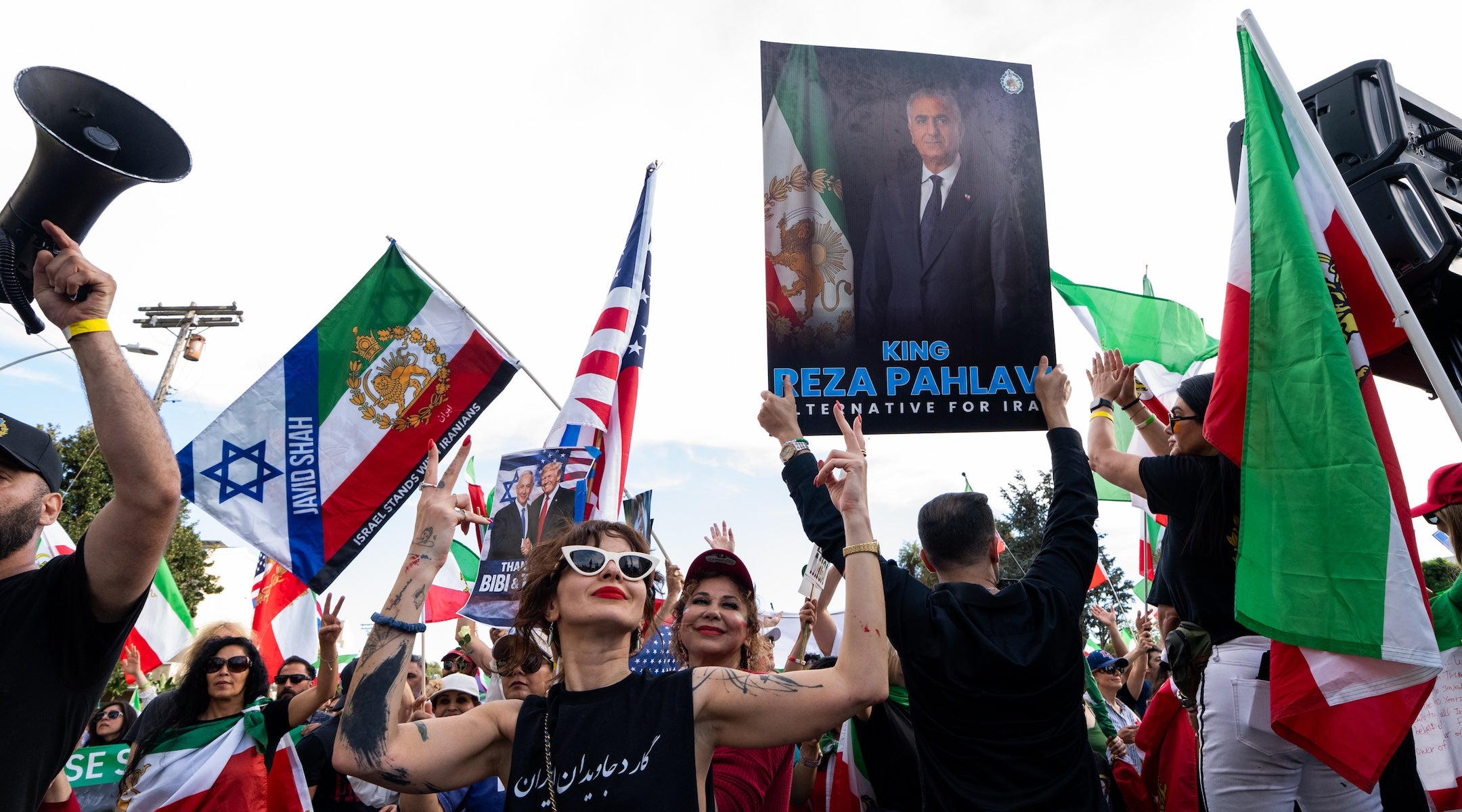
Nouriel said rallies in Los Angeles have been filled with Iranian flags — and, strikingly, Israeli ones.
“The majority weren’t Jewish,” he said. “There were Israeli flags, people holding signs like ‘Tehran to Tel Aviv.’ It was quite a sight to behold.”
Still, he acknowledged anxiety about what comes next, including concern for the small Jewish community that remains in Iran and uncertainty about who might fill a power vacuum. Many in the diaspora, he said, support a transitional role for Reza Pahlavi, the exiled crown prince.
Bral and Nouriel both describe a community glued to their phones, refreshing social media feeds, texting relatives and friends, and toggling between U.S., Israeli and Persian-language news sources. The war began while Bral was in Washington, D.C., at the annual conference of J Street, the liberal pro-Israel lobby, where panel discussions competed with breaking news alerts. “As soon as I get to my room, I’m catching up on everything,” he said.
The emotional intensity comes at a season already dense with symbolism. This week Jews around the world celebrate Purim, commemorating the ancient Persian story of Queen Esther and the salvation of the Jewish people from a royal decree of annihilation. Soon after comes Nowruz, the Persian New Year, a holiday rooted in renewal and rebirth.
For Iranian Jews, the juxtaposition is powerful: a Jewish story set in ancient Persia, followed by a Persian festival of spring, both unfolding amid a present-day war.
There is, Aghalarpour said, “a remarkable sense of unity — across generations and life experiences — that brings our community together.” Congregants are seeking “accurate information, a compassionate voice, and leadership that reflects their values of faith, peace, and resilience.”
Even amid jubilation or anxiety, the longing for Iran itself remains palpable. Only a vanishingly few first-generation Iranian American Jews have ever visited the country their parents fled.
“There’s love but emptiness for a place that we’ve only heard stories about,” Bral said.
Nouriel is direct about his hope. “I cannot wait to go,” he said. “God willing, there will be a resurgence of Jewish life within Iran openly.”