

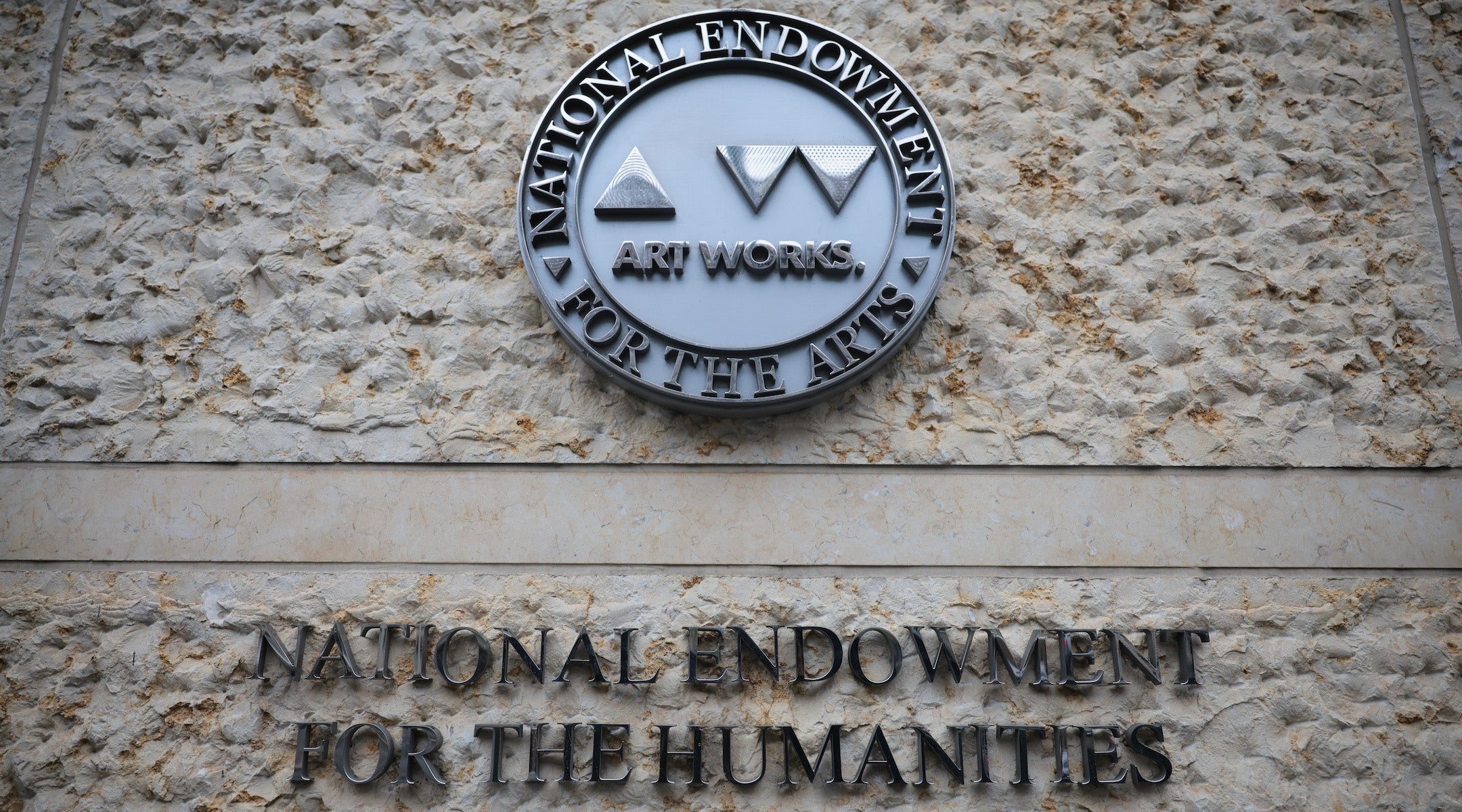
The Department of Government Efficiency tagged Jewish themes as “DEI” in ChatGPT when searching for federal humanities grants to cancel last year, according to a class-action lawsuit.
The methodology contributed to the cancellation of National Endowment for the Humanities grants to study violence against women during the Holocaust, postwar Soviet Jewish literature and hundreds of other topics, even as the NEH would soon bestow $10.4 million, its largest-ever grant, to the Tikvah Fund, a politically conservative Jewish cultural project.
The suit brought by the Authors Guild; a member organization for several academic groups including the Association for Jewish Studies; and a number of individual scholars seeks to restore the canceled funding, which comprised around 80% of the NEH’s grants and was cut amid the Elon Musk-led task force’s broader slashing of federal spending last year.
The suit names the NEH, its acting chair, and several DOGE staffers as defendants, including Justin Fox, who the suit alleges was behind the ChatGPT methodology.
While DOGE’s use of keywords to cancel research grants was already known, as was the sweep’s effect on Jewish projects, the suit has revealed new details in its methodology, including staffers’ use of ChatGPT and their contention that works dealing with Judaism are a form of DEI.
In a filing on Friday, attorneys for the plaintiffs said Fox specified that he considered Jewish grants, including those focusing on the Holocaust, part of DEI.
“For a different grant about violence against women during the Holocaust, Fox testified that ChatGPT properly classified the grants as involving DEI, and thus slated it for termination, because it was ‘specifically focused on Jewish cultures’ (as in, it was about the Holocaust) and the ‘voices of the females in that culture,’” reads the filing.
“More generally, Fox stated that he identified as DEI any grant about a specific ‘minority group,’ meaning any particular ‘ethnicity, culture . . . race or gender or religion,’” the filing went on.
“It’s a Jewish — specifically focused on Jewish culture and amplifying the marginalized voices of the females in that culture,” Fox stated about one canceled grant for a project about “violence against women during the Holocaust,” as the latest court filing described it. Fox continued, “It’s inherently related to DEI for that reason.”
When asked in a deposition about the criteria for cancellation, the NEH’s acting chair Michael McDonald said he hadn’t known that DOGE used ChatGPT in its selection process, while also noting that he didn’t agree with the assessment that the Holocaust constituted DEI. The final authority for canceling the grants rested with DOGE, not McDonald, depositions indicated.
Fox, the suit alleges, had created his own “Detection List” of identity-based traits, with separate categories for “Craziest Grants” and “Other Bad Grants,” before running the databases through the generative AI software.
His prompt, according to the lawsuit: “Does the following relate at all to DEI? Respond factually in less than 120 characters. Begin with ‘Yes.’ or ‘No.’ followed by a brief explanation. Do not use ‘this initiative’ or ‘this description’ in your response.” The grants that turned up were all terminated, with only a few exceptions.
Many Jewish-themed projects were among the NEH cancellations, including a grant for “In the Shadow of the Holocaust: Short Fiction by Jewish Writers from the Soviet Union,” a translation project that was published in book form last month. The book was singled out during the lawsuit’s discovery phase, which noted, “ChatGPT classified this grant as DEI because ‘[t]his anthology explores Jewish writers’ engagement with the Holocaust in the USSR.’”
“I find it annoyingly amusing that they weren’t bothering to read the grants themselves — that they needed a machine to give them some sense,” Sasha Senderovich, a University of Washington professor who co-translated the volume with University of Illinois-Urbana Champaign professor Harriet Murav, told the Jewish Telegraphic Agency. Three-quarters of their NEH grant had already been paid out, Senderovich said. He believes the NEH’s decision to cancel his grant was an example of “authoritarian logic.”
The book “In the Shadow of the Holocaust” showcases Jewish literature written in the Soviet Union; at right, Jewish women buy flour before Passover in Moscow in 1965. (Keystone-France/Gamma-Keystone via Getty Images)After Senderovich used similar language in a Forward story last year following the cuts, an NEH official called the accusation “tendentious” and accused “wokeness and intersectionality” of being the true authoritarians in a text to McDonald, according to the court filing.
While the DEI justification has generated headlines, Senderovich said, “I think it’s also somewhat misleading to get hung up on what they typed into ChatGPT.”
The NEH’s final grant cancellation list, he noted, included many projects that had not been flagged as DEI. One such cancellation noted by the plaintiffs’ attorneys — which DOGE canceled over McDonald’s objections — was “a grant to advance the National Catholic Center for Holocaust Education at Seton Hill [sic] University.”
Murav, for her part, told (JEWISH REVIEW), “I am reeling from these cascading waves of hatred.” She rejected the idea that Jews should be considered part of DEI: “DEI initiatives seek to redress historic failures in American society. DEI efforts in the world of the university are not aimed at American Jews, because American Jews are over-represented in the professions and in the academy.”
Also canceled by DOGE: a project on “the untold story of Jewish women’s slave labor during the Holocaust,” according to the suit. Documentary filmmaker Marisa Fox, whose own grant for a project matching that description was canceled, bemoaned the Trump administration’s new priorities in the Hollywood Reporter last year.
“I’ve seen firsthand how meeting a Holocaust survivor, whether in person or through a project, can dispel the most deep-seated antisemitic beliefs,” Fox — no apparent relation to the DOGE staffer — wrote then. “But if the NEH, NEA and local humanities councils are defunded, the platforms that can bridge divides will be severely limited. And so, too, will our chances of stemming hate’s rising tide.”
Even as staffers appeared to classify Jews as “DEI,” the NEH is moving forward with its support of Tikvah-aligned Jewish scholars. Ruth Wisse, a prominent Yiddish and Jewish cultural scholar, emeritus Harvard professor and senior fellow at Tikvah, is set to deliver the NEH’s annual Jefferson Lecture in the Humanities later this month at what has been rechristened the “Trump Kennedy Center.” Wisse’s lecture is titled “A Message from the ‘Blue and White’ in the ‘Red, White, and Blue,’” a reference to the colors of the Israeli and American flags.
A request for comment to Tikvah CEO Eric Cohen was not returned as of press time. Tikvah had a previously unreported connection to NEH senior leadership, the deposition shows: Dorothea Wolfson, who has worked with Tikvah and directs a program established by a former Tikvah board chair, is married to Adam Wolfson, the NEH’s assistant chair for programs. Adam Wolfson said in the deposition that he had made introductions but wasn’t involved in the grant selection.
As it shines a spotlight on DOGE’s practices, the suit also brings a different long-simmering debate to the forefront: whether Jews are considered part of “DEI,” the broad suite of diversity, equity and inclusion initiatives at universities and other institutions that conservatives have railed against.
Some prominent Jewish voices, including current CBS News editor-in-chief Bari Weiss, have argued that DEI practices are at least latently antisemitic because their practitioners do not consider Jews an underrepresented minority. The Trump administration’s crackdown on campus antisemitism has frequently been paired with anti-DEI initiatives.
Yet at the same time, a broader anti-DEI push on the right has also ensnared Jewish projects, or generated confusion among university administrators as to whether Jewish events should be canceled on campuses where DEI is outlawed.
Fox, according to investigations of DOGE staffers last year, is a former investment banker whose DOGE tenure also included stints overseeing cuts at USAID and the General Services Administration. His NEH tenure coincided with a directive for that organization to eliminate $175 million in federal grant funding. The DOGE project largely wound down following its architect Musk’s official exit from government a few months into its tenure, decimating numerous federal agencies and jeopardizing some initiatives to benefit Jews.
“It’s just ridiculous. You have these kids being told just go in and cut as much as you can,” Mary Rasenberger, CEO of the Author’s Guild, told (JEWISH REVIEW) about the DOGE maneuvers. “They were given no real instruction.”
The guild is one of several organizations that have co-signed onto the lawsuit, which is requesting the refunding of the grants. It is now awaiting a judge’s ruling on a summary judgment that would avoid a trial.
Among several individual authors represented by the guild in the suit is Jewish author and independent scholar William Goldstein, founding editor of the New York Times’ Books website, whose NEH grant was meant to fund a biography of Jewish LGBTQ playwright and AIDS activist Larry Kramer.