

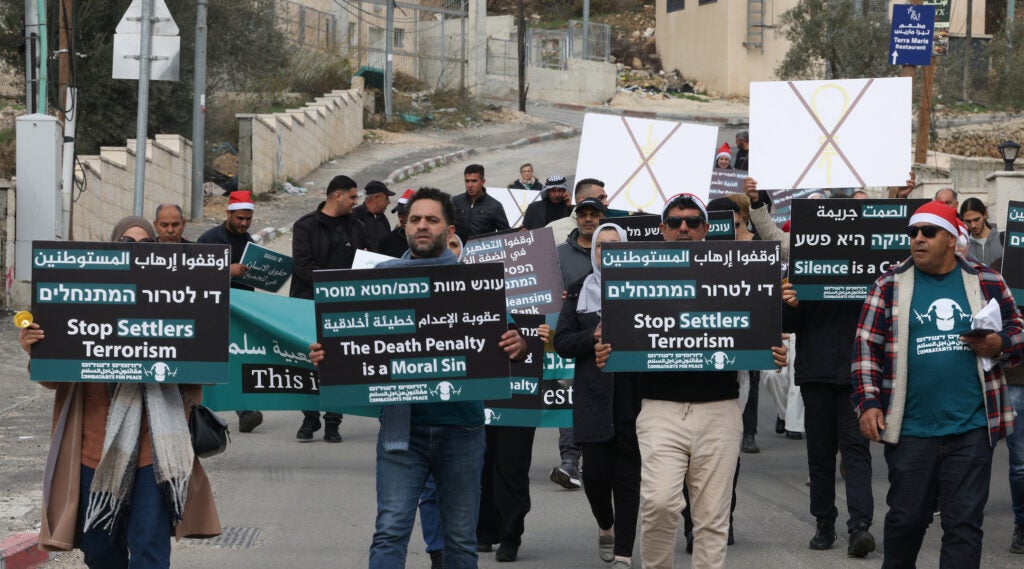
The Israeli parliament passed a law on Monday mandating the death penalty for West Bank Palestinians convicted of carrying out deadly attacks against Israelis.
The law, which was approved by the Knesset in a vote of 62-48 following nearly 12 hours of debate, marked a victory for Israel’s far-right following a years-long push to increase penalties for Palestinians convicted of lethal attacks. Israeli Prime Minister Benjamin Netanyahu voted for the measure.
“This is a day of justice for the victims and a day of deterrence for our enemies. No more revolving door for terrorists, but a clear decision. Whoever chooses terrorism chooses death,” far-right Israeli security minister Itamar Ben-Gvir, who has long lobbied for the measure, said in a statement.
The legislation has drawn widespread opposition from critics in Israel and beyond, including Israeli justice officials, progressive Jewish groups and the foreign ministers of Australia, France, Germany, Italy and the United Kingdom. Critics of the law say it effectively mandates the execution of Palestinian attackers while intentionally excluding Jewish extremists.
“In the highly volatile political climate that now imperils the rule of law in Israel, this issue further normalizes the invocation of state violence,” Michael Zoosman, the co-founder of L’chaim! Jews Against the Death Penalty, wrote in a Times of Israel op-ed in January. “It widens the gap between modern-day Israel and the central Jewish value of the inviolability of life.”
Minutes after the legislation’s passage, the Association of Civil Rights in Israel announced that it had filed a petition to Israel’s highest court asking it to strike down the legislation, calling it “discriminatory by design.” The current right-wing government has sought to weaken the court’s authority.
The law does not actually spell out that it is meant for Palestinians only. But mandates death by hanging as the default punishment for non-Israelis convicted in military court of deadly nationalistic killings. Only West Bank Palestinians are tried in military courts.
The law includes provisions that judges can opt for life imprisonment under unspecified “special circumstances,” but the death penalty would otherwise be mandatory.
While the law includes a separate provision that allows courts to impose the death sentence on Israeli citizens, who are tried in civilian courts, it stipulates that it is only intended for those who seek to “negate the existence of the State of Israel,” which experts say would likely exclude Jewish Israelis.
The law will not apply retroactively to militants held by Israel for their role in the Oct. 7, 2023 attacks, who are the subject of a separate bill now under consideration.
The law’s passage comes as Israel’s critics accuse it of maintaining an apartheid state. Some of the law’s critics say it adds ammunition to that argument.
Mickey Gitzin, the acting CEO of the New Israel Fund, decried the law in a statement, writing that it “strikes at the core of liberal democracy.”
“Make no mistake: this is a death-penalty law for Arabs alone. Its message is unmistakable—Jewish lives matter, Arab lives are cheap,” Gitzin said, adding that the group and its grantees were “already on the front lines—bringing this law to court, demanding it never be carried out, and working to scrub it from Israel’s books like the stain it is.”
Rabbi Jill Jacobs, the CEO of T’ruah: The Rabbinic Call for Human Rights, condemned the passage of the legislation in a statement, calling it a “sign of Israel’s dangerous slide into violent populism.”
“This legislation moves Israel away from justice rooted in dignity, restraint, and equality, and toward a politics of vengeance that endangers lives and erodes the moral foundations of the state,” Jacobs said. “This is a moment of reckoning for Jewish organizations and American Jewish leaders. Those who care about human life and dignity for all living in the land must speak out forcefully against this law and continue to work for systemic change.”
Reporting the stories that define our era. When history unfolds in real-time, the Jewish world turns to (JEWISH REVIEW). Your support ensures we can document the complexities of war and the resilience of Jewish communities with integrity.