

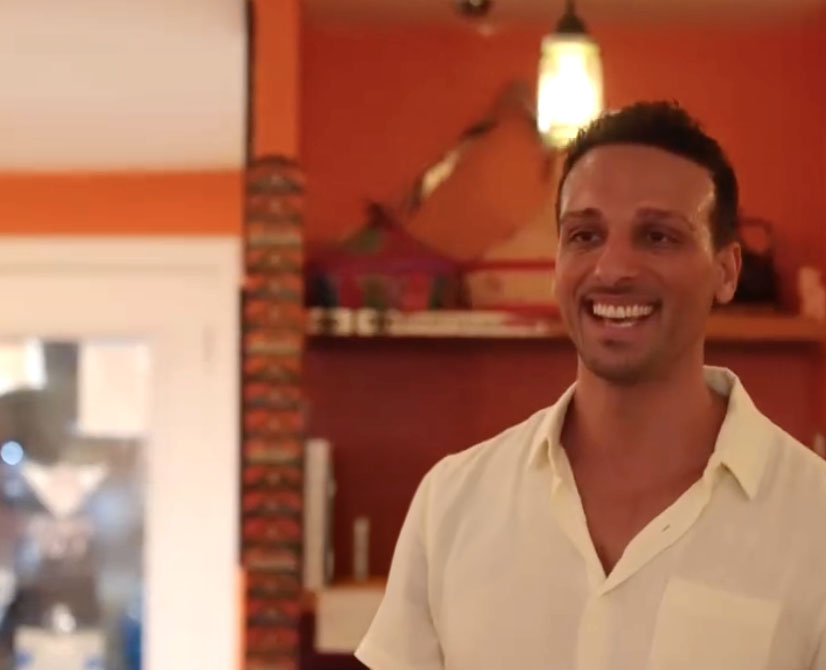
Not long ago, I watched Ari’el Stachel alone on stage—alone in the fullest sense. In “Other,” his one-man show, he inhabits scores of characters while wrestling with a life spent moving between worlds: a Yemeni Jewish father, an Ashkenazi mother, and a self that could pass as Jewish, Arab, Middle Eastern or Black depending on who is looking. He could be from anywhere but is seemingly rooted nowhere. The play is a portrait of what it costs to carry that contradiction and eventually accept one’s unique identity.
I remember sitting in the audience, watching him bear that weight in the dark. Recently, I came across something different: social media footage of a Shabbat dinner with Stachel from an evening in Harlem. Plates moving from hand to hand. Someone leaning in to explain a dish. Someone laughing a little too loudly, the way people do when they’ve just met but already feel at ease. Music in the background, not overpowering but present. A rhythm. A pulse.
And then a blessing begins. Voices gather.
This time, Stachel is not alone. He is at the head of the table and at the center of the room.
At Tsion Cafe in Harlem, he helped convene the inaugural Taaim Diaspora Shabbat, an Ethiopian and Yemeni immersive dinner that brought together food, ritual, storytelling, music and conversation. He was joined by Beejhy Barhany, the celebrated Ethiopian-Israeli chef and founder of Tsion Cafe, and Dr. Ephraim Isaac, one of the world’s foremost scholars of Semitic studies. Isaac was born to an Ethiopian Beta Jewish mother and a Yemeni Jewish father, and was the first professor in Harvard’s Department of African and Afro-American Studies; he is President-Emeritus of the Yemenite Jewish Federation of America. Isaac’s presence was not incidental. He is, in a single person, the living history that the evening was built to honor.
Barhany lights the candles and leads Hadlakat Nerot, the room quieting around her. Dr. Isaac, draped in a tallit, chants Kiddush, then Hamotzi over the dabo-Ethiopian celebration bread. Stachel performs. Live music fills the room. Strangers get up and dance. There is storytelling. There are performances, prayer, and live music along with a three-course meal that unfolds slowly, deliberately. And above all, there is something increasingly rare: people fully present with one another.
It would be easy to call this a cultural event. It would be more accurate to call it something far more important. I’ve spent years studying what builds community and what quietly erodes it. What is happening here is not programming. It is formation.
That formation is happening against a difficult backdrop. Tsion Cafe no longer operates as a conventional restaurant. Earlier this year, Barhany closed the dining room after sustained antisemitic harassment: death threats, harassing phone calls, a swastika scrawled on the front of the building. Her response was not to retreat but to pivot to immersive cultural events: no walk-ins, only intentional gatherings. The space that hatred tried to silence became something arguably more powerful.
That choice deserves to be named for what it is. Barhany, author of the acclaimed cookbook “Gursha: Timeless Recipes for Modern Kitchens from Ethiopia, Israel, Harlem and Beyond,” and founder of the Beta Israel of North America Cultural Foundation, did not simply survive the harassment. She answered it with a table. The Taaim Diaspora Shabbat is not despite what happened. It is the answer to it.
At a moment when so much of Jewish life, especially among younger generations, has drifted toward abstraction, Stachel, Barhany and Isaac are doing something quietly radical. They are rebuilding community not through messaging or institutional programming, but through shared practice. Not through scale, but through intimacy. Not through ideology, but through experience.
They are rebuilding community not through messaging or institutional programming, but through shared practice.
And it’s working.
The debut dinner sold out. Within days, three more dates were added—April 10, 17, and 24—each with limited seats. One guest wrote publicly afterward: “Hope to attend more Shabbat dinners with you all.” Another called it “one of the most special nights I’ve had in NYC.” A third, who missed the sold-out event, wrote of “spreading history and love of the Jewish people in all of its diverse beauty.” In an age of endless options and fleeting attention, the desire to return is everything.
What makes these gatherings especially compelling is not just that they bring people together, but how they do it. They are not generic Shabbat dinners. They are rooted in particular Ethiopian and Yemeni Jewish traditions, histories and textures. In a Jewish communal landscape that often defaults to a flattened, universal identity, this specificity is powerful. It reminds participants that Jewish life is not abstract or interchangeable, but lived, embodied, and richly diverse.
At the same time, nothing feels forced or didactic. There are no panels. No lectures. No institutional messaging layered over the experience. Instead, there is food to share, rituals to participate in, stories to hear, music to feel.
We have spent years trying to explain Jewish identity. Some of us have forgotten how to live it, but this is what it looks like when identity is lived.
You can see it in the room in the way people linger after the meal ends. In conversations that stretch longer than expected. In the ease with which strangers become something closer to friends. In the quiet confidence of ritual—the lighting of candles, blessings spoken, bread passed—offering structure without pressure, meaning without explanation.
Sociologists have long understood this dynamic. Ritual creates solidarity. Repeated, shared experiences generate belonging not as an idea, but as a felt reality. Judaism has always understood this too: We remember not through arguments, but through rituals repeated around a table.
In “Other,” Stachel leaves us with a sense of struggle that does not resolve cleanly—identity carried as tension, endured rather than settled. It is the right frame for the stage: identity as something you carry alone, in the dark, against a force that will not let you go. What he is building now, alongside a chef who refused to be driven out and a scholar who has spent a lifetime building bridges between worlds, is something different. Not a struggle, but a gathering. A space where identity does not need to be explained or defended, only practiced, shared, and experienced together.
The future of Jewish life will not be built primarily through better messaging, but through better experiences. It won’t be sustained through broader platforms, but through stronger tables. And it won’t be enriched simply by telling people they belong, but by creating spaces where they feel it and want to return.
That work cannot be mass-produced. It depends on hosts, on care, and on intentionality. In this case, it depends on an artist, a chef and a scholar, each of whom are, in their own way, a bridge.
Not long ago, I watched Ari’el Stachel alone on stage, trying to make sense of identity in a fractured world. Now I see him doing something more enduring: setting a table where identity does not need to be explained, only lived. And it begins, as it always has, with people sitting close enough to pass the bread to one another—in this case, malawach: a flaky, layered Yemenite Jewish flatbread, served with honey.
Samuel J. Abrams is a professor of politics at Sarah Lawrence College, a senior fellow at the American Enterprise Institute and a scholar with the Sutherland Institute.