

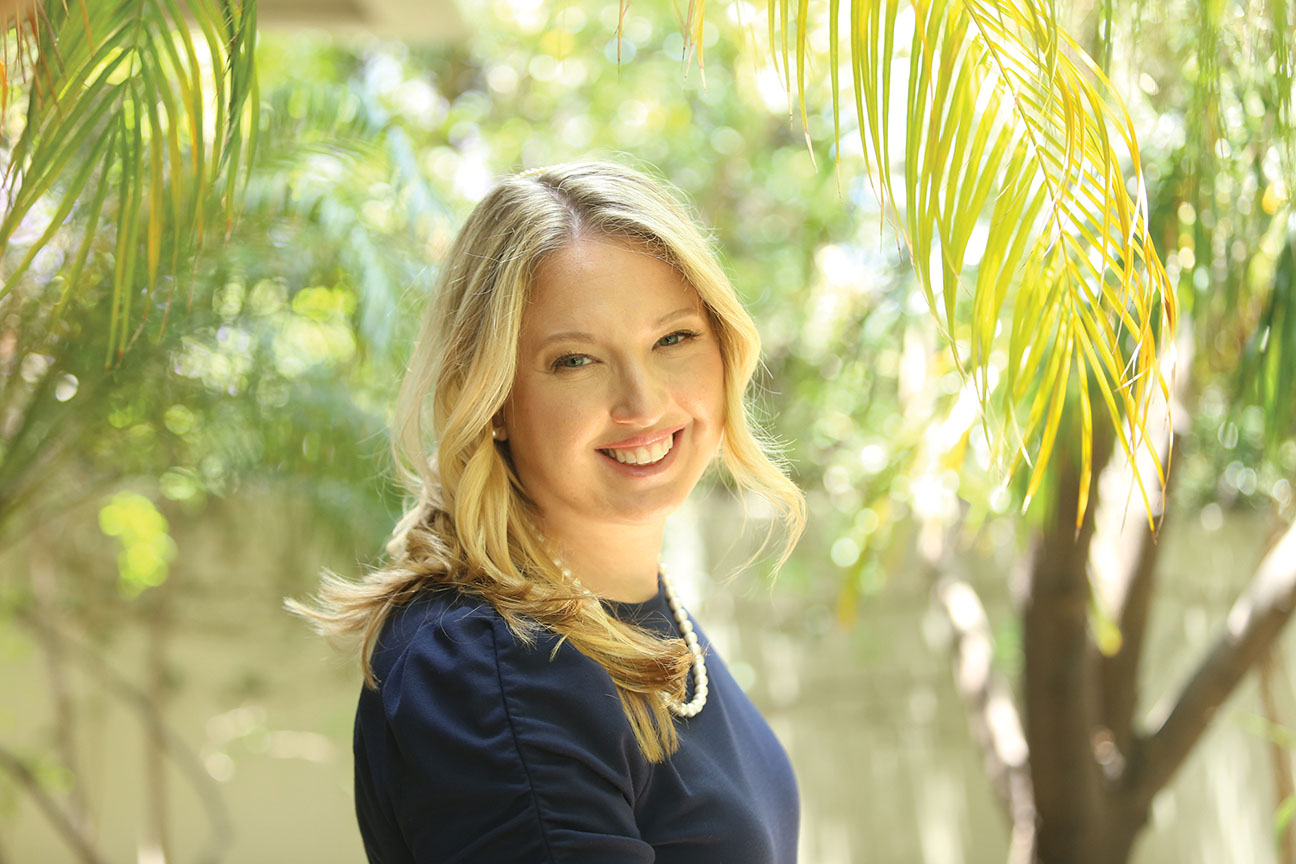
Ten years ago, Nicole Guzik, who shares the title of Senior Rabbi of Sinai Temple with her husband, Rabbi Erez Sherman, decided she needed to pursue something that was distinctly her own. Five years later, as an associate marriage and family therapist, she launched the Sinai Temple Mental Health Center to address the mental and emotional health of the Sinai community and beyond.
She became interested in becoming a therapist because she was “meeting with all different kinds of people at various stages in their lives. I felt I could be giving more to my congregants. The conversations would go well. They were helpful to a point, whether the people I was seeing were going through marital struggles or some kind of issue with anxiety or maybe reaching the next stage in life. But I was looking for insight.”
She gained the trust of congregants. More people were coming to her and baring their souls But even after 10 years of seeing clients at the Conservative temple, she was still “looking for the right questions to ask.” She needed a map.
Ambitious, curious, sometimes frustrated, Rabbi Guzik concluded that “if I wanted to dig deeper, perhaps the way to do that would be to get a degree in mental health.” So she sat down with the wisest and most respected mind at Sinai Temple, the former senior rabbi David Wolpe, whose office she now occupies. “I remember telling him ‘I think there is more to my academic career. … What do you think of my going back to school and getting my Master’s in marriage and family therapy?’” His response was unsurprising. “Of course you can,” he said. “What are you waiting for?”
One thing she noticed is that many of her clients would tell her, “Rabbi, I came to you first before going to a therapist.” She asked herself “why they had such trust and confidence” in her. The reason, she soon realized, is that “there is a sense of familiarity in walking through the doors of a synagogue. That is what research shows us: Before seeing a clinician, most people walk through the doors of their faith institution first.”
While she thought she was doing a good job, she “knew I could be doing more if someone were coming to me – I could be both rabbi and not necessarily their personal therapist – but I would be able to ask the right questions and get that person to the therapist they potentially needed.”
Her course chosen, Rabbi Guzik soon found an outlet where she could get all classes online. “I didn’t want to take anything away from my responsibilities here [at the synagogue],” she said. “It was fantastic! Online was fantastic for me because I am a book person. I was happy with my book. I was happy with writing essays at night. At the time she was the mother to little kids (her oldest is now 14). “I’d put them to bed and just sit on the couch and write, which worked out. Being in school all day, I loved it.”
She was a year into her studies when COVID hit. Seeing a way to make an opportunity out of a crisis, she asked, “Who knew that we would need a mental health center? And I would need my degree more than ever?”
Being already online, transition felt “seamless for me because my school already was online. And then my practicum – I again worked online with the Maple Counseling Center, Beverly Hills, a sliding scale mental health center people should know about. They will see anyone in California. Some clients can pay a dollar. Some can pay $100. They meet you where you are.” During her time there, she didn’t believe people knew she was a rabbi since she was behind the screen. “As a clinician there,” she said, “I gained a lot of experience from that internship.”
Talk about a working mother! During her internship, she still was working fulltime at Sinai. Mondays are her day off, depending on what’s happening on a Monday.
“The timeline kind of worked out,” Rabbi Guzik said. “Practicum [at Maple]is about 20 hours a week, which is a lot, but I would do the majority of my work on Mondays. I have a very, very supportive family.”
Jewish Journal: What is your favorite Shabbos moment?
Rabbi Guzik.: At about 4:30 every Shabbat I wake up after taking a nap, and I just know I am going to spend time with my family [children 14, 12 and 10], whether Legos or swimming or a walk — 4:30 is family time.
J.J.: Do you have an unrealized goal?
R.G.: I have two for the summer. One is to finish my license as a Marriage and Family Therapy clinician, and I am putting together a book based on [her “A Bisl Torah”] series in The Journal – 365 days of ethical living.
J.J.: Best book you ever have read?
R.G.: Let’s say impactful. That would be – with every student who is interested in Judaism or an introduction to Judaism, I always, always reference Joseph Telushkin.