
Days after Hebrew Union College graduated its final rabbinical class in Cincinnati, a new Jewish seminary has its eyes on the school’s campus — and wants the state of Ohio to bestow the prize on them.
The College for Contemporary Judaism, which aims to become a new home for liberal rabbinical students in the Midwest, on Thursday added its voice to a lawsuit against HUC brought by Ohio Attorney General Dave Yost. The state’s suit claims that HUC, the Reform rabbinical school, violated state nonprofit law and misled its donors by shuttering its historic Cincinnati campus this year.
In its motion to intervene, the new college argues that it should be the rightful steward of HUC’s campus, as well as all other Cincinnati assets of the Reform movement mainstay. They include the Klau Library, the American Jewish Archives, the Skirball Museum and hundreds of millions of dollars given by donors who believed HUC would “permanently” remain in the city.
“The Attorney General has appropriately stepped forward to enforce the charitable trust obligations that bind those assets to the State of Ohio and their underlying charitable mission,” CCJ argues in its brief.
Now, the new college argued, the court “has before it a concrete, mission-aligned Ohio candidate capable of carrying forward the very charitable purpose at issue,” referring to CCJ.
A representative for HUC said the school “is responding to the Ohio attorney general’s unwarranted lawsuit and will respond appropriately to any additional filings.” A representative for Yost declined to comment, citing pending litigation.
HUC has previously criticized the state’s lawsuit against them and is fighting the state to retain its assets. The school’s president, Andrew Rehfeld, has said the allegations “mischaracterize our decision-making, misrepresent our stewardship of donor funds and ignore our sustained record of transparency and good faith.”
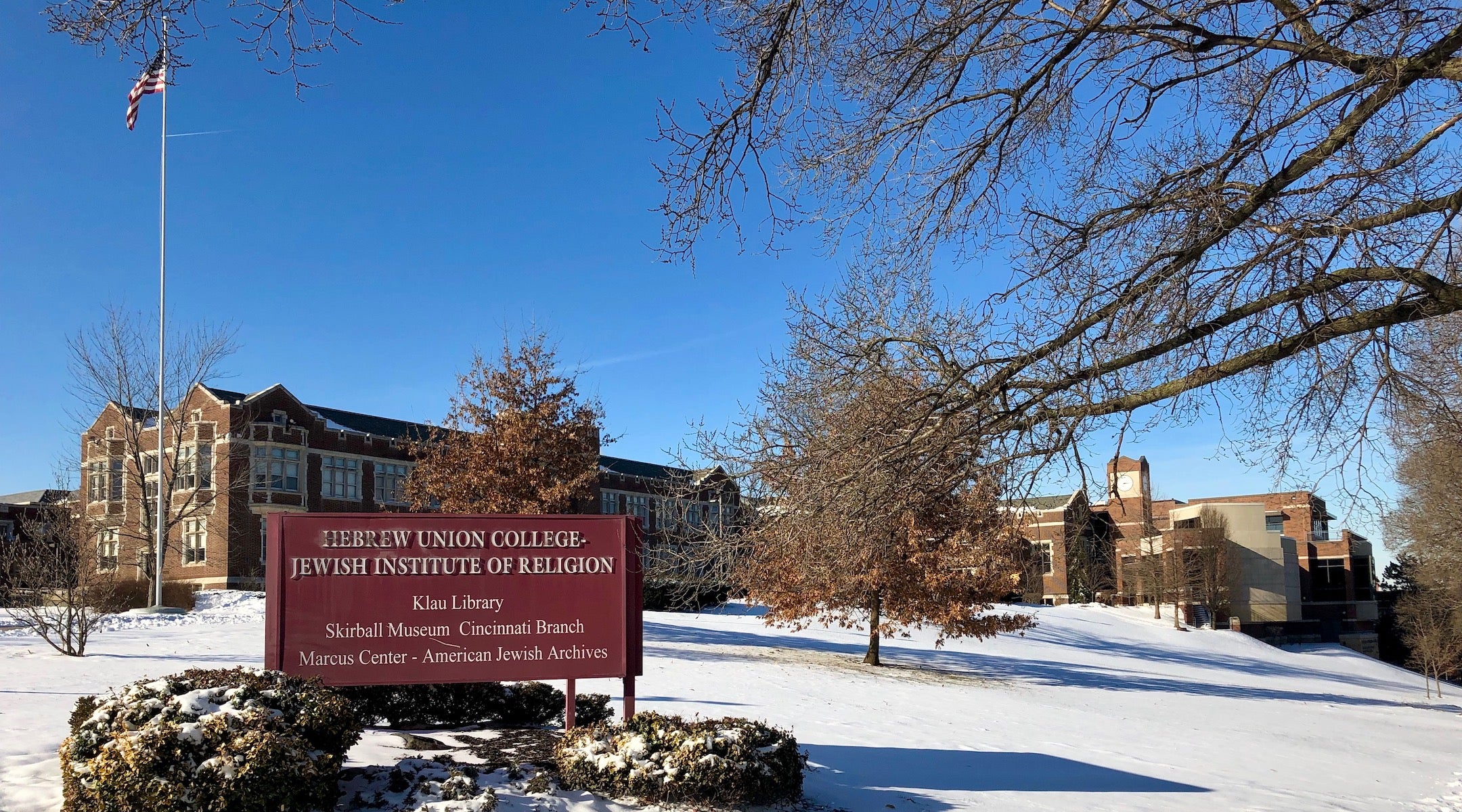
The Jacob Rader Marcus Center of the American Jewish Archives at Hebrew Union College in Cincinnati, Ohio, January 21, 2019. (Warren LeMay via Creative Commons)
The College for Contemporary Judaism’s request is unusual for an institution that, for now, exists in name only. The CCJ, formally founded in 2022 in response to HUC’s closure, has no permanent home and has yet to enroll any students. It also lacks a set timeline for when its first class would start. HUC, meanwhile, with campuses in New York, Los Angeles and Jerusalem, has been the Reform movement’s foremost seminary since its founding in Cincinnati in 1875 by Rabbi Isaac Mayer Wise.
CCJ’s founders, most of whom have deep associations with HUC, argue they are better positioned than any other party to carry on the mission of ordaining liberal rabbis in the Midwest. It’s a cause they say HUC is abandoning, in violation of its own charter language promising to “permanently maintain” a campus in Cincinnati — the same language AG Yost is drawing on in the state’s suit against the college.
“We are stepping forward and saying, ‘We are willing to undertake this role,’” Andrew Berger, a founder and board chair of CCJ, told (JEWISH REVIEW). Berger added that the state AG’s office was “aware of us.”
Berger is a former HUC board chair, while CCJ’s founding president, Rabbi Gary Zola, is the former longtime executive director of HUC’s archives. The school’s honorary president, Rabbi Sally Priesand, was ordained at HUC as the first woman rabbi in the United States.
Such deep connections to HUC make their participation in a lawsuit against the seminary “very difficult,” Berger said. He said the school had angered many when it pulled out of Cincinnati, which he argued was “a completely unnecessary decision.” (HUC has cited financial struggles, while its opponents argue that the move didn’t result in major cost savings.)
Critics of the move have also accused HUC of abandoning Jews in the Midwest, South and Mountain West, regions where its Cincinnati graduates would often find work. The school also sparked blowback, and earlier attention from AG Yost, by proposing a sell-off of some of its rare books.
Other graduates and staff have argued the move makes sense as the school focuses on its New York and Los Angeles campuses, which were established in the 1950s and ’60s following the college’s merger with the Jewish Institute of Religion. Prior to the closure decision, HUC said enrollment at the Cincinnati campus was falling far faster than at the L.A. and New York campuses, reflecting the preference of students to live and study at its coastal locations.
This month, four rabbis were ordained at the Cincinnati campus, and six students received their doctoral or master’s degrees, according to HUC. Nineteen rabbis and cantors were ordained in New York, and six rabbis were ordained in Los Angeles.

Ohio Attorney General Dave Yost in Salem, Ohio, on Friday, March 15, 2024. (Bill Clark/CQ-Roll Call, Inc via Getty Images)
CCJ, its founders say, was formed in response to the void being left by HUC.
“There are not enough rabbis being ordained today,” Berger said. “With all the rabbinical seminaries now being on the coasts, I very much fear for Jewish life in the middle of the country. It’s always been a little difficult to recruit rabbis to the middle of the country, but it’s going to be so much harder without a seminary here.”
To make its argument for HUC’s assets, CCJ is drawing on a legal term known as “cy pres,” which permits charitable assets reclaimed by a court to be redistributed to a different nonprofit with a similar mission. Yost’s lawsuit, which he filed last month, asks the court to redistribute ownership of HUC’s campus and other assets to a different, unspecified “permanent” rabbinical seminary in Cincinnati.
CCJ, which bills itself as a nondenominational “school for Liberal Judaism,” wants to be that home. Its ordination procedures will be administered by the school itself, rather than any particular movement.
Though Berger said the school has not yet held direct conversations with movement leaders, he noted that, due to a general shortage of clergy, many liberal congregations today are hiring rabbis with nontraditional ordinations.
While HUC leaders sometimes spoke of their struggles to fill Cincinnati’s classrooms, CCJ is confident they can recruit their own student body.
“We’ve been approached by a number of prospective students who have said to us, ‘We would love to come to your school,’” Berger said.
Reporting the stories that define our era. When history unfolds in real-time, the Jewish world turns to (JEWISH REVIEW). Your support ensures we can document the complexities of war and the resilience of Jewish communities with integrity.