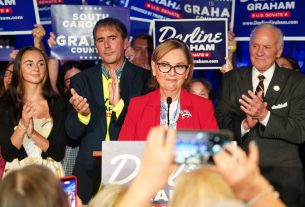

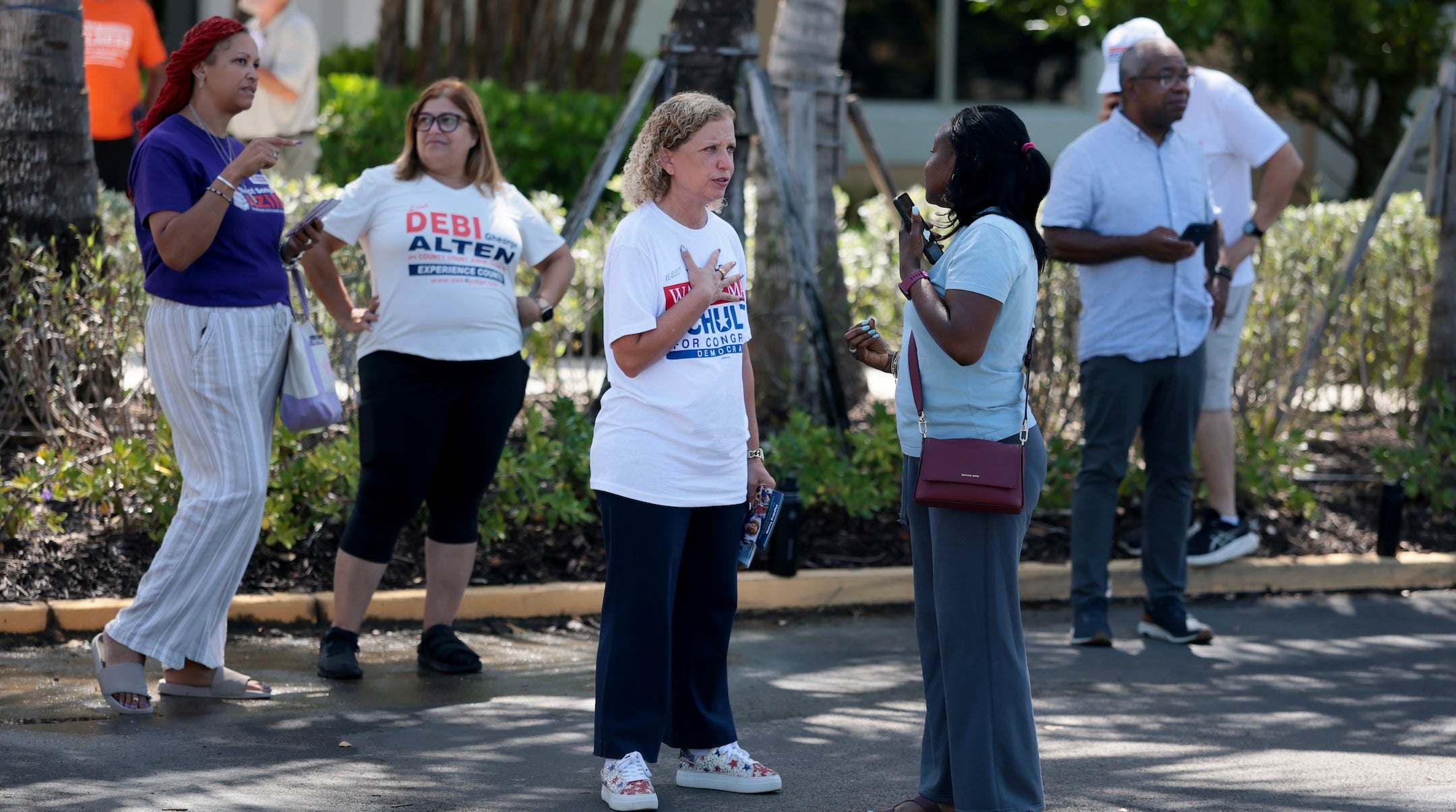
Rep. Debbie Wasserman Schultz, a veteran Southeast Florida Democrat, defeated her opponents in Tuesday’s primary race that took place in unfamiliar territory, following a statewide rewrite of electoral battle lines.
The Associated Press called the race just minutes after polls closed, at 7:24pm, when Wasserman Schultz secured 50.5% of the votes, with 67% of votes counted. The candidate viewed as her top challenger, Elijah Manley, had amassed just 12.8% of the votes, while Dale V.C. Holness had gotten 21.1%.
“The people that we spoke to all across this district understand that I’m going to fight to make sure that they can pay their rent,” Wasserman Schultz said in an emotional victory speech on Tuesday. “We’re going to make sure we fight those damn Republicans.”
Wasserman Schultz, who will be seeking a 12th term in November, had long been representing Fort Lauderdale and southern Broward County. But earlier this year, Gov. Ron DesSantis urged state legislators to redraw the congressional map, in line with a Trump administration push to reshape voting boundaries in GOP-led states. Florida’s answer was to consolidate Democratic districts and minimize the number of blue seats.
The redistricting means that Wasserman Schultz’s current region, the 25th District, would stretch from Miami Beach to Delray Beach and likely turn red, according to Ballotpedia.
Wasserman Schultz therefore chose to run in a redrawn 20th District, a reliably blue region that includes most of Broward County’s Black-majority precincts. But her move sparked considerable discomfort in a region that has sent Black Democrats to Congress since 1992, according to the Associated Press.
“The most important thing I can say is that I can commit to the people of District 20 to work every day to live up to the legacy of Alcee Hastings,” Wasserman Schultz said on Tuesday, referring to the Black congressman who served the 20th District from 2013 until his death in 2021.
Ahead of the primary, Luis Fleischman, a professor of sociology at Palm Beach State College, had warned that Wasserman Schultz’s entrance into this district “creates tensions between Wasserman Schultz and parts of the constituency.”
Though Wasserman Schultz faced four rivals, all of whom are Black, her main competition was Elijah Manley, a 27-year-old gay activist who said that he converted to Judaism but has also been a fierce critic of Israel. While Manley has described himself as a Democratic socialist, he is not a member of the Democratic Socialists of America.
Stephen Sussman, a professor of public administration at Barry University, had said prior to the primary that Wasserman Schultz could benefit from having multiple opponents, as these candidates could split the vote.
“The reality of it is that all she needs is a plurality,” Sussman added, noting that Florida primaries don’t require a majority winner.
Though Wasserman Schultz has been serving Southeast Florida for more than two decades, both the political landscape and her views have shifted. When she took office as Florida’s first Jewish congresswoman in 2005, she represented what the Forward described as “a heavily Jewish swath of Broward County.” She advocated for Israeli-Palestinian peace, diverging from her hawkish predecessor, Peter Deutsch.
Wasserman Schultz today lists Israel among her legislative priorities, with an emphasis on “the threat of antisemitism at home and abroad.” She has stressed the Jewish state’s right to defend itself while also expressing continued support for a two-state solution.
Manley, her main opponent, spent considerable airtime on the campaign trail criticizing both her support of Israel and the financial backing she has received from American Israel Public Affairs Committee.
In a recent social media post, he called her “a key Netanyahu ally” who has accepted “more pro-Israel PAC money than anyone else in Florida.” He made these claims after the House Democratic Caucus appointed her to the Foreign Affairs Committee, where she vowed to “fight Trump’s self-serving, America-last foreign policy.”
Pro-Israel PACs have spent around $1.5 million on Wasserman Schultz over the course of her career, according to Track AIPAC, which uses Federal Election Commission data to document contributions from Israel-linked special interests groups. FEC filings from the current race link at least $250,000 to AIPAC. A lump sum of $250,000 came from Pro-Choice Majority Action, an affiliate of the Elect Democratic Women Action Fund, whose biggest funder is the United Democracy Project, AIPAC’s super PAC.
Wasserman Schultz, meanwhile, told (JEWISH REVIEW) in a statement that Israel and AIPAC haven’t typically come up “in the thousands of conversations” she’s had on the campaign trail. When constituents bring up foreign affairs, she said they tend to focus on fears that the Trump administration could “force their family and friends to be deported back to brutal homelands plagued by lawless violence and oppressive poverty.”
“Voters here always ask how I’ll help lower gas, grocery and healthcare costs, and stop Trump’s rampant cruelty and corruption,” she added.
Reporting the stories that define our era. When history unfolds in real-time, the Jewish world turns to (JEWISH REVIEW). Your support ensures we can document the complexities of war and the resilience of Jewish communities with integrity.