

Antipathy for Israel alongside objections to the Iran war were among the causes of the Republican losses in the Nov. 3 midterm elections, U.S. President Donald Trump told CBS’s “60 Minutes” during an interview aired on Sunday.
“They didn’t like the war. They didn’t like the fact that gasoline went up, ’cause I had it down at a low, and there’s – a great dislike, incredibly, for Israel,” Trump said.
His words echoed those of Vice President JD Vance, who wrote on X on Nov. 4 that his four takeaways from the election results included the need to end the Iran war and change the U.S. relationship with Israel.
Vance’s words sparked an uproar among Jewish Republicans and Israel supporters, with Jonathan Greenberg, director for combatting antisemitism at Defending Education and a former staffer for the American Israel Public Affairs Committee, telling (JEWISH REVIEW) they were “nonsense.”
When asked by “60 Minutes” host Ross Douthat if he agreed with Vance’s post on X with regard to Israel and the Iran war, Trump said, “I don’t disagree with it,” adding that he had told Vance to “write what you feel.”
Douthat pressed Trump further, asking if he regretted his decision to help Israel with its “decapitation strikes on Iran,” a question that referred to the assassination of Iranian Supreme Leader Ali Khamenei on Feb. 28, 2026.
Trump didn’t directly answer that question, but at a different point in the interview he doubled down on his decision to launch a military campaign against Iran, an act that included joint Israeli-U.S. strikes against its nuclear facilities in an attempt to prevent the Islamic Republic from developing nuclear weapons.
“You can’t let Iran have a nuclear weapon. I think, historically, this will be a very good decision. Is it a good decision for today and tomorrow? Maybe not. But you know, I have to go with what’s right for our country. If they had a nuclear weapon during my term, I would be excoriated far worse than what’s happened,” Trump said.
He claimed that countries the U.S. has protected would pay back the costs of the war.
“Those countries that we’ve protected are going to pay us back any and all costs that we’ve had for the war, because without us, they wouldn’t exist.” Then he specifically spoke about Israel, stating, “Without us, Israel would not exist. Let me tell you.”
He has made similar remarks in the past, saying that without the United States – and specifically his leadership – Israel would be in existential danger, and he repeated it throughout the interview.
In referencing the previous joint U.S.-Israeli attack on Iran’s nuclear facilities in June 2025, he said, “Israel would not exist except for Donald Trump because we went in with those beautiful B2 Bombers more than a year ago, and we hit the three sites at – at the time.” Israel and the United States then joined in a war against Iran from February to April this year, and all sides have said it may resume.
The Israeli public has supported attacks on Iran, a country aimed at its destruction. Israel has been at war with Iranian proxy groups for over three years and intermittently with the Islamic Republic itself.
But the American public has increasingly disapproved of the U.S. strikes on Iran, which caused gas prices to rise after Iran restricted and, at times, closed the Strait of Hormuz, through which 20% of the world’s oil flowed prior to this year’s Iran war.
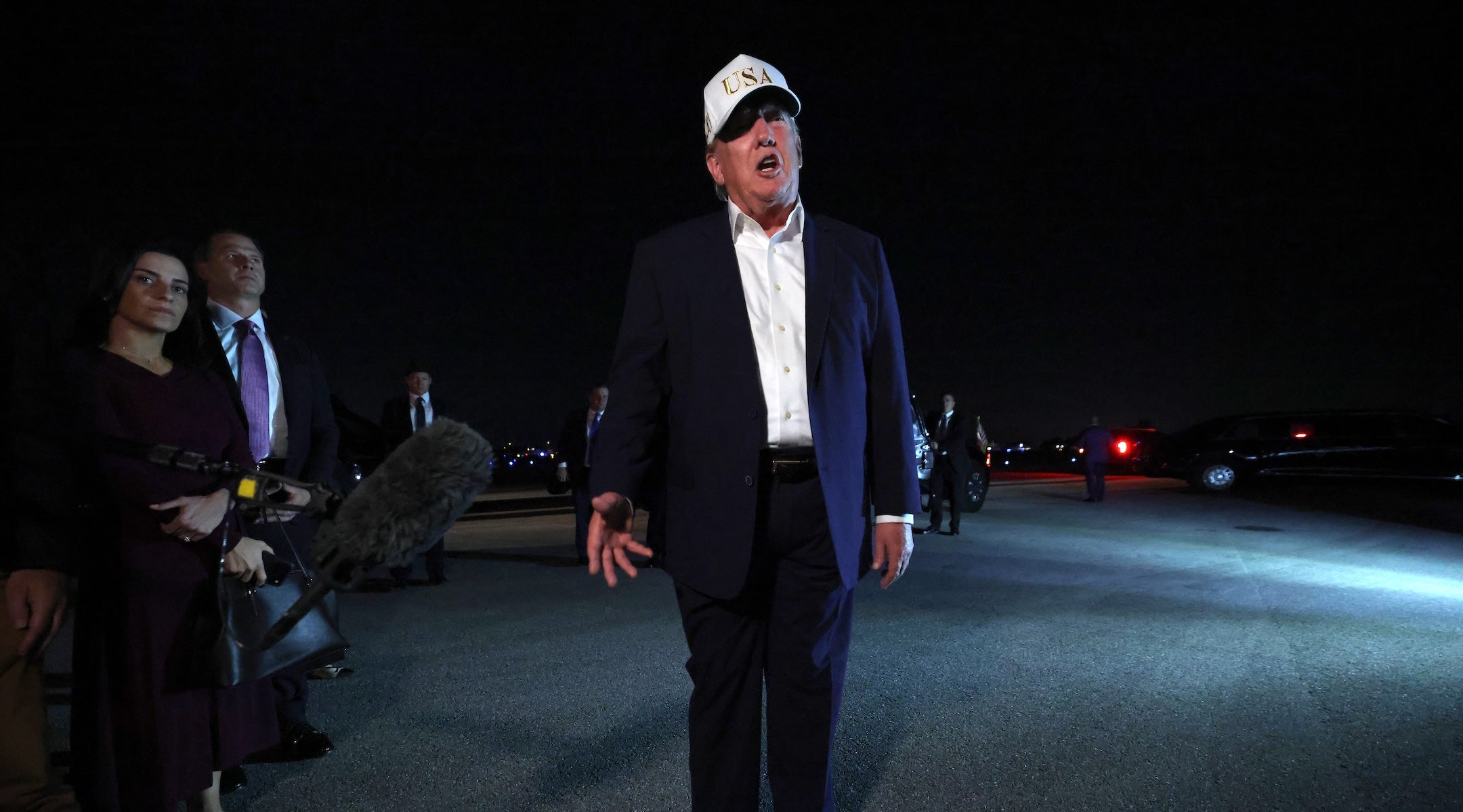
Speaking to reporters on Sunday night in Florida before boarding Air Force One to return to Washington, Trump again defended the Iran war, explaining that it saved the Middle East and Israel, and the world as a whole. If he had to do it again, he said, he would, because if Iran had a nuclear weapon “it would blow up the whole world. You know why, because they are crazy.”
Trump was also asked about Israeli President Isaac Herzog’s decision to give the mandate to for a government to the head of the Yashar party, former IDF chief of staff Gadi Eisenkot. If successful, Eisenkot would replace Benjamin Netanyahu as prime minister.
Trump said that both men were similar in terms of their policies and views, stating, “They are both strong on what I do.”
On Eisenkot, Trump said that the Yashar politician had said “very nice things about me. He says he loves Trump.”
A Season of Big Decisions. From the Knesset campaign to American midterms, Jewish communities are weighing what comes next. Help (JEWISH REVIEW) keep delivering the deeper context.


