

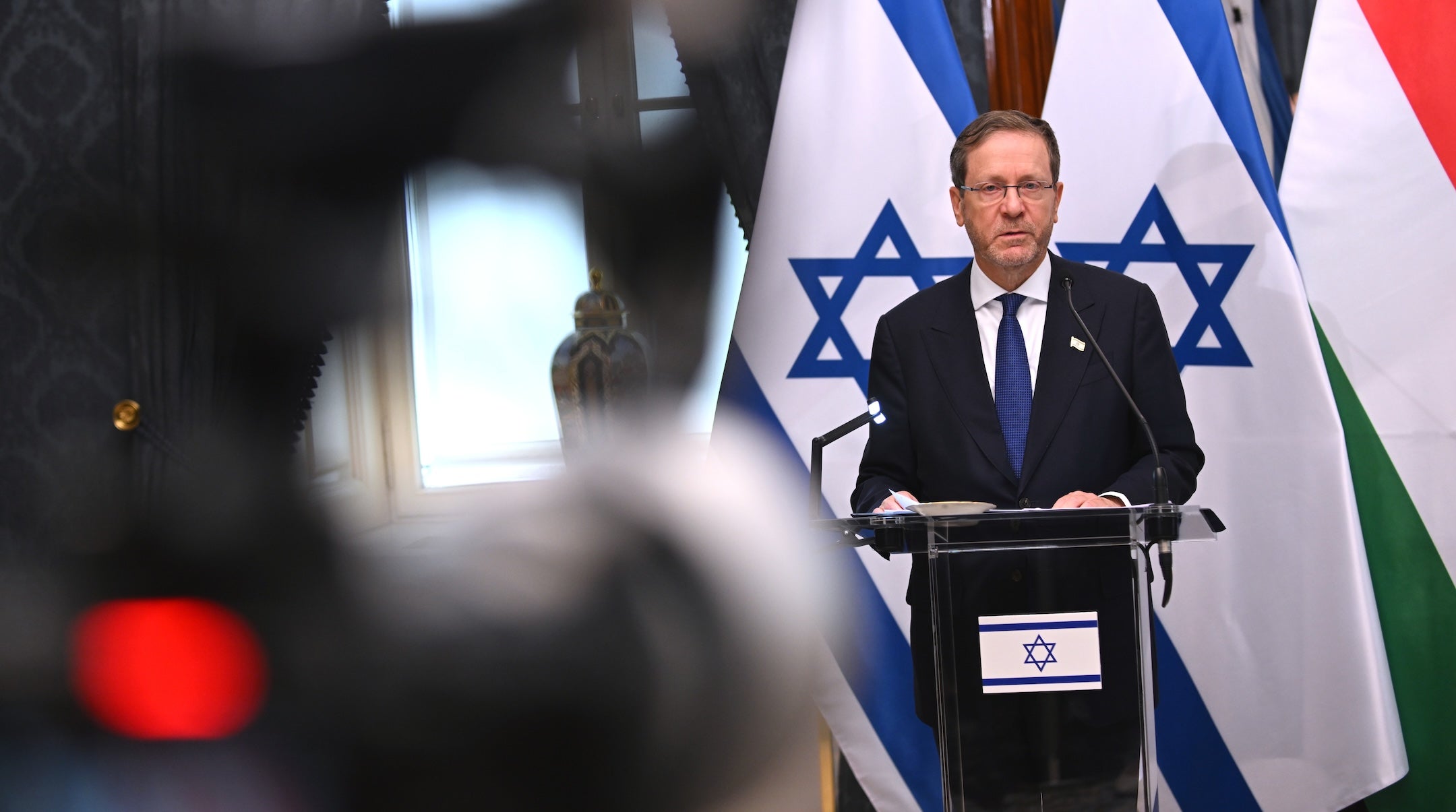
BUDAPEST, Hungary — Israeli President Isaac Herzog is backing senior Israel Defense Forces commanders in taking decisive action against violent settler attacks in the West Bank, he told the Jewish Telegraphic Agency.
His comments came a day before Israeli forces detained New York Democratic congressional candidate Brad Lander along with 90 rabbis and activists accompanying Palestinian farmers during the olive harvest.
At a press briefing in Budapest, (JEWISH REVIEW) asked Herzog what action had been taken to curb settler violence following his previous calls for a stronger government response. Herzog pointed to a meeting he held earlier this month with the IDF’s West Bank division commander and other senior officers.
“I looked them in the eye and I gave them full backing to do whatever it takes to stop this terrible phenomenon,” he said.
The goal was to end the settler violence “at its roots,” Herzog said, adding that “major efforts” were underway.
Israeli police arrested 10 suspects following a series of settler attacks over the weekend, including a violent assault on Washington Post photojournalist Heidi Levine. Nine of those suspects were released from custody, Haaretz reported on Wednesday.
IDF Chief of Staff Lt. Gen. Eyal Zamir ordered the deployment of an additional Border Police company to the West Bank to combat extremist violence. The unit is expected to begin operations in late November.
Herzog had personally called Levine on Saturday to apologize for the attack, which left her with four broken vertebrae and other injuries. “I was morally tormented during Shabbat when I thought about it, and I express deep sorrow and apologize for what you went through,” he told her.
The attacks have drawn condemnation from the U.S. and European governments. On Sunday, the European Union called for Israel to take “full accountability” in preventing further violence against Palestinians, journalists and diplomats.
During his visit Tuesday, Herzog met with Hungarian President András Baka and Prime Minister Péter Magyar, whose government ended its predecessor’s opposition to EU sanctions against extremist Israeli settlers.
Herzog’s visit was the first by a senior Israeli leader since Magyar defeated longtime Prime Minister Viktor Orbán, a close ally of Israel and Prime Minister Benjamin Netanyahu, in April. At a joint appearance, Baka described relations with Israel as “cordial and stable,” while Herzog called Hungary a “friend and an ally.”
Asked later at the press briefing whether he had received a cooler reception than under Orbán, Herzog dismissed the suggestion, describing his meetings with both leaders as “fantastic.”
Pressed on Baka’s reference to the Palestinians, Herzog said the issue had been discussed “very politely” but had not dominated the talks, adding that it was “a perfectly legitimate subject to discuss.”
Herzog called the new prime minister “a brilliant person, a very impressive leader.”
The Hungarian leaders had “opened their hearts” to him, Herzog said, citing the attendance of several senior ministers at a lunch hosted by Magyar among other gestures that he said went beyond diplomatic protocol.
The visit also had personal significance for Herzog, whose father, former Israeli President Chaim Herzog, made the first state visit to Hungary by a sitting Israeli president in 1991, shortly after the restoration of diplomatic relations between the countries.
Herzog also addressed the closing gathering of Voice of the People, his initiative bringing together 150 Jews from Israel and the diaspora. He warned that combating antisemitism would be a “long-range battle” and stressed the need to engage millions of unaffiliated Jews.
“Ask the average Israeli – he has no clue about the diversity of Jewish life,” Herzog said, adding that many Jews in the Diaspora were similarly unfamiliar with Jewish life in Israel.
A Season of Big Decisions. From the Knesset campaign to American midterms, Jewish communities are weighing what comes next. Help (JEWISH REVIEW) keep delivering the deeper context.


