

“The Jews could have prevented the Holocaust if they just tried hard enough.”
The words hung in the air of my eighth-grade classroom, spoken casually during a debate on human nature. My classmate didn’t say it with malice; she said it with the quiet confidence of someone who believed she had just stated a fact. I sat there, stunned, until the sickening realization hit me.
It was this book that put the idea into her head.
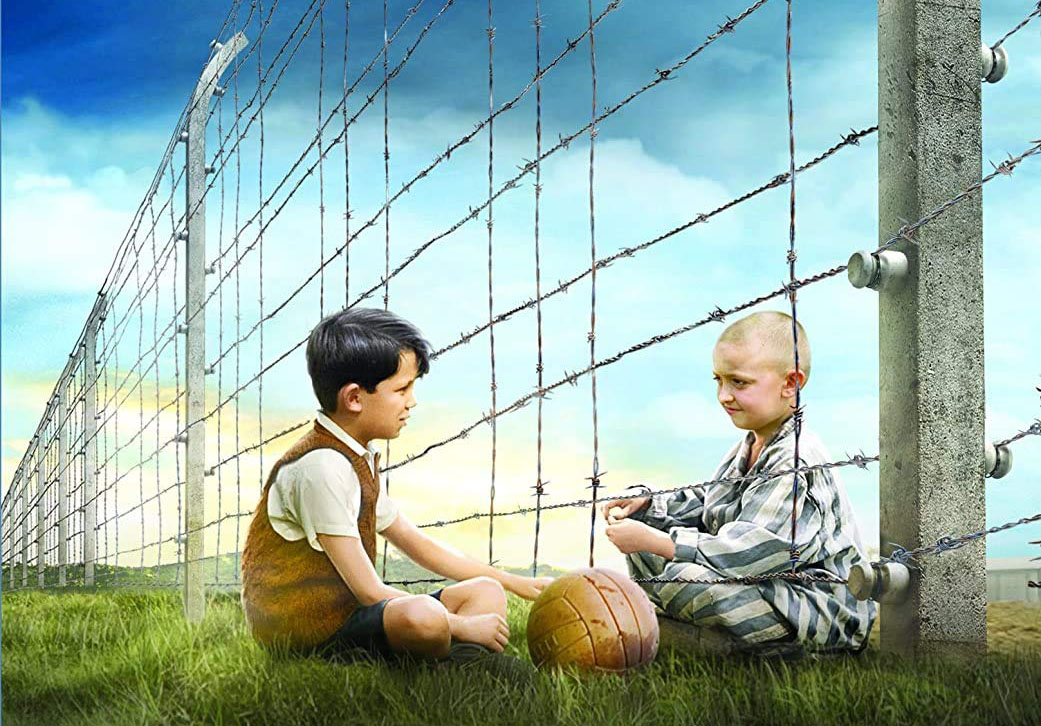
Our class had just finished reading John Boyne’s “The Boy in the Striped Pajamas.” The bestselling novel follows Bruno, the naive son of an Auschwitz commandant, who strikes up a secret friendship with Shmuel, a Jewish boy imprisoned on the other side of the camp fence. While popular culture often praises it as a touching fable, historians have long condemned it as a dangerous fabrication. Watching a classmate unknowingly victim-blame the millions who perished, I saw firsthand why the historians were right.
For my twin sister, Orly, and me, this was never just an imperfect lesson plan. As the great-granddaughters of five Holocaust survivors, our ancestors’ lived trauma was being erased by a comforting fantasy. The novel, and its sanitized film adaptation, strips Auschwitz of its brutal reality. There are no electrified wires, no roll calls in the freezing mud and no guarded death strips (the wide, cleared zone between double rows of barbed wire and guard towers where prisoners caught attempting escape were immediately shot on sight).
It erases the fate of the 200,000 children sent to Auschwitz, almost all of whom were murdered upon arrival. Instead, it creates an imaginary camp where a Jewish child sits unbothered at a porous fence line, demanding our sympathy for a Nazi commandant’s grief while reducing Shmuel’s terror to a plot device.
The text actively manipulates its readers, demanding sympathy for the perpetrators while erasing the systematic brutality faced by Jewish victims. The idea that a German commandant’s son in 1943 wouldn’t know the phrase “Heil Hitler” isn’t just historically false; it paints German citizens as innocent, oblivious bystanders rather than subjects of intense indoctrination. Worse, the book creates a magical Auschwitz where Shmuel can simply sit unbothered at a porous fence line.
Even Boyne himself admitted in an interview that the novel was never intended for classroom instruction.
We soon discovered major global organizations condemn the book. The Auschwitz-Birkenau State Museum explicitly warns against teaching it. The Melbourne Holocaust Museum called the premise of a child playing checkers through a death camp fence “frankly, perverse”. The University College London Centre for Holocaust Education found the novel actively fosters the misconception that ordinary Germans were simply brainwashed and ignorant.
Orly and I knew we couldn’t just sit through it and move on. We compiled our research into a comprehensive dossier, “The Boy in the Striped Pajamas: The Cost of Fictionalizing the Holocaust”, and, once in high school, requested a meeting with our former middle school principal.
Our request was simple: pull the book from the curriculum and replace it with historical truth.
The principal defended the text as an exercise in analyzing an “unreliable narrator.” While he offered to expand the unit, he pointed out how compressed the semester already was, suggesting teachers could correct misconceptions on the fly. But we saw the fundamental flaw in that logic: for middle schoolers in our district, this unit is their very first introduction to the Holocaust. You cannot ask thirteen-year-olds to unpack an unreliable narrator when they have no foundation of fact. Teaching a fable as an introduction all but guarantees the fiction will stick long after a teacher’s brief verbal corrections fade.
We refused to let the issue die in that office. We escalated our campaign to the Irvine Unified School District Board of Education, filing a formal curriculum challenge to replace the novel with authentic survivor accounts, like Leon Leyson’s “The Boy on the Wooden Box.”
Orly brought national attention to the issue when her essay won The New York Times Student Open Letter contest out of more than 11,000 entries. “The Boy In the Stripped Pajamas: The Cost of Fictionalizing the Holocaust.” Backed by a formal letter of support from the Anti-Defamation League, we presented our evidence directly to district officials.
A month later, we sat down for an intake meeting to map out the review process. Throughout the months that followed, IUSD treated student advocacy with real seriousness. Rather than making a quick bureaucratic dismissal, district leaders took the time to read our research, evaluate the novel firsthand, and listen to classroom teachers, community leaders, and Holocaust education scholars from UC Irvine. The Sierra Vista team worked alongside the committee throughout the review process, serving as a partner in the decision to adopt an alternative core novel. Mr. Morano displayed a change of heart and led his school in phasing out the book a full year earlier than recommended.
Then came the waiting game. We anxiously spent weeks refreshing our inboxes, wondering whether our district would lean on the comfort of a familiar bestseller or take on the necessary weight of historical truth.
On October 15th, we finally got our answer: Irvine Unified School District officially decided to remove The Boy in the Striped Pajamas as a core eighth-grade instructional text.
We are genuinely grateful to IUSD leadership and our educators for their collaboration, open ears, and commitment to academic integrity. By choosing truth over convenience, the district sent a clear message about what responsible education looks like. Officials are now actively evaluating survivor testimonies and vetted alternatives, with a permanent replacement set to be chosen this April.
For my sister and me, this victory is a promise that our ancestors’ memories, and the brutal truth of the Holocaust, will never be replaced by fiction.
Trying to hold back a global tidal wave of four-thousand-year-old hatred can leave you feeling hollowed out, an impossibly small ghost shouting against a wall of apathy. But we cannot single-handedly dismantle international media bias or resolve millennia of conflict before the final bell rings on graduation.
The victory isn’t in shattering a monolith overnight; it is in refusing to disappear. When you anchor yourself in local resilience, pushing back in your own hallways, building a single bridge across a divided quad, or simply waking up and standing unapologetically tall in your Jewish identity, you have not failed. You have transformed the world directly in front of you. Focus on the people right beside you, and then let that impact ripple outward. One classroom, one school, one community at a time. That is how real, enduring change actually happens.
Meital Kochinski is a junior at Northwood High School in Irvine, California. She is the 2026-27 StandWithUs Kenneth Leventhal High School Intern at the school, a TEDx speaker and national award-winning writer.