

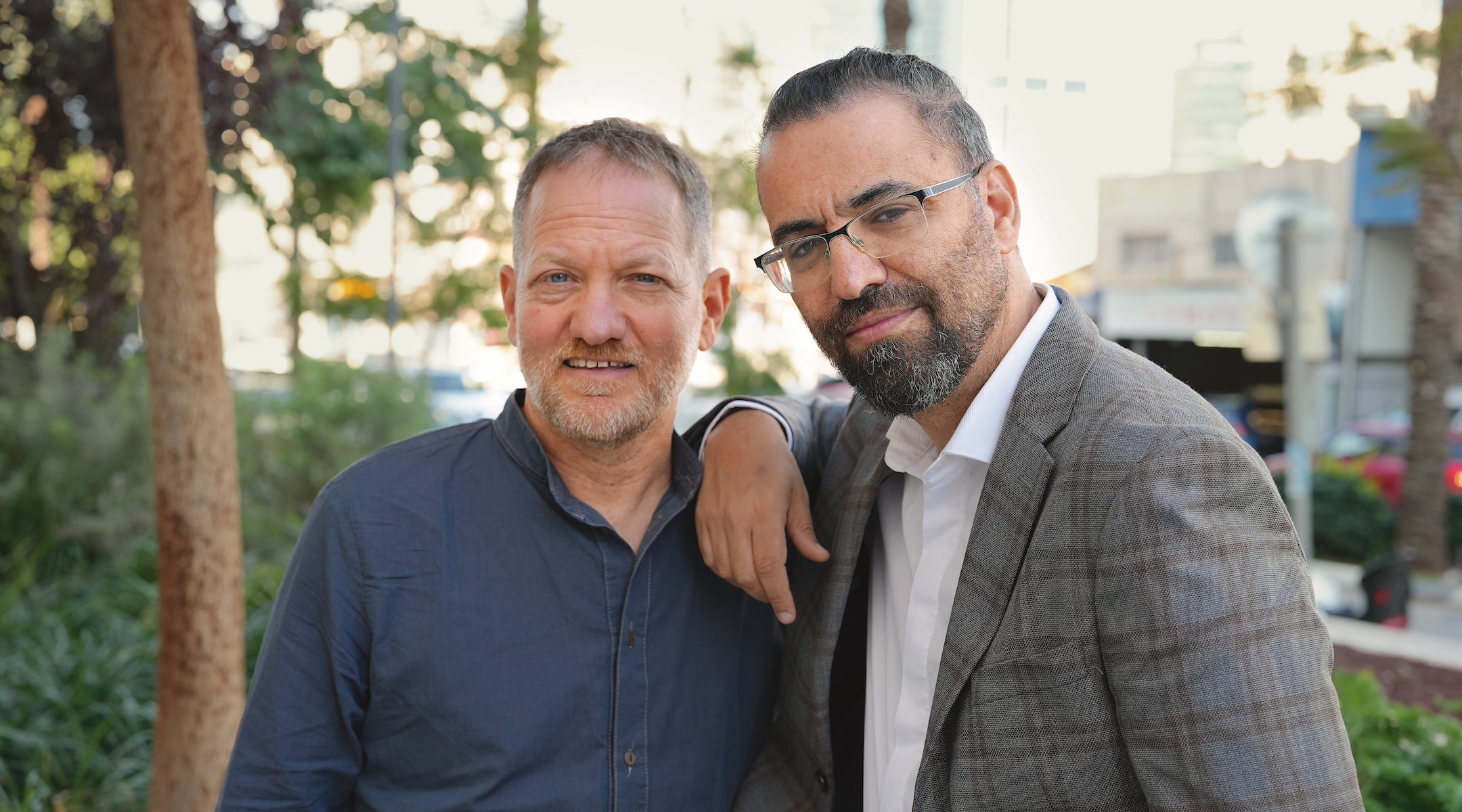
At a time when the Israeli-Palestinian conflict feels perhaps farther than ever from a solution, Aziz Abu Sarah and Maoz Inon are offering something else: a story of hope.
Inon, a Jewish Israeli, and Abu Sarah, a Palestinian Muslim, are on a media blitz for their new book, “The Future is Peace.” Inon’s kibbutznik parents were killed on Oct. 7; Abu Sarah’s brother died in 1990 after being tortured in an Israeli prison.
The two have become partners in an effort to “step down from the battlefield,” Inon told me Thursday, when I reached him and Abu Sarah as they took the train from New York to Washington for an appearance at the Sixth & I historic synagogue and cultural center. In their book, their travels and their dialogue initiative, InterAct International, they are trying to show that two people usually depicted as mortal enemies can imagine a different, better future.
On Monday, they took that message to “The Daily Show,” sitting across the desk from a clearly inspired Jon Stewart. The mood was light, even buoyant. Abu Sarah joked that he and Inon found each other on JDate, and that after the two had an audience with Pope Francis, he had to stop Inon from converting to Catholicism.
“All I want to do is hug you and talk about this beautiful book and how wonderful it is,” Stewart gushed.
Compare that to one of the last times Stewart brought on a guest to discuss Israel. When Stewart and non-Zionist journalist Peter Beinart spoke about the Gaza war last July, the segment was unrelentingly grim. The two agreed that Israel’s response to the Oct. 7 attack was “so self-evidently inhumane and horrific,” as Stewart put it. Even some liberal Jewish critics of Israel complained the segment was one-sided.
By Thursday of this week, the YouTube video of Inon and Abu Sarah’s interview had been viewed more than 300,000 times, and the comments were overwhelmingly positive.
“This is who should be running the peace talks,” read one. “Comedy doesn’t bring me to tears often, but here we are,” read another. Inon “really is the best possible ambassador for our country,” wrote an Israeli.
“I usually don’t read the comments because they are terrible, but what I read mostly [under the ‘Daily Show’ video] were things like, ‘We are desperate for these voices,’” said Inon.
What’s not to like? Quite a lot, apparently. Elsewhere, commentators on the pro-Palestinian left have accused the pair of ”false equivalence” and “normalization” by suggesting that both sides share equal blame and responsibility, and say that their “kumbaya” act obscures the Palestinians’ powerlessness under occupation. Their tour is taking them to several synagogues and Jewish institutions, but no appearances have been publicly advertised to take place in mosques or hosted by Arab groups.
On the flip side, a rabbi friend who identifies with their vision for an equitable future for Palestinians and Israelis complained to me that the book has an “anti-Israel bias” and said it blames Israel almost exclusively for the conflict.
Staunch supporters of Israel will bristle when both men refer to the Gaza war as a genocide, or when Abu Sarah keeps open the possibility for “a single state with equal rights, where any qualified Palestinian or Israeli could serve as president of prime minister.”
Inon and Abu Sarah have heard these critiques, and are unfazed. Hope dies, Abu Sarah told me, when one side or the other insists on agreement before entering into a dialogue. “For disagreements not to lead to violence, we need to agree on values,” he said. “We both agreed on universal values: equality, justice, dignity, recognition of each other. When we ask how we deal with disagreement based on those values, it is much easier than you can imagine.”
There was little disagreement on display at a book event held Monday night by New Jewish Narrative, the liberal Zionist organization. Dozens of people crowded into the Upper West Side apartment of feminist author and activist Letty Cottin Pogrebin, who moderated a discussion with the authors. I recognized nonprofit execs and activists and academics familiar to me from similar Jewish gatherings of what Rabbi Donniel Hartman calls the “troubled committed”: supporters of Israel who are nonetheless critical of the extent of the Gaza war and the far-right policies of the Netanyahu government.
The authors shared their painful histories. The last time Inon spoke to his parents, Yakovi and Bilha, was on that Saturday morning when they messaged him that Hamas had invaded Netiv Ha’asara, their kibbutz by the Gaza border. Hamas gunmen shot and killed the couple, and reduced their home, and bodies, to ashes. Abu Sarah grew up in East Jerusalem during the first intifada and would throw stones at passing cars. After his older brother Tayseer was released from an Israeli prison, where he had been taken on accusations of throwing rocks at soldiers, he died from what Abu Sarah said were untreated injuries inflicted by his interrogators.
Inon and Abu Sarah met as adults working in the tourism industry and reconnected when Abu Sarah reached out after Oct. 7. Despite backgrounds that have led others to seek revenge, the two instead felt compelled to learn the other side’s narrative. “We can be on the same side, fighting for justice and for equality and for peace,” said Abu Sarah. “The way we should divide ourselves is into those who believe in equality and justice and peace, and those who don’t.”
The authors had come to the Upper West Side straight from the “Daily Show” taping, and brought some of that energy to the event. Their rapport is brotherly, and their back and forth seemed both natural and practiced. Although their opinions can be sharp — at one point Inon said, “Actually, there is only one side that can choose to genocide,” meaning Israel — their tone was playful, and laughter filled the room.
Which is exactly what bothered a friend who wrote me the next day. The friend objected to what they called the “kumbaya” feel of the event, and compared it to the night, famously skewered by Tom Wolfe, when Leonard and Felicia Bernstein hosted a fundraiser in their West Side home for the Black Panthers. They objected to the tone of the evening and the lack of policy specifics.
Abu Sarah has heard it before. “Do we need more policy papers?” he said in our interview. “What we need is for people to believe those solutions are possible. I think it was Kafka who said that ‘impossible is what you haven’t desired enough.’ It sounds like a cliche, but if you are filled with despair, it is impossible to act.”
What they offer is less about policy than process. Eliding the discussion of one state or two, they agree that Israelis and Palestinians need to get to a place that offers both sides justice, forgiveness and reconciliation. It starts, they insist, by modeling a new reality through joint initiatives. “Hope is an act of resistance,” Abu Sarah said.
That can feel awfully squishy for anyone anxious for solutions and accords — and naive if to those who feel one side or the other can never be trusted. But this is a movement when solutions feel far away, if not unreachable. The “troubled committed” know this. When they gather — around Shabbat tables, at events put on by groups like New Jewish Narrative, J Street and Israel Policy Forum — those who continue to hope for a solution that offers dignity and security to Israelis and Palestinians aren’t necessarily looking for policy prescriptions. They’re looking for hope, and what a religious Jew might call hizuk: support, encouragement and uplift.
“In the face of despair you have to believe there is a way of getting out of this, and that is us working together. That is not a false hope,” said Inon.
And some welcome any story that changes a narrative that regards Israel as the villain and anyone with any attachment to Israel as an enabler. I’m not suggesting that the goal of their ongoing collaboration is to improve Israel’s public image.
But amid the drumbeat of anti-Israel invective, it can feel like a balm to hear two people, steeped in the misery and tragedy of their native land, coming to a conclusion other than bloodshed. Sometimes you need a little kumbaya.
Passover may be over, but your chance to support independent Jewish journalism isn’t. Help (JEWISH REVIEW) keep reporting the stories that define our era.
is editor at large of the New York Jewish Week and managing editor for Ideas for the Jewish Telegraphic Agency.
The views and opinions expressed in this article are those of the author and do not necessarily reflect the views of (JEWISH REVIEW) or its parent company, 70 Faces Media.