

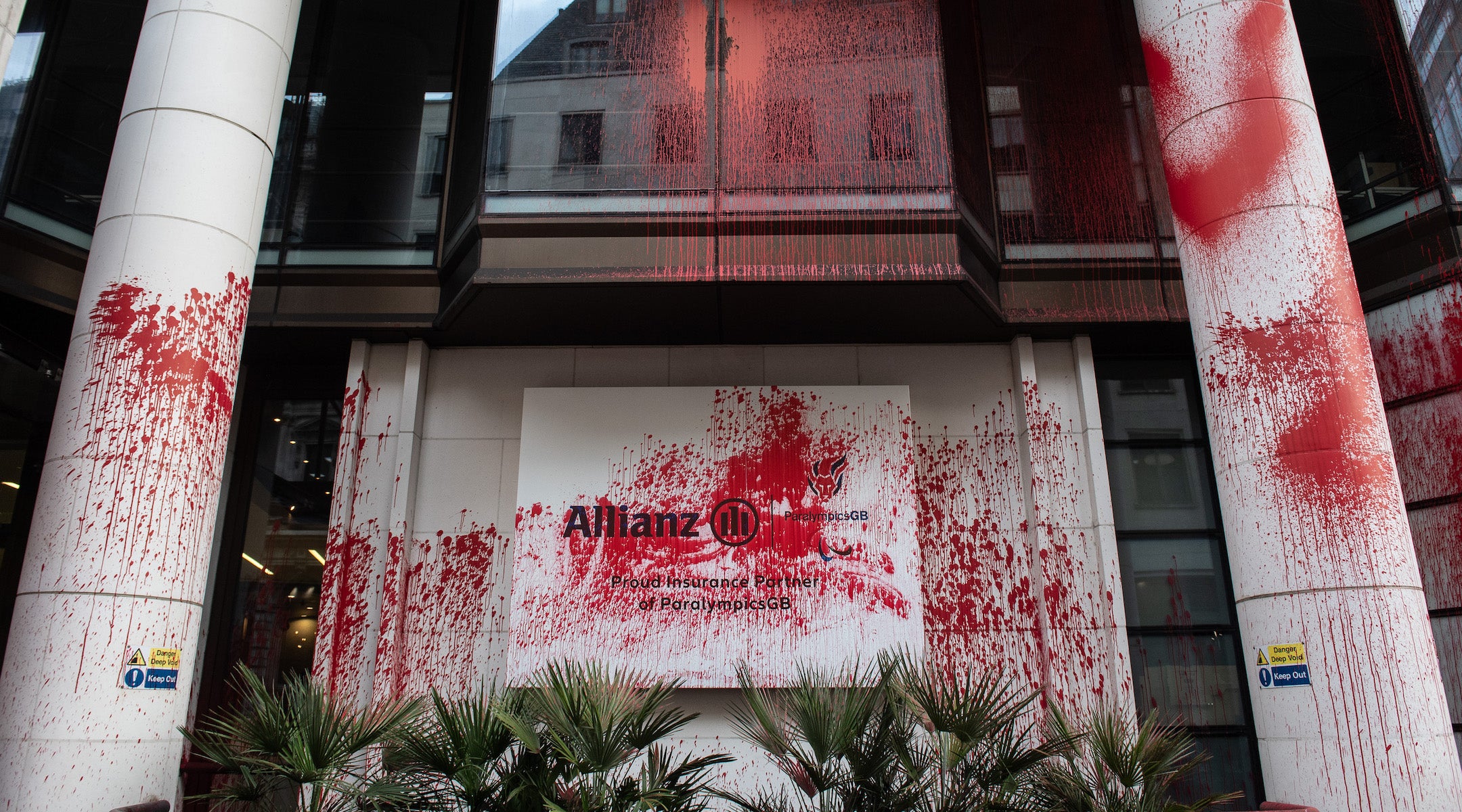
Prominent Jewish groups in Canada have called on its government to designate Palestine Action as a terrorist entity after the activist group published a “target map” identifying locations across Canada, Europe and the United States as possible targets for “direct action.”
Palestine Action’s “target map” is available to the public online and lists hundreds of addresses of companies and homes across the globe linked to Elbit Systems, an Israeli-based military technology company. Each location also includes a link to the group’s “underground manual” which instructs viewers to create “cells” and “disrupt [sic], damage or destroy” targets by breaking into them, blocking pipes or vandalizing them with spray paint.
The manual also offers instructions on how to evade law enforcement and destroy evidence of vandalism.
“The manual offers operational guidance for terroristic anarchy,” Richard Robertson, B’nai Brith Canada’s director of research and advocacy, said in a statement. “By promoting this manual and identifying specific targets, Palestine Action is inciting its followers to commit criminal acts in furtherance of its radical ideology.”
The calls to proscribe Palestine Action in Canada come as a related group, Palestine Action-UK, was banned by the United Kingdom under the Terrorism Act in July after its activists broke into a Royal Air Force base and spray-painted two planes to protest Britain’s support for Israel.
On Tuesday, four British Palestine Action members were found guilty of criminal damage in connection to an August 2024 break in at the U.K. site of an Israeli defense company.
Robertson called on the Canadian government to “treat transnational extremism as a national security threat,” citing the group’s recently published audit of antisemitic incidents in 2025, which found that Canada saw 6,800 antisemitic incidents last year, its highest on record since the group began recording them in 1982.
“Palestine Action is an example of how extremist movements use digital platforms to weaponize propaganda into acts of intimidation and criminal conduct,” Robertson said. “Publishing target maps, circulating manuals for unlawful activity, and encouraging people to organize in secret cells is akin to the tactics of terrorist entities.”
Canada’s Center for Israel and Jewish Affairs also criticized Palestine Action’s guide, saying that the group had “openly incited violence against some of the country’s leading defence and aerospace companies” in a post on X.
“Already banned in the UK as a terrorist group, we cannot allow extremists to threaten Canadian jobs or national security,” the post read. “We urge the Government of Canada to act proactively and add this group to the list of banned terrorist entities.”
Palestine Action is not the first pro-Palestinian group to draw backlash for using maps to note institutions for potential protest.
In 2022, the Mapping Project, an anonymous collective of Boston-area pro-Palestinian activists, sparked outcry after it published a list of names and addresses of Massachusetts Jewish groups, including schools, community funds and synagogue organizations. And in 2023, the group Within Our Lifetime briefly published maps online detailing the locations of Jewish organizations in New York City alongside the caption “KNOW YOUR ENEMY.”
Passover may be over, but your chance to support independent Jewish journalism isn’t. Help JR keep reporting the stories that define our era.