

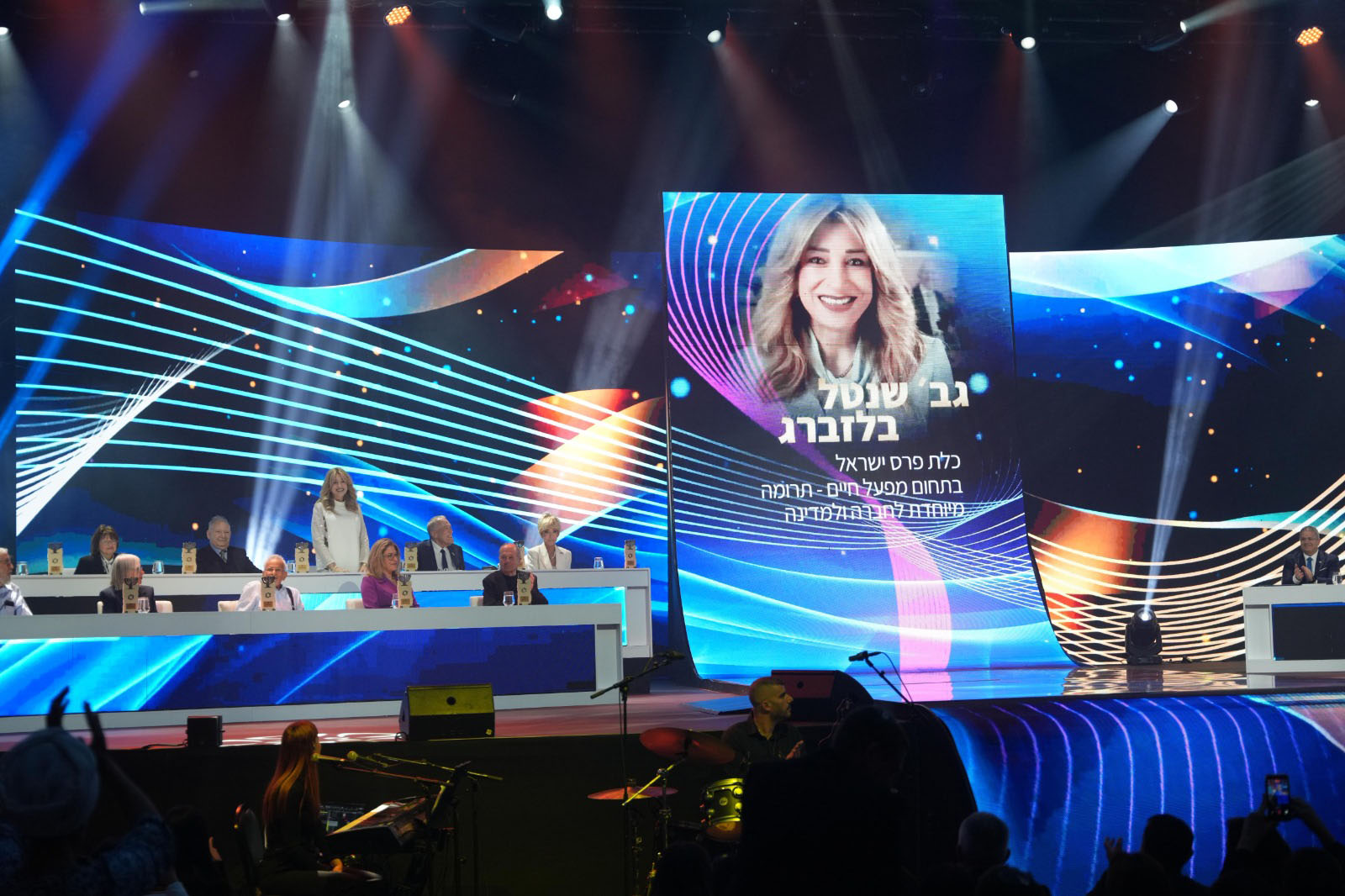
For as long as I can remember, I watch the Israel Prize ceremony, which comes at the end of Israel Independence Day. The ceremony is always inspiring; the style is usually strait-laced and serious.
An anecdotal poll among my friends revealed that I was not the only one who sensed the atmosphere in the ceremony was lighter this year, its official format notwithstanding. Perhaps this was due to the return of all the hostages, heart-breaking as it was that not all returned alive.
The awardees are chosen from a reservoir of highly accomplished and dedicated scholars or achievers in the fields of the humanities, social sciences, Jewish studies, life and exact sciences, culture, arts, communication and sports. Space will only allow me to concentrate mostly on the Lifetime Achievement awardees, people who have moved mountains to improve Israeli society.
This year we were fortunate to receive tickets to the live event. Full disclosure – the coveted tickets came from Chantal Belzberg, who was honored with a Lifetime Achievement award as the co-founder, with her husband Marc, and as the deeply involved, hands-on groundbreaker of OneFamily (https://onefamilytogether.org) since 2001, an organization dedicated to supporting families of victims of terror, and of soldiers who fell in battle.
A series of synchronistic coincidences conspired to have me experience deeply emotional meetings, by chance, with others who were also invited by Belzberg.
The security was tight. Once we got into the building, we found ourselves in one of two slow-moving lines, at the head of which were officials scrutinizing identity cards. After several people appeared to talk their way to the head of the line, I mumbled something. The woman in front of me turned around and said, “We need to be patient. Maybe we were meant to be here together so we’d talk to each other. My name is Orly Weissman.” I introduced myself and my husband to her; it turned out they live in the same community as my sister-in-law. Let the Jewish geography roll. I told her our daughter also lives in a community nearby, though I didn’t mention her name. I asked why she was there. Orly said she and her husband were invited by OneFamily, with whom they are involved, as their son was killed ten years ago in a terror attack.
After that I took a deep breath and kept my mouth shut, realizing that some of the people in those lines were there for a similar reason.
We walked up the stairs to the reception. All the precious award booklets with the photos and information about the prize winners were gone, but I picked up one on a distant chair that appeared to be discarded (perhaps by an English speaker who realized the book was only in Hebrew). A few minutes later an usher who knew I was a journalist brought me another award book. Rather than decline it, I resolved to give it to the first person who asked me for it.
A few minutes later, a lady asked if she could look through one of my books. She smiled gratefully when I handed her the extra and said, “It’s yours.” I asked her why she was there. She, too, had been invited by OneFamily; she was clearly in their orbit, as she was Tali Ben Yishai, the mother of Ruth Fogel, who together with her husband, Ehud, and three of their children, had been murdered by terrorists in 2011, on a Friday night. A daughter who had been spending the Shabbat evening with friends discovered them when she came home. This grandmother had raised the surviving three children. She told me about what the surviving orphans were up to, “kvelling” with pride. I asked how she did it. “I get strength from Am Yisrael,” she said.
We entered the hall. The ceremony took place before a large colorful banner on an electronic screen declaring, from the Book of Samuel II (1:23): “They were swifter than eagles and stronger than lions.” Ah, that lion metaphor, in Israel, never gets old.
The awardees were positioned across from the President of Israel, the Minister of Education, the Chief Justice of the Supreme Court, the Speaker of the Knesset and the Mayor of Jerusalem. The audience was filled with members of the awardees’ families, colleagues and friends. The MCs, a male and female, were upbeat as they announced the various prize winners.
One of those was U.S. President Donald Trump, who was awarded for his “unique contribution to the Jewish people,” the first time in the prize’s history that the honor was bestowed on a non-Israeli citizen.
There were four Lifetime Achievement awards. In addition to Belzberg, there was one awarded to Irit Oren Gundars, a retired IDF Lieutenant Colonel and former Head of the Human Resources Branch in the Combat Engineering Corps, who founded “Or L’Mishpachot,” “Light to the Families” in 2008, an organization which works for the benefit of families of soldiers who fell in battle. (https://www.or4family.org.il )
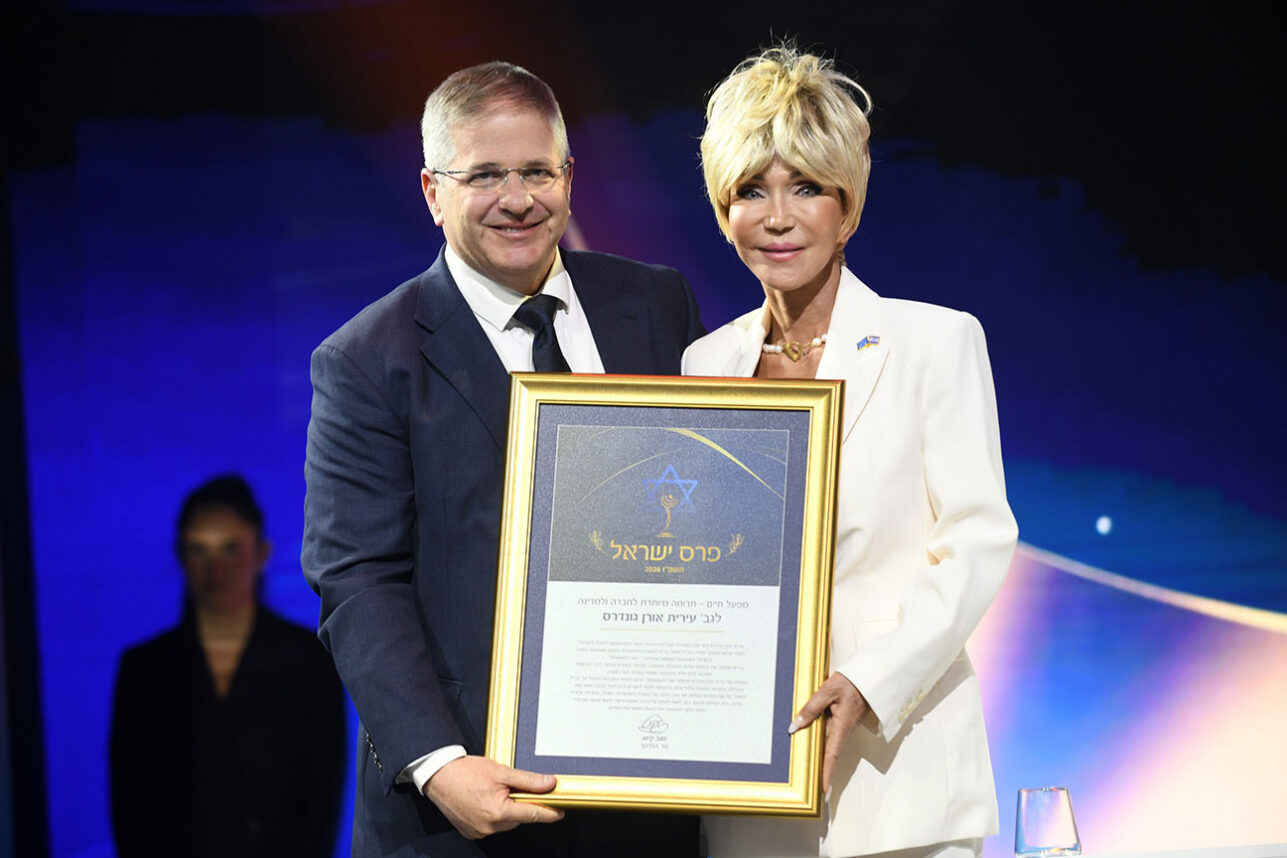
Yoav Kisch, Minister of Education, said of Belzberg and Oren Gunders, in his speech toward the end of the ceremony, “These women together are a beacon of compassion, mutual responsibility, and light. Their work reminds us all that Israeli society, at its best, is measured by its ability to embrace, to support …. This evening, at the Israel Prize, there is an embrace from an entire nation for you, dear families.”
Like OneFamily, Or L’Mishpachot has groups and special events, programs, trips, offers financial help and more, appropriate for particular members of the family constellation – mothers, fathers, siblings, grandparents, etc.
Two personal connections
Several days before the Israel Prize ceremony, Chantal Belzberg was hosted in an interview on Channel 14 in Israel, together with Hila Kol Lipskind. Both of Hila’s parents, Dov and Rachel Kol, were shot dead in a terror attack in 2005, on Tzir Kissufim, the route leading in and out of Gush Katif. They had been visiting Rachel’s sister’s family, three weeks before Gush Katif was uprooted and destroyed. They left Hila, who was married and had given birth just seven weeks earlier, and two younger children, aged 15 and 17.
Hila’s biological mother had died of cancer when she was a toddler and Dov had remarried Rachel, a good friend of his deceased wife. Rachel was the aunt of our son-in-law, and my husband was a good friend of Dov. Their story became legendary in Israel, as it was a time of great division. Dov was a non-religious left-wing Ashkenazi Tel Avivian, involved in journalism and PR. Rachel, a medical researcher at Hadassah Hospital, was from an Iraqi Sephardi religious right-wing Jerusalemite family. She raised Hila as her own, and she and Dov had two more children together.
All Rachel and Dov had in common was their love for each other and for Am Yisrael.
In the car park at their double funeral, blue and orange ribbons flew side by side, like a mirror image to the people inside — religious and secular, right and left, mingling closely, joined by sorrow and love, the blue ribbons owned by those who approved of the expulsion from Gush Katif, the orange owned by those who opposed it.
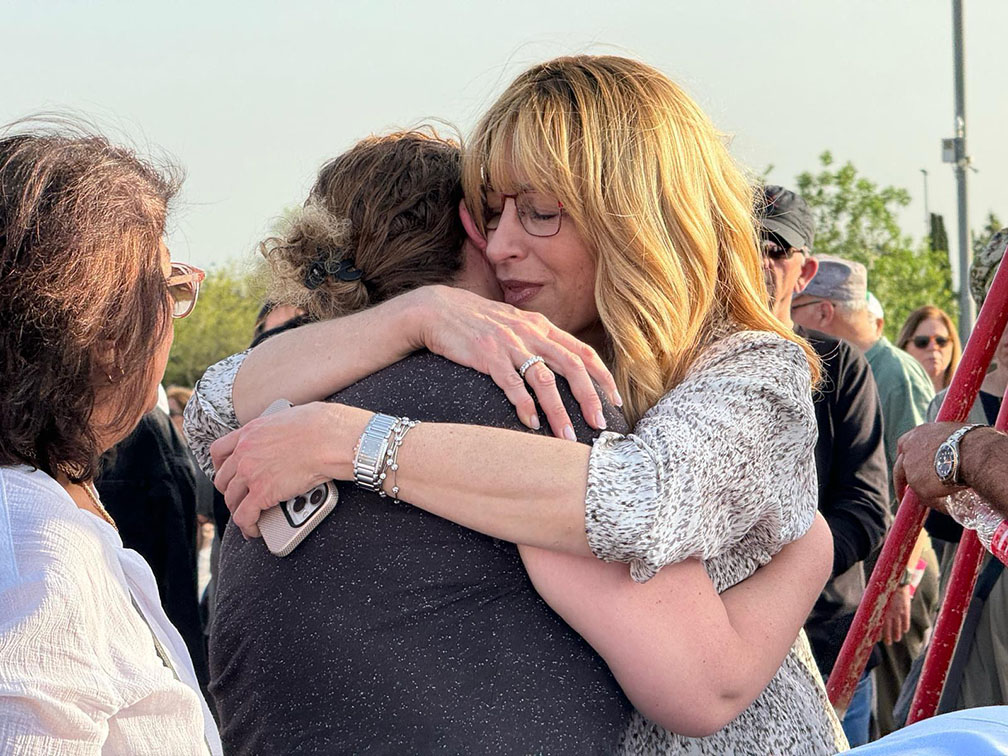
OneFamily became like another family for Hila and her siblings. Belzberg said, “We saw that there was a small, quiet, gentle group of children who had lost both parents, and we realized that they needed something else… we built a community for them. We also had to … give each one the strength they needed.”
Tragically, that sub-group has grown. Hila said, “We have an amazing group of people, with differences in age, religious background, political views, but there is some common denominator that holds us together, and gives us the ability to be there for each other, and support each other.”
Chantal Belzberg said in her ceremony video, “A family is not just in the biological sense. It is also someone who … tells you, I am with you now. It is hard, but we will survive this together.”
The judges wrote about OneFamily and Belzberg (excerpted): “The organization currently supports more than 20,000 victims from across the country, and over the years has invested more than 100 million dollars in direct assistance to families. She…maintains an extraordinary level of personal involvement… and accompanies them over the years….…. During the events of October 7, 2023…she led the rapid establishment of a national emergency system that provided immediate assistance to thousands of families.”
Another personal connection for me was the awardee Irit Oren Gundars, through friends Bryna and Sammy Hilburg, whose son, Yohanan, fell in battle in Lebanon in 1997. Bryna was thrilled that Irit was winning the award. She told me, “I found out about Irit through a friend who’s also a bereaved mother, Miriam Peretz…She’s such a warm person and willing to help everybody that she can. Every time Irit meets me, I get the feeling like, wow, I’m the most important person, and she’s been waiting for me to come.” In the beginning of this war, Bryna said, Irit went to every single family that lost a child in the army; at some point, there were so many, she galvanized others, drawn from the reservoir of parents who were also bereaved. Bryna was one of them.
“The first response [when I reached out] was sometimes, ‘Don’t call me. I’ll call you.’ But Irit said, ‘Don’t give up.’
“And I didn’t. And now I have some really good new friends and it makes me feel good every time I talk to one of them; most of the time I’m listening. It gives me a sense of relief. And I hope for them it’s good because it gives them also somebody to talk to who has been through it, and who knows that life really does go on afterwards even if you don’t think it will.
““It makes me feel as if in some small way Yohanan is still alive. Because when I meet these people, I can be with Yohanan….”
A Lifetime Achievement award in a new category, of “Young Leadership” was given to Adi Altschuler, founder of the Krembo Wings youth movement for children and young adults with disabilities, among other initiatives.
Minister Yoav Kisch spoke emotionally about his late son, Matan, of blessed memory, who was “a wonderful child, a special child. At the age of one, he was diagnosed with a rare genetic disease that did not allow him a normal life…It was a shock that shook our entire world…But Matan was a happy child, a joyful child. And even though he did not know how to speak… he knew how to communicate. He was a member of the youth movement Krembo Wings.
“I wish to say in the name of my son Matan, in the name of all special children: thank you, Adi…My son Matan felt loved, wanted, and that he belonged there. …You built a bridge where others saw only difficulty, and this is the Israeli human spirit at its best. A spirit of inclusion, of equality, and mutual responsibility.”
As I was writing this, I discovered that I have an 11-year-old granddaughter who participates in the youth movement Krembo Wings (https://www.krembo.org.il/en) for children with and without disabilities. (She is without.)
Professor Avraham Rivkind, director of the trauma unit and the department of general surgery at the Hadassah Medical Organization, also received a Lifetime Achievement award. The award committee described Dr. Rivkind as “a pioneer in developing new medical approaches and tools for saving lives…” Prof. Rivkind spoke on behalf of all the prize winners, and he opened by gesturing to the other award winners and saying, “We all come from different worlds…but one thing we have in common is that we all love this land more than any award.” There was an emotional moment when he went off script and said, regarding those who were wounded and he had treated, and their families, “Keep sending me those messages about your children, what they are doing, if they are in kindergarten, high school, in the army, if there are grandchildren… Those messages make my day, they make my year, and that’s why I’m here.” He added, “There is no other place on earth where I would rather live. There is no other people on earth who I would want to be a part of.”
The evening opened with the singing of “Hatikva” and ended with the lively song “Oleh oleh,” accompanied by young, colorfully costumed dancers, during which many in the crowd stood and joined in the song, whose chorus is, “Let the song rise up for us together, when joy blooms in the heart, let the song rise up, for young and old, like a rainbow in the cloud.”
While we were leaving the ceremony, we saw Professor Binyamin Weiss, originally from New York, who had been awarded the prize for Research in Mathematics. He was also an advisor to security systems in Israel. I stopped to tell him how I met friends from B’nei Akiva and camp, who also made aliya, at our annual BBQ, and they had been talking about how they remembered him, admiringly, as a counselor from camp and the youth movement. Another friend said about him later, “He’s a big talmid chacham (Torah scholar) but doesn’t acknowledge it. Still in great physical condition. A chalutz (pioneer) at heart. I still see him walking around the neighborhood in khaki kibbutz shorts and a kova tembel (old-time Israeli kibbutz hat).” By coincidence my husband had been the high school math teacher of Professor Weiss’ son.
A small country.
Postscript
On the Saturday night after the ceremony, I read a column I had published three years earlier. It was called “A Story Bridging Yom Ha’Shoah, Israel Memorial Day and Independence Day” and one of the stories it told was how our pregnant daughter, Ephrat, and son-in-law, Tzachi Cohen, who had decided to give the name “Yanai” to their expected boy, were watching a TV program on Israel Memorial Day which highlighted a soldier who, some years earlier, while off-duty and without a weapon, had been killed while trying to stop a terror attack in a supermarket. His name was Tuvia Yanai Weissman.
Ephrat was in the middle of contractions. Even though they had already chosen the name, Tzachi said that they were also happy that this child would continue the name of that heroic soldier.
My heart skipped a beat as I realized it was the same Yanai who was the son of Orly, who I had met in line for the Israel Prize ceremony, to whom I had mentioned my daughter who lives near her. Orly, a bereaved mother who taught me a lesson in patience. Orly, who had said that maybe we were in line together because we were meant to meet and talk.
I called Orly and told her about our newly discovered connection. She remembered, and told me there were other Yanais who were also named for her son.
May we know quieter times, and have occasion to give names for great and elderly people, and not for those who die young in the service of our nation. May we always meet people “by chance” who enrich our lives.
The writer is an award-winning journalist and theater director. Her current production, with Raise Your Spirits Theatre, is “Heroines! Songs & Soliloquies for the Soul,” about the heroines of Oct. 7.