

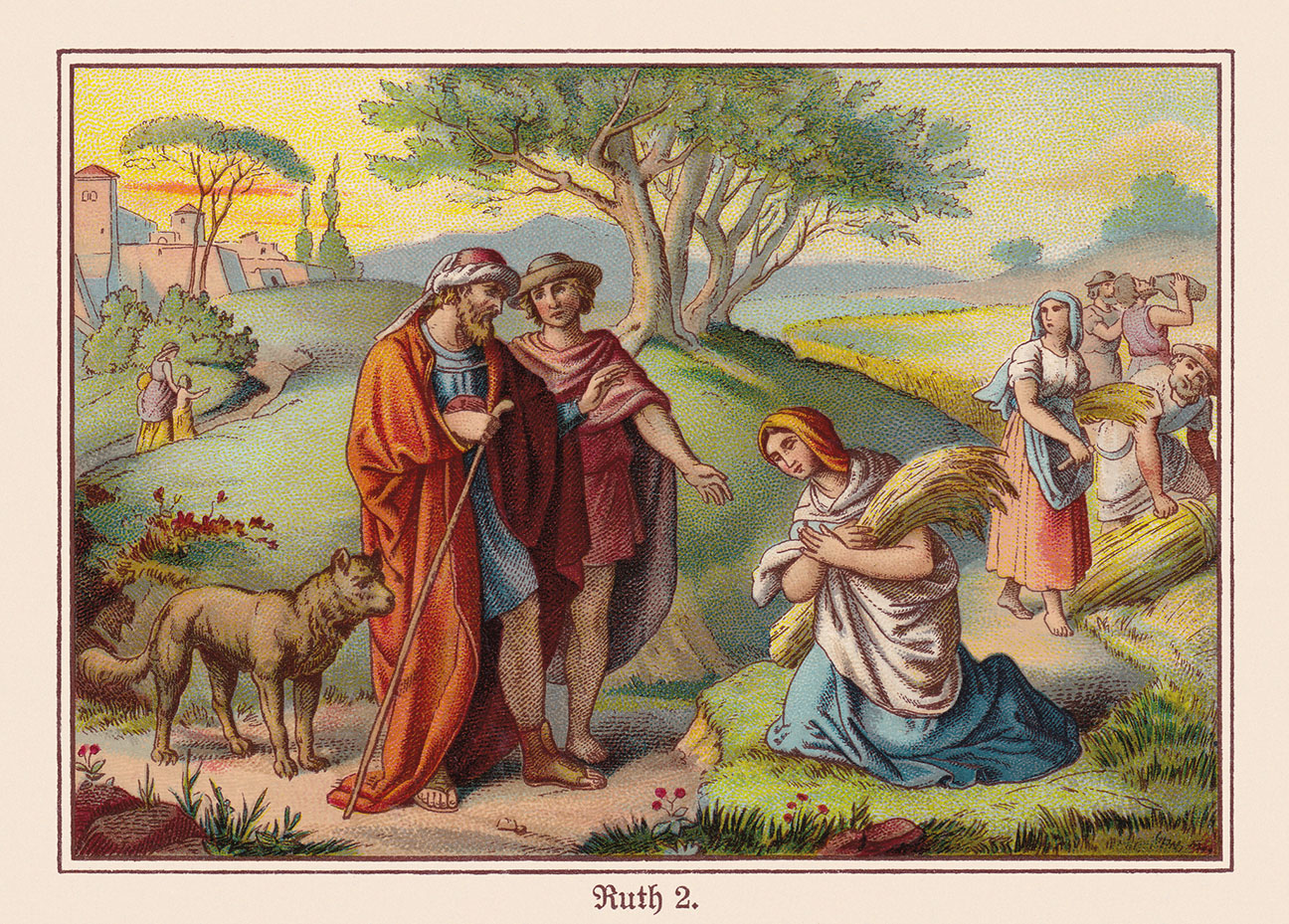
My favorite bible book, to tell the truth,
is short and sweet and called the book of Ruth.
Regarding what she looked like, whether short
and sweet to look at, there is no report.
About her looks I am an ignoramus,
but looks were not in fact what made her famous:
her lovingkindness had the highest titer
that ever had inspired any writer,
and that became the essence of her glory,
and why I’ll recapitulate her story.
It happened in the days when judges ruled––
it’s hard to think of times when do they not––
that Elimelech, by the market fooled,
set out for Moab, no great patriot.
He died quite soon, perhaps since he’d displeased
the Lord by leaving Bethlehem, his home;
he’d never cared for those who were diseased
or hungry, quite a selfish gastronome.
His widow was Naomi, which means that
her disposition was extremely pleasant;
his two sons’ names came with a caveat,
implying that they soon would be decedent.
In Moab they lived well, there was no famine,
and both the sons to Moabites got married:
their consciences they hardly did examine,
for both their wives were sterile or miscarried,
perhaps because the Torah laws forbid
the Israelites to marry Moabites.
The sons died since they both backslid,
survived by wives who were not proselytes,
and therefore not commanded to obey
the Torah’s laws as both their husbands were.
When back at home the famine went away
Naomi decided she’d prefer
to live no more in Moab where she had
a lot of painful memories and go
to Bethlehem her home, no more nomad.
Her sons’ two widows said that they also
would like to go with her to where she’d dwelt,
for they were both reluctant to remain
in Moab where the two young widows felt
like aliens––people tended to disdain
them both, for though they’d not converted,
they’d chosen two Judeans and rejected
their fellow Moabites, and had deserted
their nation, as if they were disaffected.
Naomi said to Orpah, who was older:
“Go back to Moab, where you have your roots.”
Although she said the same to Ruth, Ruth told her:
“I’m leaving with you with my tickets and new boots,
and don’t intend to stay here one more second!
Wherever you will go I will go with you.”
On such a course Naomi hadn’t reckoned.
Ruth wouldn’t like her sister say adieu,
although Naomi warned her she was far
too old for her to have a son whom she could choose
to marry, and she warned her of the bar
that separated Moabites from Jews,
an ugly separation Nehemiah
enforced most strictly when the Jews returned
from exile, thus with Ezra causing dire
restrictions on the people whom they spurned.
Ruth said: “I beg you please do not entreat me
to leave you, for where you go, so will I;
where you lodge I will lodge, you’ll meet me
wherever you may be, and when you die
I’ll find a grave that’s close and lie beside you,
and from today your God is also mine.”
Naomi said: “I cannot override you:
what’s mine is thine and what is thine is thine.”
That’s language from the Ethics of Our Fathers:
both women in such ethics quite excelled.
Ruth loved Naomi so much that she’d rather
be homeless than from Naomi expelled.
They walked together; neither of them straggled,
determined both to find in Bethlehem
some comfort, but when they arrived bedraggled,
the people whispered, ready to condemn
Naomi for the way she’d left Judea
when times were hard. It would have been far fitter
for her to stay behind without the panacea
of emigration. Rumors made her bitter,
and so she said: “Please do not call me Pleasant”––
the meaning of her name–– “but Bitter Mara:
though pleasant when I left, I have a present
sweet as haroseth, Ruth, there’s no one fairer.”
Haroseth is a condiment that Jews
eat Passover to sweeten bitter herbs;
it’s made of sweet things than cause herbs to lose
the bitter taste that otherwise disturbs.
A paradox her words, a Moabitess
for Jews in those days had as little use
as generations later had for Titus,
destroyer of the Temple of the Jews.
Men frowned so much upon Ruth’s intermarriage
that Naomi and Ruth were shunned and sent away:
of justice there’d have been miscarriage
if Boaz hadn’t come to save the day.
To Elimelech he was close as kin,
but also he felt pity on the widow.
He thought her emigration was no sin,
and didn’t share his colleagues’ legal credo
that stated that a marriage with a stranger,
especially from Moab, is a no-no:
with sympathy he acted, not in anger,
and to the court he put his case pro bono.
The efforts that he made to give support
to both the widows caused a furor;
Naomi got a very bad report,
and Ruth the Moabite was labeled whore.
News spread those days as fast as it in Paris
would spread for people who were not enlightened,
fictitious stories tending to embarrass
the victims, into silence being frightened.
Rumor turned to gossip that spread faster
when people started publishing each libel,
attempting to prevent the great disaster
of marriage to a Moabite the bible
abhors because it threatens the pollution
of Israel which could trace to Abraham
its roots, and did not want a revolution
like that in France that followed Uncle Sam.
While others thought the strangers bacchanalian,
inclined to alienate their men from God,
Boaz let Ruth glean, although an alien,
dressed modestly, with feet that were not shod.
He told his servants they should not embarrass
the Moabitess as she gathered barley:
any youth attempting to sex-harass,
would lose his job, and home, perhaps his Harley.
Naomi noticed all the small attentions
that Boaz paid to Ruth, and being clever,
determined to find out if his intentions
were serious. To learn if he would ever
redeem young Ruth she sent her in the middle
of the night to lie beside him as
he lay inside his barn—then starts an idyll
between the future lover and his lass.
Naomi first instructed Ruth to put
on perfume and a very pretty dress
that flattered her when she exposed a foot,
a limb unmarried couples might caress.
It’s possible that she accompanied
the woman whom she called her daughter for
that’s what is written, though we do not read
these words aloud. All Bowdlerists deplore
suggestions of such intimacy that
would echo daughters’ incest with old Lot,
producing ancestors whom both begat
although the law forbids this. In the plot
describing how King David’s dynasty
occurred you should know bible authors claim
that Solomon and David were not free
of blemishes from antenatal shame.
Don’t think that Moab, Ammon were exceptions,
for Judah with Tamar broke many laws.
It’s very clear the dynasty’s conceptions
can hardly be the reason for applause.
She came in secret, after Boaz ate
and drank some wine that made him somewhat sleepy,
a fact that was extremely fortunate,
for he would not have let her in his tepee.
Though Ruth spoke first, she tried to be discreet,
and sweetly asked him: “Are you my redeemer?”
He saw that she was lying at his feet,
and wondered was he drunk or just a dreamer,
then saw that Ruth had taken off the cover
that had been lying on his legs while dozing,
and said to her: “Though I’m not yet your lover,
hear now my plan that I am here proposing.
Your qualities are certainly quite stellar!
I’ve seen the lovingkindness you have shown
to your late husband and Naomi, valor
should be the middle name you rightly own.
You’ll be my wife of valor with a price
above all rubies, as our proverbs say,
as precious as the very fragrant spice
that on the altar priests twice daily lay.
However, though I dearly wish to marry,
you have a closer kinsman, so it seems:
I must give him a writ of certiorari
to see if he both marries and redeems.
If he refuses then I may become
your husband, chief of dramatis personae.”
The name of the redeemer was Sir Dumb,
for that is the true meaning of “Almoni,”
the curious name he goes by in the chapter
with which the book concludes, as I’ll explain.
As spouse of Ruth her champion was far apter,
and Boaz when he failed did not complain,
but gave the man at once a writ mandamus
for having failed to follow Holy Writ,
thus showing that he was an ignoramus––
the word for him in England is a twit.
He told her she should spent the night beside
his feet, but leave before the rosy lips of dawn,
for people might not trust his bona fide,
associating her with alien corn.
He gave her just before she left some barley,
which she gave to Naomi who was thrilled,
for though the tryst was planned somewhat bizarrely,
it seems the union was what God had willed.
Next day the elders gather by the gates,
in order to determine who’ll redeem
the property of Elimelech: Boaz waits
prepared to activate his clever scheme.
The nearest kinsman I’ve called Mr. Dumb
says he’s prepared to do so on condition
that he’s not called to be the groom
of Ruth, who’s of the Moabite tradition––
the word we use more often is persuasion,
a euphemism used by those whose pride
with prejudice looks always for occasion
to look for racial features to deride.
The opportunity he, dumbly, declines,
explaining that he would not waste his seed
by mixing his blood with Ruth’s alien lines
that would pollute the bloodlines of his breed.
He fears that he will waste his seed
as Onan with Tamar had feared to do:
shahet, “destroy,” connects the former’s deed
to Mr. Dumb before he lost his shoe,
for once he told the elders, “I will not
redeem this woman,” she was told to take
his shoe and spit, to put him on the spot
since he had not shown kindness for her sake.
The fact that with the marriage come the farms
of Elimelech does not compensate
for marriage with a Moabite that harms
whoever should become Ruth’s lifelong mate.
As Torah law requires in such cases,
Ruth spat into the levir’s face to shame him,
and took his shoe off, cutting off its laces,
and with the elders started to defame him:
“Ruth’s conduct shows our disapproval
of all the levirs who refuse to build
their kinsmen’s houses. ‘House of Shoe Removal’
shall be his name, his seed lost like that spilled
by Onan who would not redeem his brother
who in Tamar’s bed died without an heir.”
The stories do resemble one another,
for when Tamar reacted with despair
after Judah would not let young Shelah,
his third son, use his seed to be a levir,
she dressed up as a whore who meets a sailor
and lay with him, a ruse extremely clever,
performed close to two fountains called Enaim,
which echo one where in another saga
a man gave Laban gifts to satisfy him,
and in another God gave help to Hagar.
Tamar bore Judah twins, one Perez, who
was destined to be David’s royal ancestor,
like Boaz, who helped Ruth produce one too,
each man in royal lineage investor.
The author does not mention that Ruth spat,
but I believe she did so since the law
in Deuteronomy requires that
for men who on kinswomen shut the door.
Some people say the way that Ruth behaved
is not due to the law of Deuteronomy,
but I think Boaz thought she should be saved
by levir law, not by his bonhomie.
Recalling this connection the narrator
describes Ruth’s great redemption as temurah,
which means “exchange” but is an indicator
Tamar was in his mind, though Ruth was purer.
The dynasty of David has its sources
in acts of incest far worse than Tamar’s:
incestuous origin of Moab reinforces
the one of Perez that above we parse,
for Lot told both his daughters he would know ’em,
producing thereby ancestors not only
of David, the first king, but Rehoboam—
the man who thinks that’s moral must be lonely.
It seems the bible authors wished to quarrel
with kings descended from royal David’s line;
at least to me that would appear the moral
that to these stories readers would assign.
Once Mr. Dumb had publicly refused
to marry Ruth, there stepped into the breech
her lover, Boaz, who then disabused
the racist elders with a rousing speech,
declaring he was quite prepared to marry
the Moabitess whom they had rejected
immediately. He didn’t want to tarry
a moment—this was hardly unexpected.
The people said that Ruth would be like Leah
and Rachel who were matriarchs of both
Judea where King David was a player,
and northern lines whom southerners would loathe,
predicting that with Boaz she’d achieve,
with what would be a matriarchal energy,
as much as Adam had with Eve,
for Ruth and Boaz had a sinless synergy.
They prayed the hero’s house should now resemble
the ones that Perez and Tamar had built,
and hinted that the building of the Temple
would by his great-great grandson soon be built.
According to the midrash, Boaz died
the night he married Ruth. How often joy
gives way to grief: when we in love collide
we sometimes build and sometimes we destroy!
Though Boaz had produced three hundred sons,
he died like Onan on his wedding night,
not wasting seed, a vandal like the Huns,
but loyal to the primae noctis right
that every husband in the world enjoys.
Why did he then like Onan have to die?
The ones God loves are those whom He destroys,
but ours cannot be to reason why.
The tree that starts with Perez and concludes
with David makes this book end unabruptly.
We see that there’s no one who now excludes
a Moabite who, pure and incorruptly,
had struggled to preserve her husband’s name
in places where she braved the alien corn,
and with adopted mother fanned the flame
until to Boaz, Obed, son, was born.
His name means “Slave,” a clue foreshadowing
that David, whom God chose to designate
as son once he had been anointed king,
was born in slavery before God made him great,
adopted by him just as Jacob had
adopted the sons of Joseph who had been a slave.
Slaves lose their kindred, lacking mom or dad
who bore them, sons to lay them in the grave,
which also is the reason why God said:
”My first born son is Israel!” He adopted
the nation Israel, which became instead
of feuding tribes His mom-and-popped hit.
The slave name Obed means that Judah’s kings
were not descended from their ancestors;
the shoot of Jesse just like Israel springs
from people whose oppression law deplores.
As an afterthought I add a verse.
The way that Naomi expressed
her very sad decision to reverse
her name to one that we detest,
Mara, just like maror that we must eat
on Passover, recalls alienation
of Elisha ben Abuyah and the son we meet
in the haggadah whose education
did not in spite of dad cause him to learn
from any questions, since he in fact never
asked any, and was thereby left to burn
because of this, perhaps in hell forever.
Just as by Rabbi Meir he was pardoned,
so must we Mara when she changed to Naomi.
Her heart to strangers Mara never hardened,
loving them like Meir as a homey.
On 5/17/26, Professor Jim Diamond on Torah in Motion, “God has Attacked Me: Ruth, Suffering, and the Lesson of a Rabbinic Heretic,” discussed the midrashim that link the negative history concerning the abandonment of the land of Israel by Naomi at the beginning of the book to the abandonment of the Torah by Elisha ben Abuyah, who becomes known as Aher, meaning “The Other One.” The midrash seems to imply that Elisha ben Abuyah’s alienation from the Torah echoes that of Naomi described in the first verse of the book of Ruth. In Ruth 1:20, Ruth tells her two daughters-in-law, Ruth and Orpah, her decision to change her name:
וַתֹּ֣אמֶר אֲלֵיהֶ֔ן אַל־תִּקְרֶ֥אנָה לִ֖י נׇעֳמִ֑י קְרֶ֤אןָ לִי֙ מָרָ֔א כִּֽי־הֵמַ֥ר שַׁדַּ֛י לִ֖י מְאֹֽד׃ “Do not call me Naomi,” she replied. “Call me Mara, for Shaddai hemar, has made me extremely bitter.”
The midrashic link between Naomi and Elisha ben Abuyah, implies that Naomi’s change of her name to Mara reflected her identification of herself as the maror, bitter herb, eaten on the first night of Passover, while her alienation from Israel reflected by her departure from the land accompanied by her husband Elimelech linked her to Elisha ben Abuyah. Elisha’s alienation from the Torah was attributed by the midrash to his inability to ask good questions, a failure that linked him to the fourth son listed in the haggadah, the son who does not ask any good questions. Ruth 4:3-4 states the following explanation of why Ruth’s closerelative, anonymously identified as Ploni Almoni, refused to redeem Ruth by marrying her, in contrast to the willingness of Boaz to perform, as a substitute for the designated redeeming relative, such redemption.
Ruth 4:3-4 states:
ג וַיֹּאמֶר, לַגֹּאֵל, חֶלְקַת הַשָּׂדֶה, אֲשֶׁר לְאָחִינוּ לֶאֱלִימֶלֶךְ: מָכְרָה נָעֳמִי, הַשָּׁבָה מִשְּׂדֵה מוֹאָב. 3 And he said unto the near kinsman: ‘Naomi, that is come back out of the field of Moab, selleth the parcel of land, which was our brother Elimelech’s;
ד וַאֲנִי אָמַרְתִּי אֶגְלֶה אָזְנְךָ לֵאמֹר, קְנֵה נֶגֶד הַיֹּשְׁבִים וְנֶגֶד זִקְנֵי עַמִּי–אִם-תִּגְאַל גְּאָל, וְאִם-לֹא יִגְאַל הַגִּידָה לִּי ואדע וְאֵדְעָה כִּי אֵין זוּלָתְךָ לִגְאוֹל וְאָנֹכִי אַחֲרֶיךָ; וַיֹּאמֶר, אָנֹכִי אֶגְאָל. 4 and I thought to disclose it unto thee, saying: Buy it before them that sit here, and before the elders of my people. If thou wilt redeem it, redeem it; but if it will not be redeemed, then haggidah, tell, me, that I may know; for there is none to redeem it beside thee; and I am after thee.’ And he said: ‘I will redeem it.’
Boaz’s use of the word “haggidah” confirms my suggestion that Naomi links herself to maror, the bitter herb that is eaten on Passover, when she calls herself Mara, thus drawing our attention to the fact that the book of Ruth links the festivals of Passover and Shavuot. The word implies that the liturgical recitation of the Book of Ruth on Shavuot links Shavuot to Passover, a festival in which Jews have been rabbinically encouraged to read a text called haggadah, a text which – like the book of Ruth – explains how the process of redemption has preserved the Jewish nation.