

WASHINGTON – Israeli Prime Minister Benjamin Netanyahu slipped into the White House through a side door and didn’t get any public face time with President Donald Trump on his visit Tuesday.
It was a choreography reminiscent of Netanyahu’s February visit that also lacked the ceremonial handshake followed by a question-and-answer session with reporters. Behind closed doors, however, Netanyahu made such a compelling case for war against Iran that within weeks the two countries embarked on a joint military campaign that has reverberated across the Middle East.
Netanyahu is in Washington at a critical moment in this latest phase of the Iran war, where the battle is now between the U.S. and Iranian armies, and Trump has to decide whether to intensify the war or go for a ceasefire.
The Israeli leader, who has been blunt about his belief that military action is still needed to prevent a nuclear Iran, emerged Tuesday from the White House bursting with triumph.
“I just finished an excellent meeting with President Trump,” he told Israeli reporters, speaking emphatically in Hebrew, after the 80-minute conversation.
“And when I say excellent, it’s not lip service – a conversation with full cooperation, with mutual support with the understanding of the joint goal to ensure that Iran will not have a nuclear weapon, and other goals,” he said of his eighth meeting with Trump in the president’s second term. “This was one of the greatest conversations I have ever had with our friend, President Donald Trump.”
Netanyahu has long cultivated his image as a U.S. whisperer. His contentious relationship with former President Barack Obama helped shape his reputation as a leader ready to stand up to a superpower, and he was happy to indulge reports, even false ones, that reinforced it.
He has taken the opposite tack with Trump, who has in his first and second terms aligned himself with Netanyahu’s outlook. Instead of contention, Netanyahu has depicted the relationship with Trump more as a mindmeld.
That reputation was at a peak in February when Israel and the United States joined in launching a war against Iran, the first time the two countries were ever in a fighting alliance. Now, Netanyahu and Trump are both unpopular in the United States, as Iran has the upper hand in a war which is fueling inflation and discontent in the United States.
Netanyahu, if the meeting did indeed go as well as he claimed, had good reason to hope for a positive outcome: He faces elections on October 27, and his reputation as the Israeli leader best suited to handle the alliance has taken a hit. As he sat in the White House Tuesday, pundits theorized that Netanyahu had grown so unpopular in the United States due to the Iran and Gaza war that Trump could not afford to be seen with him politically.
Going in, the meeting Tuesday did not look auspicious. There would be no public comments. Photographers had to stick their cameras up against a fence to get a picture of Netanyahu entering.
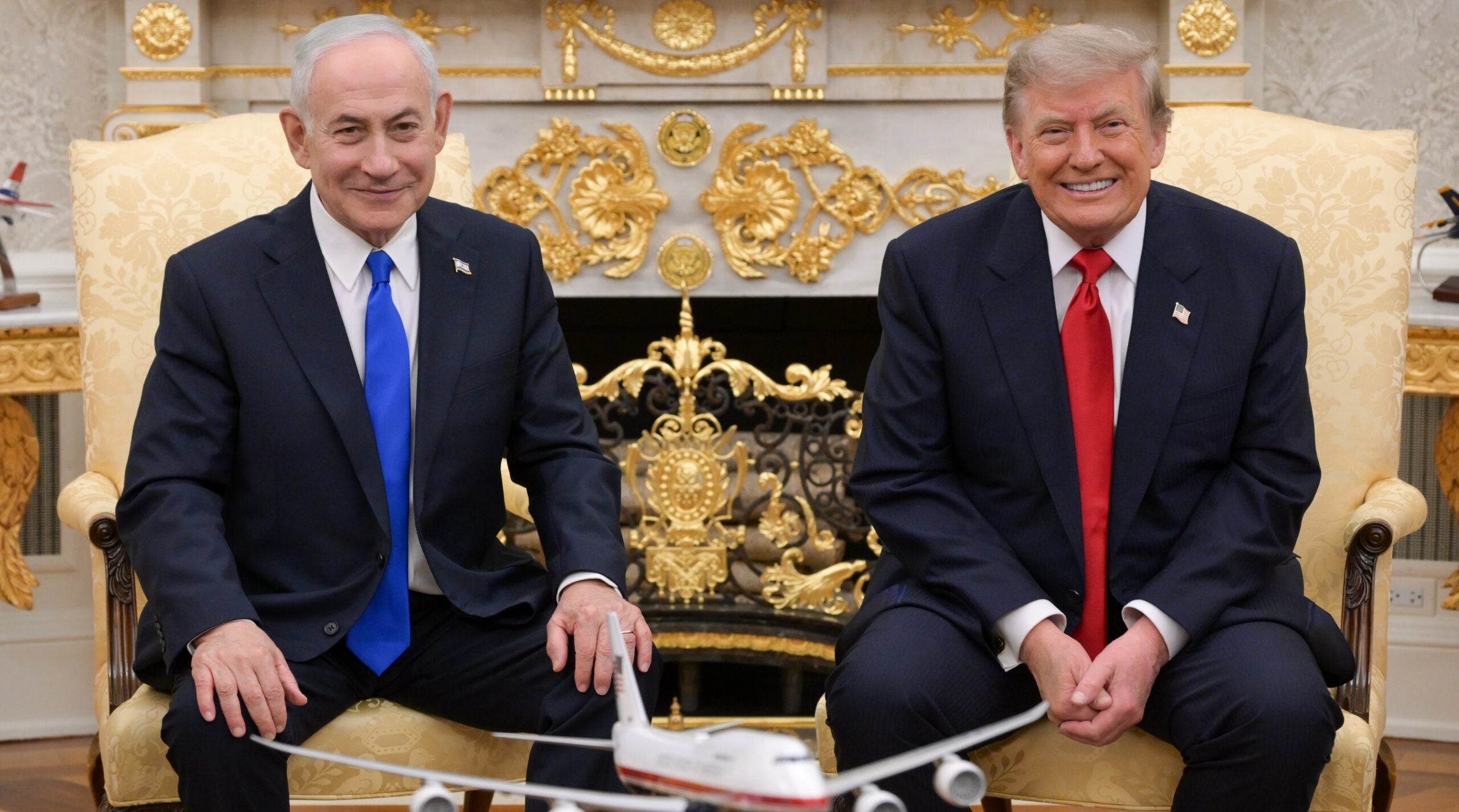
But after the meeting, Israel’s Government Press Office released smiling photographs of the two men, looking as if their famous diplomatic friendship and alliance was intact.
The White House statement following the meeting offered little, jamming together into two short sentences Netanyahu’s meeting with the president and the other announced meeting Trump had Tuesday, with Ukrainian President Volodymyr Zelensky, also away from the cameras.
“President Trump has concluded his meetings in the Oval Office with President Zelensky and Prime Minister Netanyahu,” Karoline Leavitt, the press secretary, said on X. “Both meetings were positive and productive!”
It might well have been productive, said David Makovsky, a fellow at the Washington Institute for Near East Policy. Netanyahu’s goal was not to persuade Trump to abandon efforts to reach a ceasefire with Iran, Makovsky said, but to be ready to hit Iran hard should those talks fail.
“I don’t think Netanyahu came believing he can move Trump from Plan A, which is a mediated deal that will get him through the midterms,” said Makovsky, a veteran of Obama’s Israeli-Palestinian peace-brokering team.
“Trump is very aware that Netanyahu has become associated with pushing for more kinetic combat and I don’t think he sees that association with Netanyahu to his benefit,” he said in an interview. “He’s open to Netanyahu’s arguments, which is ‘All right, Donald. If you want plan A with the diplomacy, you should try it, but if it doesn’t stick, I want to know: Can we converge on a Plan B?”
Given Netanyahu’s demeanor after the meeting, Makovsky said, he might have got a positive answer. “It’s more of a Plan B meeting than a Plan A meeting.”
Just hours before the meeting, however, Trump took a shot at Netanyahu on a favorite media venue, Fox News’ “Fox & Friends.” The president was irked, he said, that Netanyahu appeared to be going public with information Israel believes shows that Iran is ready to revive its nuclear weapons program at Pickaxe Mountain.
“Well, I don’t need Bibi to tell me that,” Trump said, using Netanyahu’s nickname. “Bibi is telling me that because he wants me to stay involved.”
“We know exactly what’s going on,” Trump said. “But no, I heard Bibi announce that. I said, ‘Why don’t you just tell it to me? Why do you have to announce it to the world?’”
In fact, Netanyahu never made the claim publicly – it was leaked on Monday to the New York Post, citing an Israeli source. On Tuesday, a top Israeli diplomat told Israeli media that Pickaxe Mountain never came up in the meeting, and that reports that Netanyahu was ready with intelligence to unveil to Trump were false.
Dropping the Pickaxe Mountain gambit, if the advance reports were accurate, was a smart move, said Ilan Goldenberg, a senior official handling Middle East policy in the Obama and Biden administrations. It’s not the first time that stories leaked ahead of Netanyahu’s Washington visits suggest he had stunning new evidence of malfeasance by Israel’s enemies, Goldenberg said in an interview, and it’s not a good look for Israel.
“It’s kind of condescending and annoying if you’re the president of the United States, and there’s stories out there of ‘This prime minister is going to show me intelligence, and that’s going to change my mind on something,’ which is how this stuff is framed,” said Goldenberg, a senior vice president at J Street, the liberal Jewish Middle East policy lobby which has opposed the Iran war.
Netanyahu knew going in there would be differences with Trump, Yisrael Katz, the Israeli defense minister, said on Channel 14, an Israeli outlet that is supportive of Netanyahu. Iran’s control in recent weeks of the Strait of Hormuz, the waterway through which 20% of the world’s petroleum transits, and the ensuing inflation were an American problem, he said.
“The United States and Iran, these are certain problems that are outside the specific interests of Israel, like Hormuz, the energy crisis,” Katz said, emphasizing that otherwise the relationship has never been better.
Aaron David Miller, a veteran Middle East negotiator under Republican and Democratic administrations, said that Trump had little interest in embarrassing Netanyahu, given Trump’s own reputational stake in the war.
“Trump doesn’t do himself any favors in castigating Netanyahu publicly for dragging him into the war or pretending that he has other objectives,” than Netanyahu, “he just doesn’t, because he condemns his own judgment in doing that,” Miller said in an interview.
Netanyahu’s low profile made sense, said Jonathan Schanzer, the vice president of the Foundation for Defense of Democracies, which backed the war, because neither Trump nor Iran wants to pull Israel back into the war, which resumed on July 13 after a brief ceasefire.
“The Iranians understand that the moment that Israel gets back into the war, they’re going to start targeting top leaders, which is something that the U.S. is not likely to do,” he said in an interview. “Donald Trump is facing an American public that is generally not in favor of this conflict, and so I think he has decided to try to manage this conflict to try to keep it to a low-intensity war. Inviting the Israelis will only increase that intensity.”
Reporting the stories that define our era. When history unfolds in real-time, the Jewish world turns to (JEWISH REVIEW). Your support ensures we can document the complexities of war and the resilience of Jewish communities with integrity.