

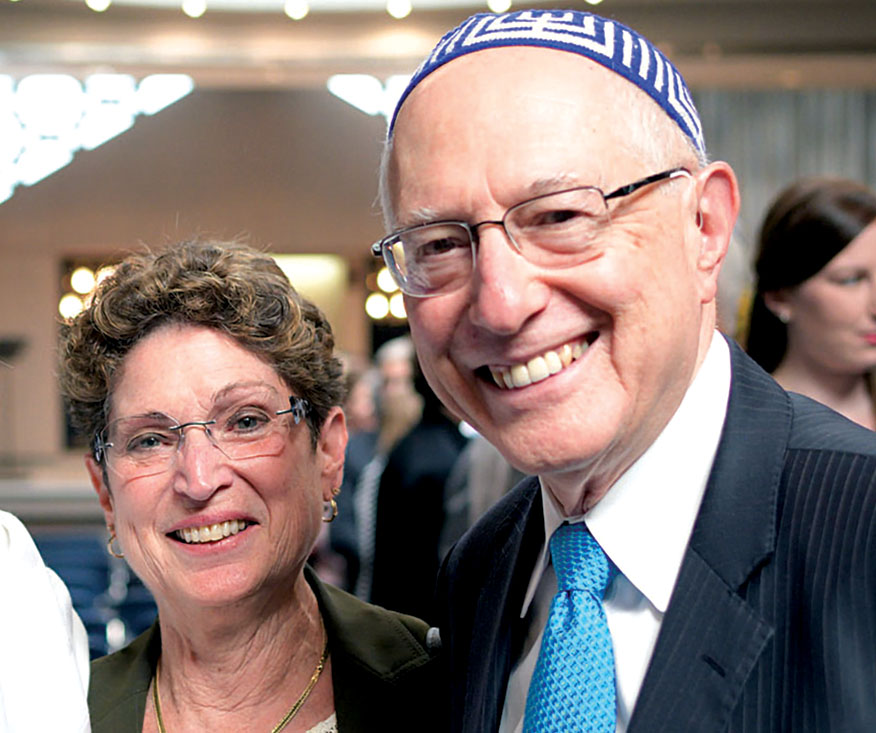
On the memorable evening at Camp Ramah where Joel Rembaum was
introduced to Fredi Breverman, who would be his wife for 61 years, the mutual friend who introduced them made an 11-word pitch: “You should get to know this lady,” he said. “She’s really, really good.”
He did, and their relationship lasted until last April 20, when Fredi died of cancer.
“I guess HaKadosh Borchu stepped in,” Rabbi Rembaum told The Jewish Journal. “It was staff week, before the kids come up. I get my food and walk into the dining room. There, seated, is Rabbi Moshe Tutnauer, her rabbi in Phoenix who was camp rabbi this summer. He was my counselor/teacher a few years before at Camp Ramah in the late ‘50s. Sitting next to him is this blonde-haired young lady. I said ‘OMG, that’s Fredi Breverman!’ I thought this might be an opportunity. I sat down next to Rabbi Tutnauer. I introduced myself, and the three of us began to talk.”
Rabbi Tutenauer soon excused himself to lead Havdalah, leaving the two young singles to become better acquainted. “A Sports Night had been planned,” Rembaum said. “Since we didn’t play sports, we sat there all evening talking. Then I walked her back to her bunk, and we just said ‘Good night.’”
As the young man walked away, he was hit by a surprising thought. “I have been talking to this lady for three straight hours!” he said to himself.
Next day there was an announcement tickets were available for a double feature at the Ojai Theatre. “When I found (17-year-old) Fredi,” said Rabbi Rembaum, “I asked if she wanted to go to the movies with me tonight.”
She immediately said sure. “We go to the movies,” the rabbi said, “and we are sitting next to each other. Now the moment of truth arrives. I began to exercise the over-the-shoulder maneuver. You put your arm on the back of the seat and slide it over her shoulder. Her response determines what the future will hold. She did not take her hand and move it off, so my arm stayed there. Later on, my arm got tired. So I pulled it off and held her hand. It stayed there.
“Needless to say,” he continued, the 63-year-old memory still fresh in his mind, “by the end of the evening, we were it. Years later, I found out the same way by me – by her it was love at first sight. That’s how we began. So we spent the summer as ‘The Thing,’ one of the items at camp, oblivious to everybody else.”
In 2010, Rabbi Rembaum closed out 25 years as the leader of Temple Beth Am, his home from birth, while Fredi was carving an enviable career as a community social leader via the Jewish Federation and Hebrew Union College among other settings.
Fredi finished high school and Rabbi Rembaum finished college. “I’m less than three years older than she is. That was the year she made the decision she is going to come to New York. She lived in Phoenix. We saw each other often, taking a bus or an airplane back and forth.”
More than six decades later, Rabbi Rembaum speaks as if he still cannot believe his good fortune. “The irony of the whole thing,” he said, “is that Fredi’s parents and mine never said boo about the fact that we were babies. They both fell in love with our choices. HaKadosh Borchu was doing good stuff here. The following year, she was in the dormitory downtown at NYU and I am up north at the Jewish Theological Seminary. We got engaged in the spring of 1964, and we were married on June 20, 1965. She graduated NYU with honors, and I finished my program at the seminary.”
Rabbi Rembaum explained that their chemistry “had to expand its perspective and take different paths because of the changes in our lives. We always wanted, we said at the beginning, we wanted six kids. The Holocaust. “However, as our relationship developed, we realized that ain’t gonna happen. So four was the number.” Their names: “And God bless, they [Yona, Avi, Nomi and Joshua] were good kids.”
How does a rich love evolve? “It matured with the responsibilities that came into our life,” the rabbi said. “There were health issues but nothing life-threatening. When we changed jobs, it meant shuffling hours, household responsibilities vs. work. Things became complex. And the beauty of our relationship was that it adjusted and adapted.”
Once Rabbi Rembaum gets talking, you barely have to ask questions. A steady stream of memories comes forth. “In 1968 she finished her work at NYU and in 1970, I was ordained a rabbi. Those are landmarks. Fredi worked for a year in New York. She wanted to go into pre-professional social work with a psychiatrist – she learned more about dealing with people professionally, and then we had Yonah (the Rembaums’ first-born). The last year there, she was a Mom.
“All six of us came through with flying colors. We were on the same page, working things out.”
Since Fredi’s role was altered, her husband’s was, too. Later, “we needed her to go back to work because our number of children were growing. We sent them to day schools. I was teaching (at the University of Judaism), and universities are not the highest paying institutions. I spent 15 years as an academic. Those were great times. But we needed income. So Fredi went back to work. That meant we had to adjust our lives and figure how we were going to take care of our kids while we worked. We managed that. We figured out a way. So we both are expanding our horizons professionally while we are expanding our horizons as parents.” Family delivered again. “We had our own parents and cousins. We also had friends.” He smiled. “It was a very complicated but full life. We were there together for all of it.”
When they both had time off, the Rembaums would sit down and decide, “’okay, what did we want to do.’ We were basically interested in similar things. Fredi grew into a love of classical music,” he said. “I learned that from my mother, may she rest in peace. Over the last number of years, we have been going to concerts. To this day, we have a subscription to the Berlin Philharmonic, that we can watch concerts whenever we want. You just pay a certain amount. It’s not that expensive.”
Then came April 20.


