

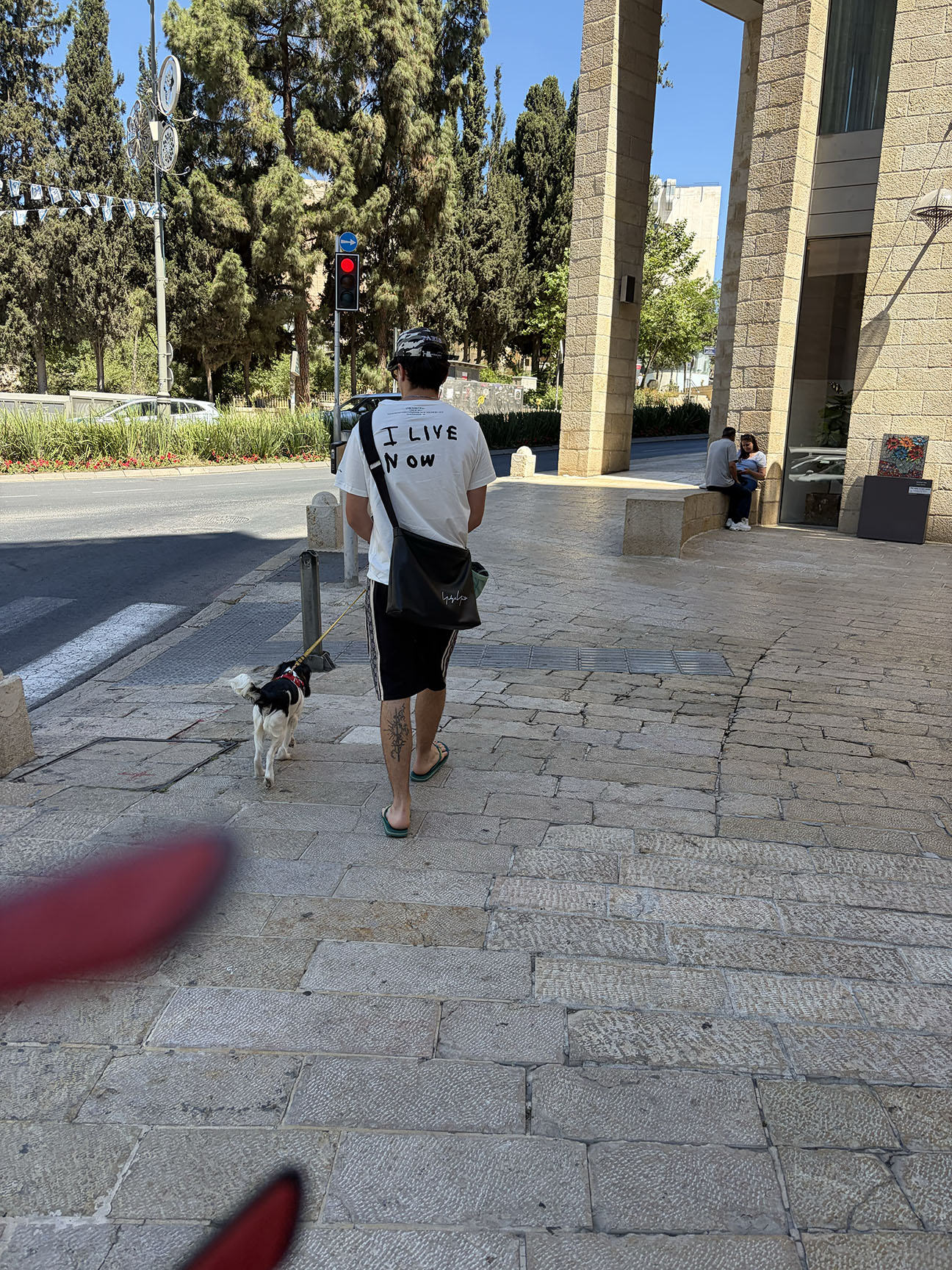
I’m in Jerusalem, and I need some water.
It’s late afternoon, the sun is still shining bright, lots of people milling around the Mamilla area.
As I head to the grocery store (run by the same Arab man I’ve known for 20 years), I’m thinking only of quenching my thirst.
The problem is I’ve had this lifelong habit of reading everything.
Put words in front of me—an ad for Dior, an announcement of the Messiah, a warning about slippery stairs—and I’ll read them.
The words now in front of me are on the back of a white t-shirt worn by a cool-looking young man in sandals walking his dog.
“I Live Now.”
The lettering is slap-dash, as if a kid had scribbled it in a few seconds. This is no slick branding campaign from The Gap.
The phrase is awkward, almost too simple.
I understand “live for the moment” or “live for the now.”
But “I live now?”
Of course you live now. We all live now!
So why can’t I get those three words out of my head?
At night, at a Shabbat dinner in the Old City, I find a possible answer.
We’re with a large, eclectic group, with visitors from around the world mixed in with IDF soldiers.
Before dinner, the hostess invites a group of female soldiers in uniform to join her for candle lighting.
The words flow out of her mouth. Elevation. Holiness. Transcendence. What is most moving, though, is the scene itself— a group of armed soldiers who deal with danger every day in a semi-circle facing an army of beautifully lit candles while a woman dressed in white shares her spiritual light with the echoes of our biblical Temple not far away.
It’s easy to get lost in the moment, and my friend and I do.
Then something happens.
One of the soldiers moves closer to the candles and speaks to the hostess about a close friend and fellow soldier who was killed a few days earlier.
Our Shabbat moment instantly shifts to another place and time— to a tragedy in a war that seems to own time.
I can only imagine how many such moments have afflicted Israel since October 7—someone, somewhere, reflecting on the loss of a loved one.
The soldier chokes up as she talks about her friend.
Her mind is on a tragic loss in the past and how much she’ll miss that friend in the future.
But right now, she is neither in the past nor in the future; she is in the intense here and now of Shabbat.
The hostess suggests we dedicate our Shabbat gathering to the fallen soldier. A feeling of peace seems to emanate from the army of candles. We’re back in the moment, and we’re bringing the lost friend with us.
Later that night, I start to better understand that awkward line on the t-shirt.
We can grieve the past and feel anxiety about the future, but “now” is really all we have.
Israelis seem to have a special affinity for the moment. Maybe that is how the country has made it this far— millions and millions of “What do we do now”?
What do we create? What do we fight? What do we sing? What do we pray for?
Shabbat, a time when work stops, ironically may be the ultimate now.
Shabbat liberates us to be present in the moment. It is the now in all its glory.
Yes, we need memories from our past and dreams for our future, but as we go through our daily lives, whether we are poets or soldiers, Shabbat reminds us there really is only now.
There is only life.
And, especially in a place like Israel, there is only “I live now.”
Maybe those awkward words was what I was thirsting for.