
The front courtyard of the Amal high school in the western Galilee village of Yanuh Jat, with its stone terraces, flower-lined walkways and wooden bench circles, looks more like a retreat center than a typical school. Inside the high-ceilinged lobby, banners feature quotations in Hebrew, Arabic and English from public figures like John F. Kennedy and Steve Martin.
The school serves children from villages along Israel’s northern border, and its atmosphere is no accident. Its design evokes order, beauty and respect, reflecting the philosophy of principal Wageeh Barakat, who took on the role a few years ago after the death of the school’s legendary longtime principal, Majed Bissan.
“I want students to feel like they are at home here,” Barakat said.
Yanuh Jat’s high school is one of several Druze-majority schools run by Amal, an educational network whose 50 affiliates range from vocational schools serving marginalized Israeli populations to science and technology schools in Israel’s biggest cities as well as its periphery. Amal’s Druze schools, which serve an Arabic-speaking religious minority of about 150,000 people in Israel, pursue a dual mission: strengthening Druze identity while preparing students for full participation in Israel’s diverse, democratic society.
Israel’s Druze community primarily lives in the country’s north, and they maintain their own traditions and leadership. At the same time, the community is known for its loyalty to the state and its high rates of service in the Israel Defense Forces.
The last two-plus years of war have underscored the bonds between the Druze and their Jewish neighbors. Two senior Druze IDF officers from Yanuh Jat, both alumni of the school, were killed in Israel’s war in Gaza following Hamas’ invasion on Oct. 7, 2023, while rocket fire and cross-border attacks from Lebanon have repeatedly disrupted daily life in Western Galilee Druze communities. For Amal’s schools in the region, war is not only a news story but a daily reality that shapes students’ sense of identity, belonging and future.
As part of its mission, Amal schools work with Israel’s minority communities — including Bedouins and Christians — to help explore and affirm their identities as both members of distinct cultural/religious groups and as citizens of Israel. At Amal’s Druze schools, for example, educators teach the community’s history, traditions and values alongside broader civic studies. By helping Druze students understand their own story, they can better grasp what democracy looks like in a diverse society: equal rights, mutual recognition and shared responsibility across different identities.
That mix of loyalty to Israel and a distinct communal identity also means that long-term partnerships with Jewish schools in a network like Amal are never automatic; they grow out of deliberate, respectful relationship-building that models the very democratic values the project seeks to instill.
Wageeh Barakat, the principal at the high school run by Amal Educational Network in Yanuh Jat, at his desk. (Elana Sztokman)
The Yanuh Jat high school functions not only as an academic institution but as a community hub and safe space. Open seven days a week, it hosts workshops and lectures that strengthen ties between parents, educators and children, as well as informal encounters in Barakat’s always-open office.
Barakat recalls with pride a letter from a hotel manager in Eilat praising his students’ considerate behavior on a school trip. For him, those moments matter as much as test scores because they reflect the values he wants his students to bring into Israeli society.
One expression of that vision in Yanuh Jat is the school’s Library for Democracy. With support from the Dan David Foundation, Amal is transforming its 2,100-square-foot library into a modern, multi-functional learning center with books and digital resources on democracy, human rights and citizenship.
The redesigned library will also include computer stations, quiet reading corners and spaces for community workshops and intergenerational learning, modeled on other global efforts to turn libraries into hubs of civic engagement. Barakat sees it as a resource not only for his 650 students but for the broader village, aimed at strengthening resilience and democratic values in a community living under the shadow of war.
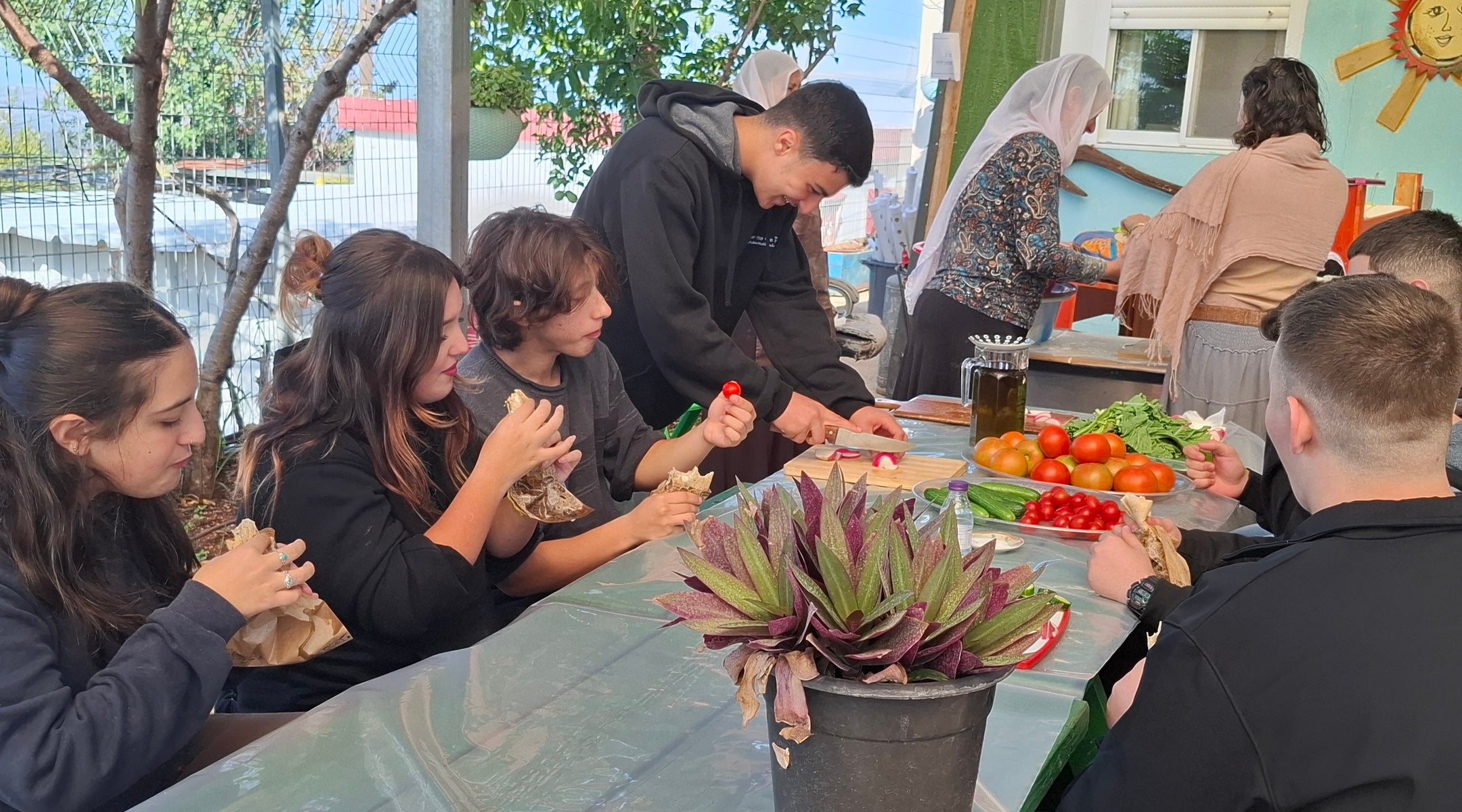
Barakat, who grew up in Yanuh Jat, also devotes significant energy to building bridges with Jewish communities. In November last year, the school hosted Jewish students from an Amal school in nearby Amka at a farm that serves as an extension of the Yanuh Jat campus.
“I am a great believer in coexistence, in partnership, in knowing the other,” Barakat said. “The more we know the other side, then there is truly room to come closer and live together in this country.”
In hillside fields, students worked together handling medicinal plants that are part of Druze culture, learning traditional techniques for pressing olive oil and conducting agricultural experiments. They shared Druze pita, labneh and cucumbers picked on site, turning a school day into a lesson in shared life.
Educational coordinator Madlen Bibar described the activity as representative of “our common roots.” The workshop is intended as a model for similar encounters in other Amal schools.
Supporting these efforts behind the scenes is regional Amal director Shiri Eshed Yehoshua, whose aim is to tighten the link between schools in the field and Amal’s central leadership, as well as initiate activities with other Amal schools to strengthen the experience of being part of a network that is proud of its mission to create a shared society.
For Eshed, that means spending much of her time on the road across the Galilee, helping educators translate Amal’s democratic values into everyday school life.
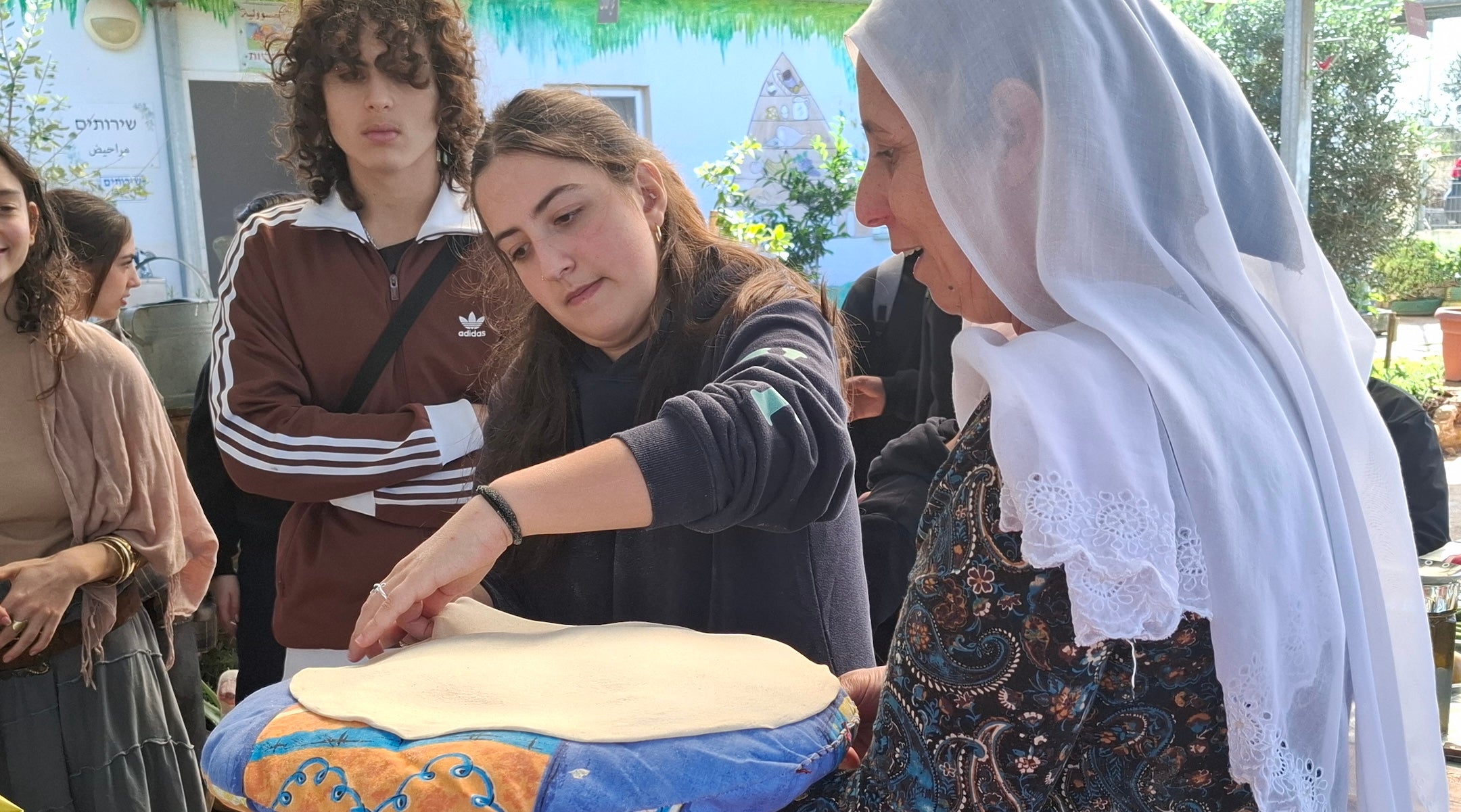
Amal students learn how to make laffa bread with Druze women during a farm trip in November 2025. (Elana Sztokman)
“This work on identity and culture is vital to the work at Amal,” she said. “It is not a one-off encounter for coexistence but rather the beginning of creating a lifelong, meaningful partnership.”
Amal’s teachers are also part of this push. Educators from Amal schools across the northern Galilee participate in a program called Democracy Community that meets every two weeks to explore civic identity and develop classroom tools for discussing difficult topics.
If Yanuh Jat illustrates how a school can serve as a community anchor, the Amal Multidisciplinary High School in Kisra Samia shows how an educational institution can become a shared anchor for two neighboring communities. Led by principal Nazir Rabah, a renowned educator and veteran Amal leader, the school serves the Druze villages of Kisra and Samia, which are about 30 minutes apart. Under Rabah’s leadership, the school has become a place where students from the two villages learn, volunteer and celebrate together, modeling a respectful coexistence that often eludes wider public life.
The school’s nearly 1,000 students are mostly Druze, though there are Christian and Muslim pupils as well. “A school must open opportunities and strengthen identity,” Rabah said. “Because a student who knows who they are can face the world without fear.”
Over the years, Kisra Samia — which offers majors in medical science, software engineering, business administration and rescue and safety studies, alongside core academic subjects — has been recognized for academic excellence, innovation and social leadership. The school frequently partners with local Jewish schools, and it also attracts visitors, including American Jewish delegations, who want to see how Israeli public schools can combine strong identity building with high-level STEM and vocational education.
The school is part of an initiative Amal is leading with the Accord Center at the Hebrew University that brings together teachers from selected schools to explore identity: social and personal, national and international, as a way of bridging differences across Israel’s diverse society.
“As a diverse network that is a microcosm of Israeli society, we see it as our responsibility to give every student in Amal the best possible education, even when the starting points are very unequal,” said Tamar Peled Amir, Amal’s vice director general for education, research and technology. “Equality, human dignity, liberty and social justice are not slogans for us. They are about giving each student the best possible ticket to the next station in life”.
In both Yanuh Jat and Kisra Samia, that “ticket” is shaped every day in classrooms, hallways and courtyards where Druze teenagers wrestle with questions of faith, citizenship and future in a country recovering from a brutal war. For Amal, investing in these schools means investing in a shared Israeli society in which a small, proud minority can both preserve its identity and fully participate in the national story.
Reporting the stories that define our era. When history unfolds in real-time, the Jewish world turns to (JEWISH REVIEW). Your support ensures we can document the complexities of war and the resilience of Jewish communities with integrity.