
Syria would be better at tackling Hezbollah in Lebanon, U.S. President Donald Trump said Tuesday, as Israel’s presence in Lebanon continued to be an Achilles’ heel in the fledgling U.S.-Iran deal set to be formally signed in Geneva on Friday.
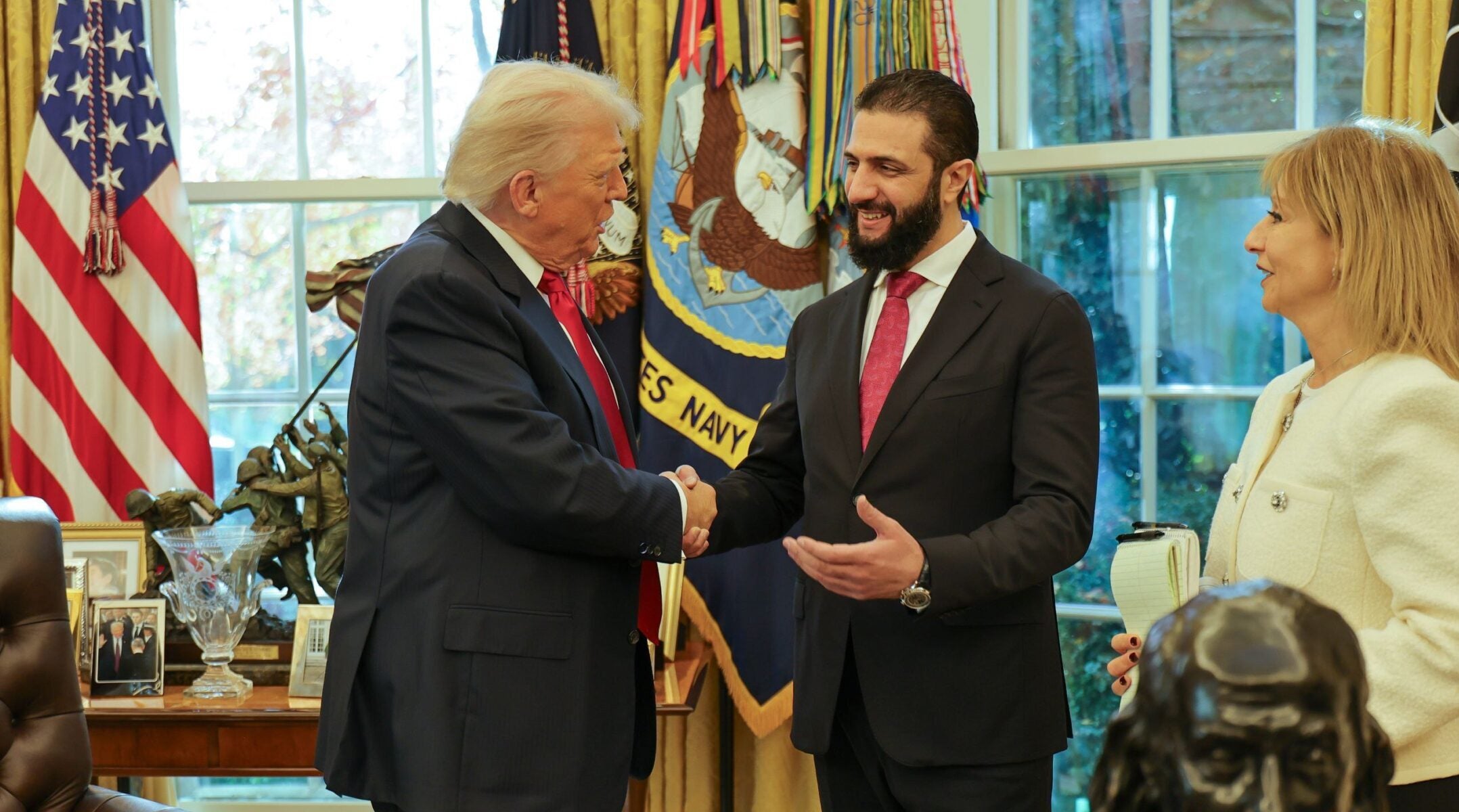
Trump said Syrian President Ahmed al-Sharaa, a former leader of an al Qaeda-affiliated group who has fashioned himself as a modern statesman after taking power in 2024, could be more effective and less destructive than Israel has been.
“If Israel can’t do the job without killing everyone else, he will do the job, Syria will do the job,” Trump said in Evian, France, on the sidelines of the G7 Summit.
Trump accused Israel of taking too long to oust the Iranian proxy group from Lebanon, just one day after he said that he himself might intervene by speaking directly with Hezbollah.
Trump also said Tuesday that “regime change” had never been the goal of the war with Iran and described Iran’s current leadership as “rational,” “smart” and “strong.” The president said the deal would prevent Iran from acquiring, building or developing a nuclear weapon.
The Iran deal to end months of hostilities between Washington and Tehran was digitally signed on Sunday, according to Trump’s vice president, JD Vance. Its terms have not been published, but officials have said that it also includes an end to hostilities between Israel and Hezbollah, even though Israel is not a party to the agreement. Separate talks have been held in Washington between Lebanese and Israeli officials toward a peace deal that Hezbollah has so far rejected.
Israel has insisted that its army will remain in southern Lebanon to prevent Hezbollah attacks against communities in northern Israel. Iran’s Foreign Minister Abbas Araghchi told reporters in Tehran on Tuesday that the deal with Washington was contingent on an Israeli withdrawal from Lebanese territory and a halt to the fighting, according to the state-affiliated Press TV.
Trump addressed the issue of Hezbollah on Tuesday in France during a meeting with Qatar’s Emir Sheikh Tamim bin Hamad Al Thani, whose country has been among those playing a mediating role between the U.S. and Iran.
“Israel is fighting Hezbollah too long, and too many people are being killed, and you do not have to knock down an apartment house every time you are looking for someone,” Trump said.
“There are a lot of people in those apartment houses, and they are not all Hezbollah, and I suggested to Israel that Syria should take care of Hezbollah, and to be honest with you, I think they will do a better job at it,” he stated.
Trump downplayed any tension between himself and his ally in Israel, Prime Minister Benjamin Netanyahu, even though he admitted that he had been upset by Netanyahu’s decision to attack Hezbollah in Beirut on Sunday just hours before the Iran deal was announced.
At one point in his remarks Tuesday Trump described the relationship as “unbelievable” and “effective,” and when asked if there was tension between the two leaders, responded “no,” even as he gave examples of how Netanyahu’s handling of Lebanon has frustrated him.
“I didn’t like that two hours before we were signing the agreement … that there was an attack in Lebanon, it was right in Beirut. I did not like it, I let them [Israel] know it,” Trump said, adding that the Hezbollah drone attack on Israel that prompted Israel’s retaliation was minor.
“You can do too much also,” Trump said, explaining that he “was not happy” with how Israel conducted itself in Lebanon, where it should have been “able to do the job faster. It just goes on and on [in a way that] throws a negative light on the big deal.”
Still, Trump said he did not think that Lebanon would derail the agreement with Tehran, describing it as a “minor war.”
Lebanon aside, Israel is concerned that the Iran deal strengthens the Islamic Republic, which it had hoped would be overthrown as a result of the war, and that the deal would allow it to continue to pursue a nuclear and ballistic missile weapons program. That the deal allows for more money to flow to the heavily sanctioned regime has only fueled that concern.
“This deal is a wall to a nuclear weapon,” Trump said, rejecting the idea that U.S. funding was a part of the agreement. “We are not investing any money. We have no obligation to invest any money in Iran,” he said.
Trump underscored the danger to the region and to Israel should Iran become a nuclear power and said the war and this deal prevented that. Echoing comments he has made before, he said, “Without me, Israel would not exist right now.”
Reporting the stories that define our era. When history unfolds in real-time, the Jewish world turns to (JEWISH REVIEW). Your support ensures we can document the complexities of war and the resilience of Jewish communities with integrity.