

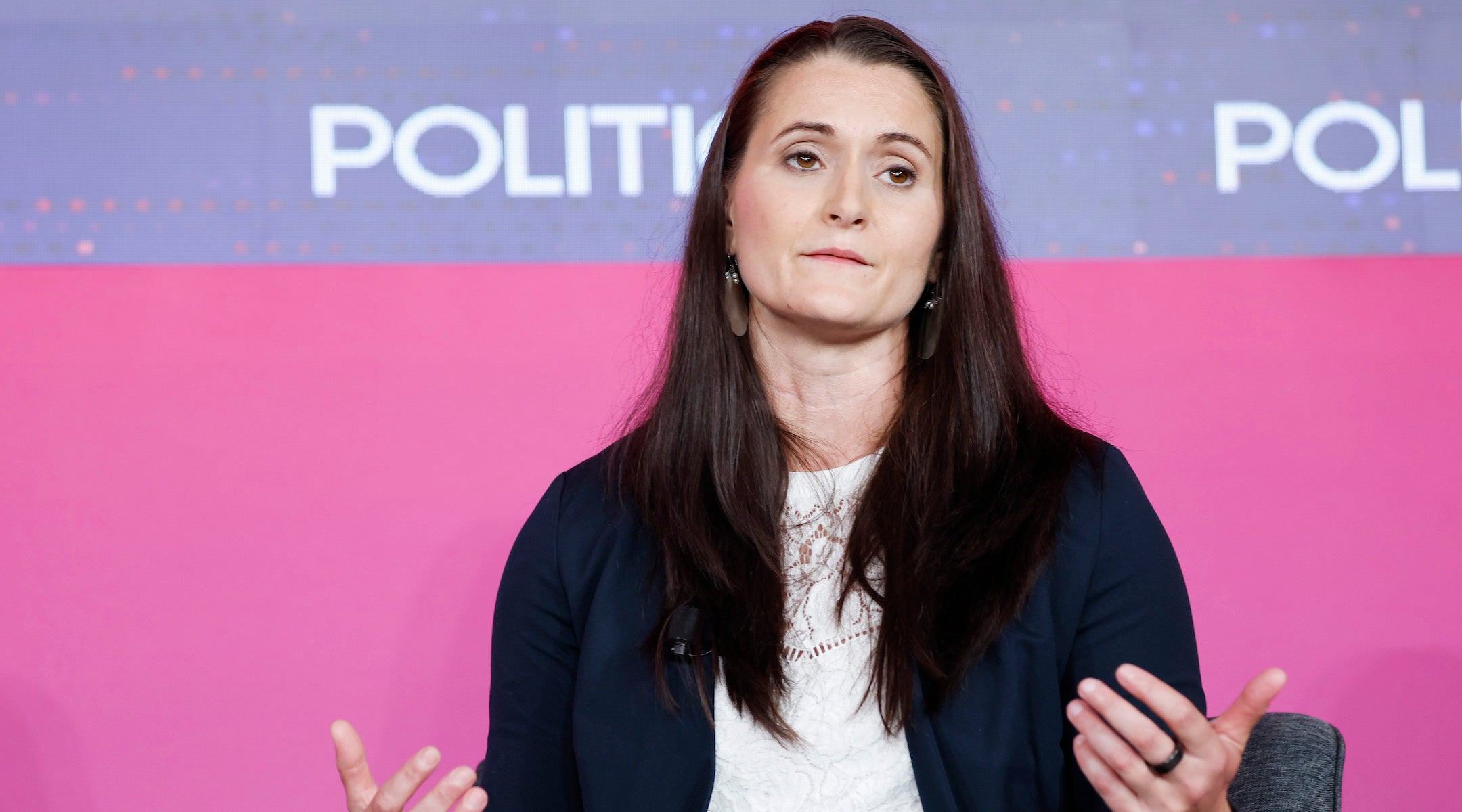
Voters in New York’s Hudson Valley on Tuesday chose Cait Conley, a military veteran and former national security aide, as the Democrat to challenge the staunchly pro-Israel Republican Rep. Mike Lawler in a heavily Jewish swing district. New York’s 17th Congressional District is a suburb of New York City that includes about 30,000 Orthodox Jews.
Cait Conley, a military veteran and former national security adviser, was declared the winner by media outlets with 64% of the vote counted. She had led by double digits in polls this month and prediction markets over Beth Davidson, a member of the Rockland County Legislature who highlighted her Jewish identity. A poll from Tavern Research last week found that 28% of voters were still undecided as the election approached.
Both had appealed to residents anxious about the cost of living, housing, healthcare and foreign conflicts. As the primary winner, Conley will also aim to claw back moderate voters who supported Lawler, one of the most vocally pro-Israel members of Congress and a representative who has forged close ties with Orthodox Jewish voters.
Davidson and Conley have both said they support the United States alliance with Israel while opposing actions by Israeli Prime Minister Benjamin Netanyahu’s government. During a candidate forum in April, they distanced themselves from Democratic efforts in the Senate to block certain military sales to Israel.
Effie Phillips-Staley, a progressive who says Israel is an apartheid state that has committed genocide in Gaza, received 16.1% of the votes as the race was called.
Conley and Davidson said they married pro-Israel views with a liberal agenda, including fighting President Donald Trump. Davidson told the Jewish Telegraphic Agency that she wanted to create a political home for “Jews that have felt lost in the Democratic party.” She previously served on the board of her White Plains synagogue, Beth Am Shalom, and has touted Jewish values as driving her public service, including tikkun olam, or repairing the world, and welcoming the stranger.
Conley has presented her military experience as an advantage. A former national security adviser in the Biden administration, she has said that she supports a two-state solution to the Israeli-Palestinian conflict and views Israel as a critical national security ally.
Conley will face off with Lawler, who has become so closely identified with the district’s Jewish community that he was recently attacked in comments by Sen. Rand Paul’s son, William Paul, who accused the lawmaker of being one of “you people,” although Lawler is not Jewish.
Often working with Democrats, Lawler has proposed a spate of legislation aimed at supporting Israel since he entered Congress in 2023. He co-sponsored the bipartisan Antisemitism Awareness Act, which would require the Department of Education to codify the International Holocaust Remembrance Alliance’s definition of antisemitism, a move championed by major Jewish groups and criticized by progressives for classifying some forms of Israel criticism as antisemitic. The bill passed in the House in 2024 but stalled in the Senate amid free speech concerns and was reintroduced in the House last year.
Lawler also introduced in 2024 the bipartisan Stand with Israel Act, which seeks to halt funding for United Nations agencies that “expel, downgrade, suspend, or otherwise restrict the participation of the State of Israel.” His bipartisan 2025 Bunker Buster Act seeks to equip Israel with massive bombs to target Iran’s nuclear infrastructure.
This year, Lawler has partnered with Democrats on two new measures that he says will combat antisemitism. The Jewish American Security Act introduced this month proposes expanding federal security support for Jewish institutions, and a House resolution from April condemns leftist streamer Hasan Piker and far-right podcaster Candace Owens for “antisemitic hate-filled rhetoric and content.”
Phillips-Staley represented the rising progressive wing of the Democratic party that is sharply critical of Israel, differentiating herself from Lawler as well as Conley and Davidson. Phillips-Staley has said that her views solidified after she traveled to Israel and the West Bank in February. She was criticized by some Democratic officials for doing an interview with Piker.
She told (JEWISH REVIEW) in March that many Jewish residents supported her belief that Israel has committed genocide and the United States should sever military aid.
“I get the most encouragement, from lots of people, but a lot of encouragement from Jews who really challenged me, especially in the beginning, to be brave and say it like it is,” said Philips-Staley.
Republicans were suspected of jumping into the late stage of the race by funding a shadowy new group called Progressive Champions PAC, which mirrors GOP efforts to influence other Democratic primaries nationwide. Davidson publicly disavowed the PAC, which has spent $1.5 million on ads attacking Conley for her contract work for an AI company that works with the Department of Homeland Security, according to the Cook Political Report.
Conley will quickly rocket to national prominence in the general election, as Lawler’s seat is considered one of the most likely to flip in November. Democrats outnumber Republicans in the district, which former presidential candidate Kamala Harris won by less than one percentage point in 2024.
Jewish stories matter, and so does your support. The New York Jewish Week brings you the stories behind the headlines, keeping you connected to Jewish life in New York. Help sustain the reporting you trust by donating today.