
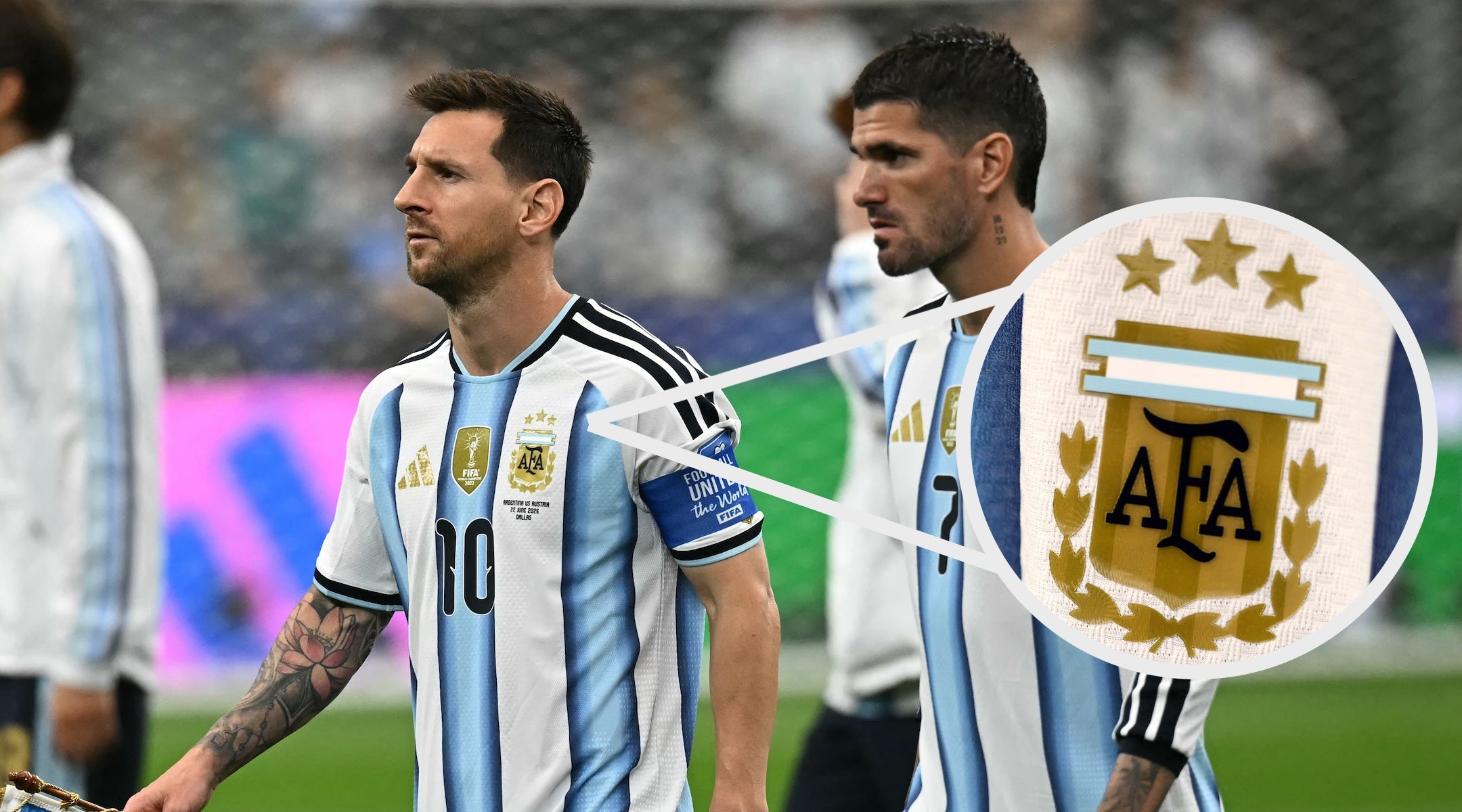
BUENOS AIRES — Soccer fans around the world are familiar with the crest worn by Argentina and its star Lionel Messi: a vertical shield with laurel branches symbolizing victory and glory at the bottom and three stars at the top representing the team’s three World Cup titles.
But few are aware that the crest has its roots in Argentina’s close-knit world of Jewish sports clubs, where its designer developed his affinity for soccer.
Norberto “Toto” Rud was in his late 20s and a member of Club Náutico Hacoaj, a Jewish club, when he proposed the crest in 1976, drawing on the branding acumen and graphic design skills he would use throughout his career as a businessman and soccer aficionado in Buenos Aires.
Rud has long been credited with developing the crest after observing that while many European soccer teams wore distinctive emblems, his own beloved Argentina’s jerseys were notable only for their sky blue-and-white colors.
Watching international soccer in the era of black-and-white television, Rud noticed that supporters could instantly recognize teams such as West Germany by its eagle or the Soviet Union by its CCCP lettering, but Argentina could easily be confused with clubs wearing similar striped shirts. He concluded that the national team needed a visual identity equal to its footballing tradition.
Rud prepared approximately 20 design proposals and submitted them to the Argentine Football Association, in a proposal that reached its president and executive committee. The crest made its debut on Nov. 28, 1976, just days after it was approved, in a 0-0 friendly against the Soviet Union in Buenos Aires.
Fifty years later, the crest is basically unchanged and is one of the most widely worn team logos in the world, as Messi jerseys are popular across the globe.
“As a son and a member of the Jewish community and as an Argentinean, it’s a source of pride,” Toto Rud’s son Oliver Rud told the Jewish Telegraphic Agency. He added, “Every time I see Argentina’s national team crest, it still amazes me.”
Left: The 1976 letter telling Norberto Rud that his design had been chosen as the Argentine Football Association’s official crest; at right, Rud’s son Oliver wears a jersey featuring his father’s design. (Courtesy Oliver Rud)
Toto Rud got to see Argentina wear his crest to two World Cup championships, in 1978 and 1986. But he did not live to see the third in 2022. He died in 2010 at age 61 and is buried in Buenos Aires’ La Tablada, Latin America’s largest Jewish cemetery.
Oliver Rud said his father’s mother came to Argentina from Ukraine, a common pathway for Jewish migrants in the first half of the 20th century. Toto Rud was born in March 1948 and was a longtime member of Hacoaj, where he played club soccer himself.
Founded in 1935 by Jewish immigrants to Buenos Aires, Club Náutico Hacoaj is a sports and cultural club with around 10,000 members and five facilities, one in Buenos Aires city and four in Tigre, a city in the north of the Buenos Aires province. Hacoaj, which means “strength” in Hebrew, has been the launch pad for a number of prominent Jewish athletes, including tennis star Diego Schwartzmann. Oliver Rud said a tree dedicated to his father is planted on Hacoaj’s sprawling campus.
“For Hacoaj, it is a tremendous source of pride that one of our members was the creator of the Argentine Football Association’s crest,” the club’s president, Osvaldo Ofman, told JR. “His design not only represents the jersey of the Argentina national team, the reigning World Cup champions, but also gives us the feeling that a small part of Hacoaj and the Jewish community lives on in an emblem recognized around the world.”
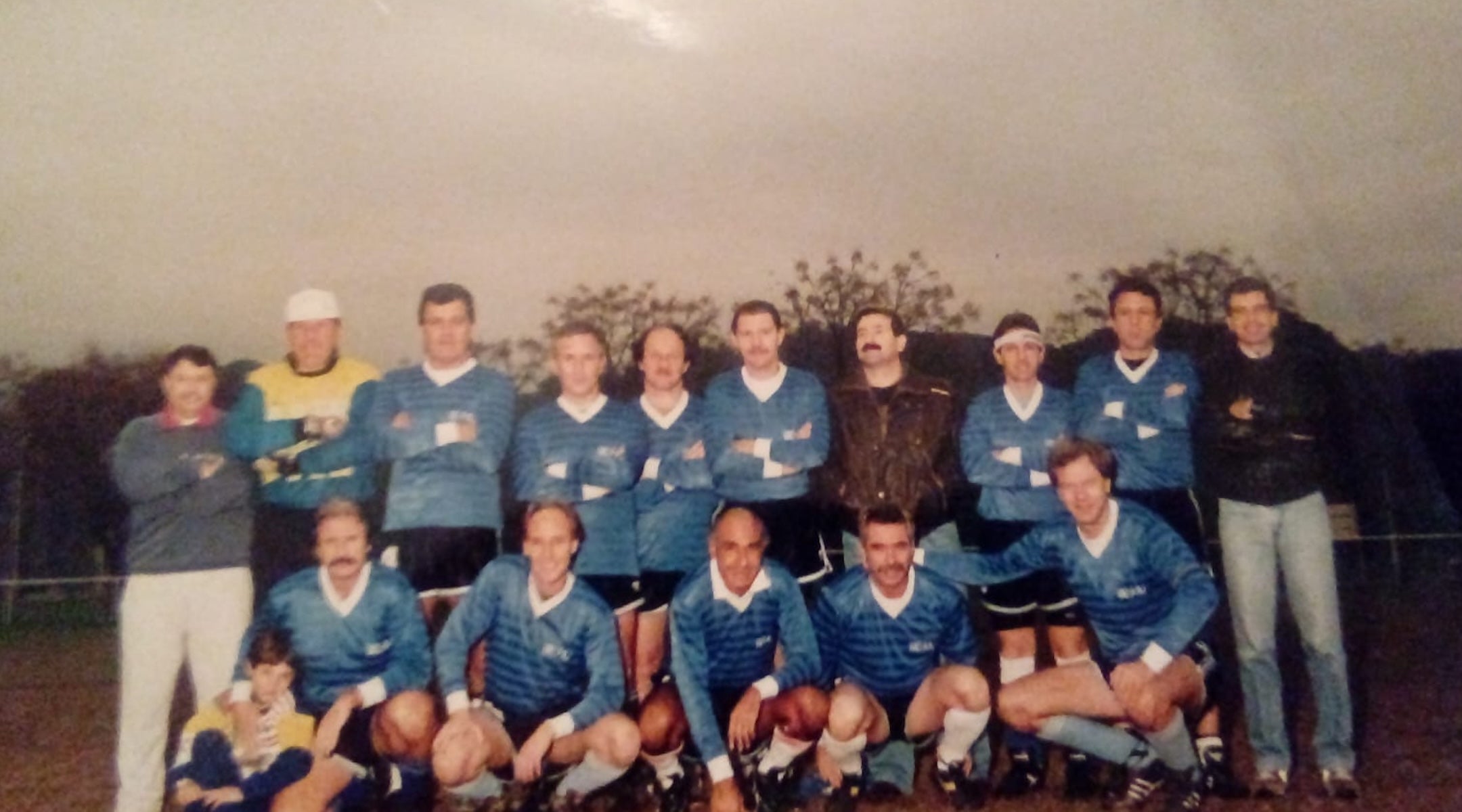
Norberto Rud, at the bottom right, is seen with his JCC Hacoaj club soccer teammates in an undated photograph. (Courtesy Oliver Rud)
Now, Argentina will face off in the Round of 16 against Egypt, whose coach Hossam Hassan waved a Palestinian flag after defeating Australia in a 4-2 shootout on Friday. Footage of him walking across the field with the flag while chants of “Free, free Palestine” were heard quickly went viral. In a post-match interview, Hassan said his “heart and soul” were with the Palestinian people and dedicated the win to both Egyptians and Palestinians.
Tuesday’s match represents something of a de facto Israeli-Palestinian showdown in a tournament in which neither the Israelis nor the Palestinians are playing. In addition to the show of support for the Palestinians from Egypt, the Argentine government staunchly supports Israel, which Messi, a Catholic, has visited. And a recent poll by an Israeli magazine found that Argentina was the clear favorite among Israeli World Cup viewers, named by 38% of respondents as the team they hope wins the tournament.
The knockout game comes a decade after Messi ignited a backlash in Egypt after announcing on an Egyptian television program that he was donating his shoes to a charity in Cairo. Presenters on the TV show accused Messi of being Jewish and aligned with Israel, which he had visited three years earlier.
“I know he’s Jewish, he donated to Israel and visited the Wailing Wall and whatever,” then-Egyptian Football Federation spokesman Azmi Mogahed phoned in to say. “We don’t need his shoes and Egypt’s poor don’t need help from someone with Jewish or Zionist citizenship.” Mogahed died in 2020.
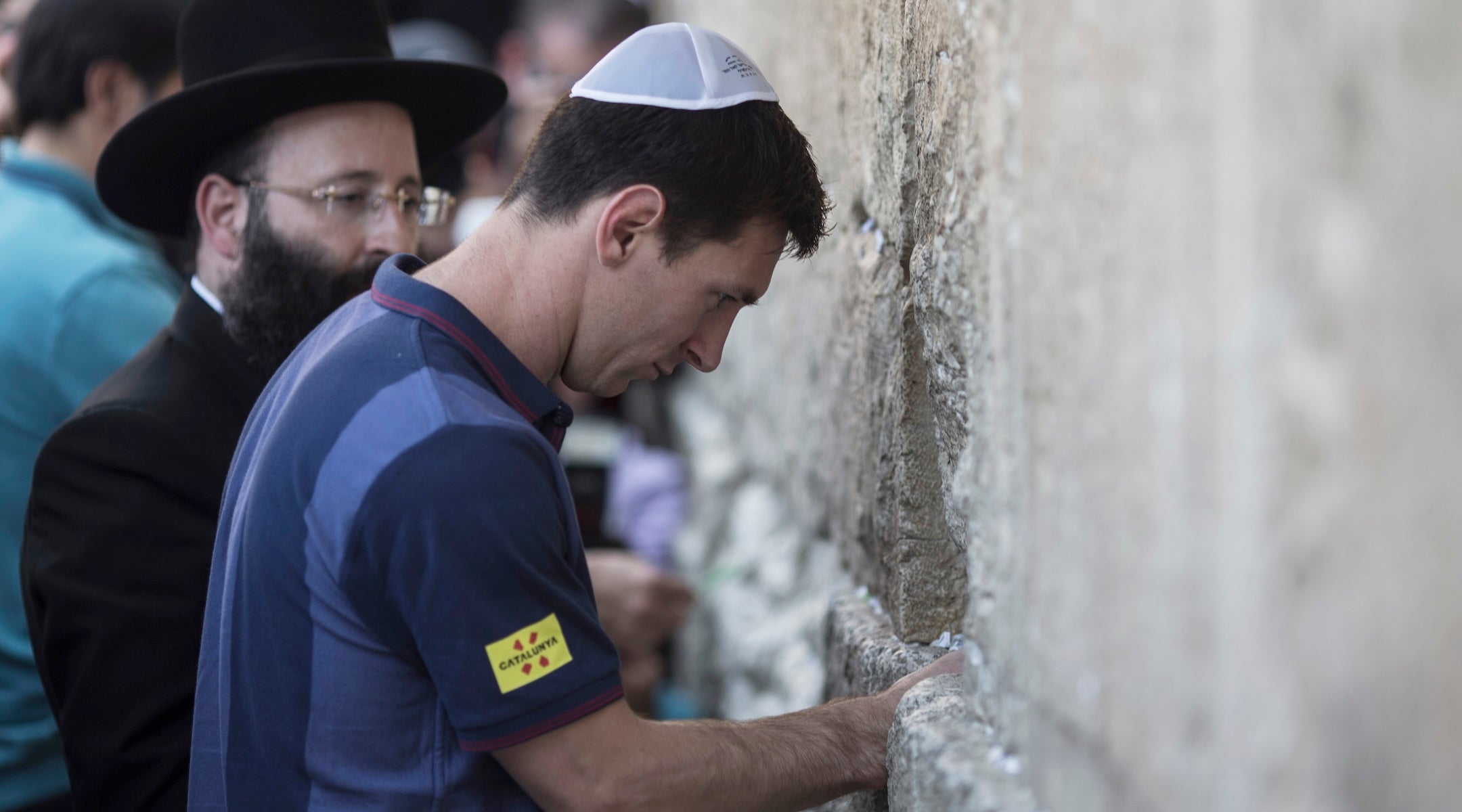
Lionel Messi, then with FC Barcelona, puts a paper with wishes in a crack in the Western Wall, Judaism’s holiest site, in Jerusalem during a team trip to Israel and the West Bank, Aug. 4, 2013. (Oliver Weiken/AFP via Getty Images)
Messi, who plays for Inter Miami during the regular season, is 39 and is widely expected not to play in another World Cup after this one, meaning that an Argentina loss could be his last game in international competition.
For Oliver Rud, the game will be an opportunity to reflect not only on Messi’s contributions but on his father’s, as well.
“Every time I see Argentina’s national team crest, it still amazes me,” he said. “In fact, my brother Guido and I were just talking about it the other day — how incredible it is to think that Toto designed the crest for the national team some 50 years ago. It’s really extraordinary. Every time I see the crest, I feel a little piece of him in my heart. It’s a beautiful way to remember him.”
Reporting the stories that define our era. When history unfolds in real-time, the Jewish world turns to JR. Your support ensures we can document the complexities of war and the resilience of Jewish communities with integrity.