

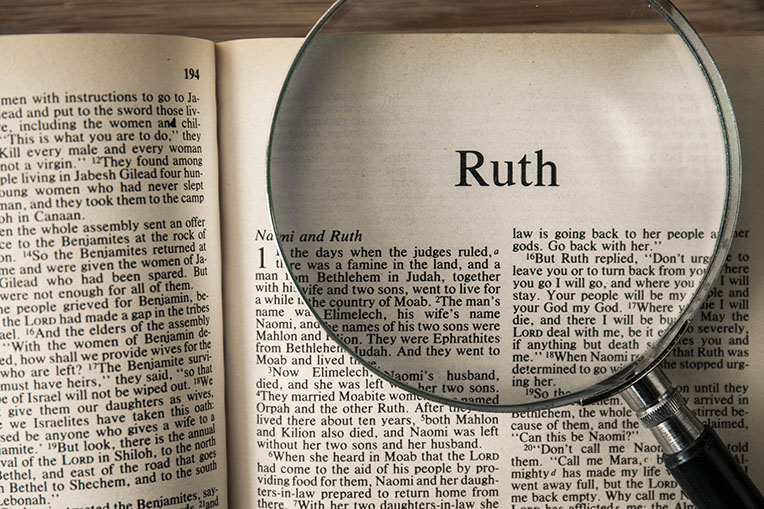
It’s never too late to consider lessons of the Torah. For the Biblical holiday of Shavuos which celebrates the Israelites receiving the Torah, Jews read the biblical Book of Ruth, a pastoral love story set in ancient Israel. If not for the last five verses of the last chapter (4:17-22) which state that Ruth was the great-grandmother of King David, this entire romantic tale may not have been included in the Bible.
These last few verses were likely a later addition to this popular love story in order to make it “kosher” for Israelite/Jewish readers to enjoy the tale of a young Moabite woman’s immodest, even illicit, behavior with an older Israelite man. It should also be noted that David, like his great-grandmother Ruth, also had a particular attraction to the opposite sex.
But my focus here is not so much on the story as on the name of the heroine, which presents a fascinating enigma, an intriguing puzzle.
Although other names of Biblical heroines like Sarah, Rebecca, Rachel, Leah, Chana, Esther and Deborah, are widespread among Jews throughout the ages, the name Ruth somehow did not catch on. It never was a popular name among Jews, especially those who are observant.
What do you mean, not popular? I hear you say. I know a Ruthie. And what about the late Supreme Court Justice, Ruth Bader Ginsburg?
My reply is: I know three Ruths, one who was born in Germany, another to Polish parents in Vienna, the third an Israeli, the latter two secular. But the point I am making is that among mainstream Jews in Europe that name was rarely given to girls.
Two ways to assess this is:
1. To look at memorial tablets on synagogue walls or on Holocaust memorial plaques or walls built in towns and cities after the Holocaust;
2. The other way is to listen during synagogue services, when the time comes to recite the “Full Recovery” or, in Hebrew, the “Refu’a Shleyma” Prayer for the person who is ill. The cantor or rabbi asks the congregant the name of the sick person and that person’s mother’s name. That is the traditional way the prayer has been formulated. For example, “May a full and speedy recovery come to: Dan, ben (son of) Rachel,” or “Sarah, bat (daughter of) Leah.”
In the decades I have been pursuing this elusive name, in synagogues in the US and in various European lands, in scores of synagogues in Jerusalem and other cities in Israel, in Ashkenazic, Sephardic, Yemenite, Iraqi and other communities in Israel — I have never ever heard the name Ruth as part of a “get-well” prayer, either in the first part of the prayer( (“May the All-Merciful One cure Ruth, the daughter or XXXX”) or the second, “May the All-Merciful One cure XXXX, the son/daughter of Ruth”). Furthermore, I have never seen that name on any memorial tablet that is usually hung on a synagogue wall.
In the southern French city of Nice, there is a huge memorial tablet honoring all the Jews who had been deported to German concentration camps. Among the hundreds of names, I did not find once the name Ruth.
In modern Israel, the name Ruth has been revived—among secular Jews. But, basically, among more traditional Jews, that name has been sidelined.
Regarding this name there is a kind of personality split among Jews.
On the one hand, on the late spring holiday of Shavuos, so ripe for a summer tale of romance as depicted in the Book of Ruth, those four short chapters are happily and melodiously read at the Morning Service of the First Day of Shavuos, with an especially upbeat tone at the end when the verses depict Ruth as being an ancestor of King David, who himself will be the ancestor of the Messiah. On the other hand, not one of the men sitting there has a wife, mother, mother-in-law, sister or daughter named Ruth; nor do any of the women sitting in shul bear the name Ruth, nor do they have any relatives with that name.
The noted memorial in Paris, The Wall of Names, lists the 76,000 Jews, including 11.000 children, that the Germans deported to death camps between 1942 and 1944, with the help of the French Vichy government. I spent a long time gazing at the almost endless list of names engraved in the stones.
I can’t say that I read all the names. But during the time I spent there I did not once encounter the name Ruth.
Now for the question: Why?
First of all, Ruth is a Moabite, not an Israelite; never mind that she entered the fold with that famous phrase that she utters to Naomi (Chap. 1:16): “Thy people shall be my people, and thy God my God.” Countervailing this, there is also the famous law in Deuteronomy 23:3 that explicitly states: “No Ammonite or Moabite or any of their descendants may enter the assembly of the Lord, even in the tenth generation.”
For a love story, however, and in a literary work whose genre is a “romance” – the rules were apparently bent. And bent so that Ruth is even listed as having King David as her descendent.
But what most likely disturbed the Jews throughout the ages is Ruth’s immodest behavior. What well-brought up, unmarried Jewish girl, even if inspired and urged on by her mother-in-law, Naomi, slips into a man’s bed and spends the night with him? Ruth is a widow; she had married one of Naomi’s two sons, Machlon; Naomi’s other son, Chilion, married Oprah. (The men’s names have ominous meanings: “illness” and “devastation”.)
Most of Chapter 3 deals with Ruth, obeying Naomi’s instructions, who secretly, and unbeknownst to Boaz joins him in his bed (Boaz is Naomi’s distant kinsman) after “he has eaten and drunk and his heart was merry” and Ruth “uncovers his feet” — a strange phrase, but the sexual overtones are not difficult to miss.
As everyone knows, this tale has a happy ending. Boaz marries Ruth and she has a son with him. This delights Naomi and the baby is like a son to her.
She takes the child (4:17), “laid it in her bosom and became nurse unto it.” It is as though Naomi herself had borne the child. However, it seems to me, Ruth’s immodest behavior doomed her name as a name of choice for Jewish girls over the centuries. The same held true for Naomi and Boaz, neither of which were popular names among Jews until they were revived in modern-day Israel.
Jews spoke in two voices about Ruth, a kind of national schizophrenia, one with joyous chanting on Shavuos as the Book of Ruth was read; the other, removing her name from the chain-link of repeated names throughout the generations. Despite her alleged family link to King David which, as I asserted before, was likely attached to the Book of Ruth to make it kosher and acceptable to Jews — the Jews expressed their opinion about this biblical character with a vote of silence.
Curt Leviant is the editor of “Masterpieces of Hebrew Literature: A Treasury of Two Thousand Years of Jewish Creativity.” His most recent fiction is “The Woman Who Looked Like Sophia L.” A new novel titled, “My Adventures with The Knight of the Mournful Countenance, His Grace, Don Quixote, as told by Sancho Panza, Ex-Squire,” will appear in July 2026.