
To stop or not to stop at a Kristallnacht monument? That is the question (at least for all German tour guides giving city walking tours to non-Jewish foreign exchange students). I was about to start a “study abroad” semester at the Technical University of Dortmund. After arriving, I learned that a city walking tour was being offered to foreign students so that we could get acquainted with our new home for the next few months: Dortmund. I didn’t have any friends. I wanted to improve my German (the tour was being conducted in German). And I didn’t have any idea what was important in Dortmund. So, of course, I decided to participate.
I had just been in Germany a few weeks before, and this was not a coincidence. Germany makes it quite easy for Jewish students to come visit on organized programs. On this highly subsidized trip, entitled “Jewish Life in Germany,” 20 other Jewish students and I were escorted through the many once-Jewish towns and cities of Germany’s southwest—Worms, Tübingen, Mainz, Speyer. When we visited the remains of these once thriving communities, our German guides could not say enough about Jews, Judaism, Jews in Europe, the tragedy of European Jewry, the lost world of European Jewry, antisemitism against Jews, historic violence against Jews, and contemporary violence against Jews.
A year before, I’d gone on two more of these types of Jewish memorial trips. In Poland, we’d visited Auschwitz, Treblinka, and the Warsaw Ghetto. In Prague, we saw the Old Jewish Quarter, Theresienstadt, and Europe’s oldest synagogue. Here, too, we naturally experienced these cities and tourist sights through the eyes of Jews. Each monument was viewed and explained, each museum was visited or at least noticed, each chance for lamentation was taken.
But on this city tour through Dortmund, I noticed something rather peculiar: no Jews. With one exception: me. Oh well, I thought, today, my generation is so trained to be tolerant that it would practically be an advantage to be the only Jew in a large group.
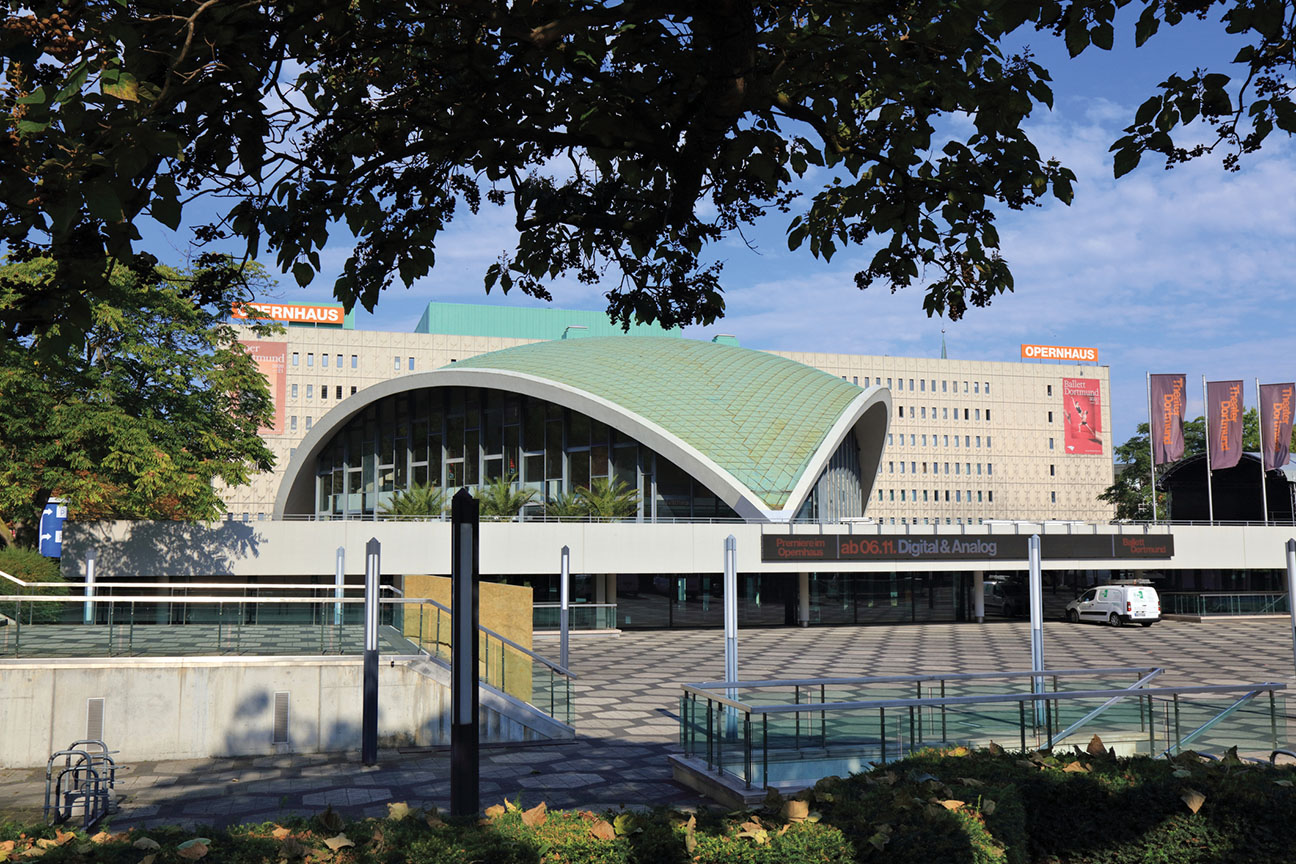
The tour began and we made our way through Dortmund. The tour guide was also only a student, but her knowledge of the city was nevertheless not unimpressive. What did we see? The soccer museum, a famous brewery with a gold “U” on the roof, some churches which were destroyed in the war and had been rebuilt. After about 45 minutes we came to Opera Square. The opera house was, like so much of the city, unnaturally new and modern. It had floor-to-ceiling windows, a roof in the shape of a turtle shell that stretched all the way to the ground like a kind of granite circus tent, and a massive central promenade with cool futuristic light rods shooting out from the marble squares.
What might have stood here before? It’s a question that one could have justifiably asked. I was privy to this answer before the student tour guide began to speak to us about Opera Square. For when we entered the Square, I saw a blue sign with the following inscription: “Location of the Old Synagogue.” And under this title was inscribed: “On this Square once stood the Synagogue of the Jewish Community of Dortmund—built in 1900 as ‘a Jewel of the City for all time’; in 1938 destroyed as a result of the terror of the Nazi Regime.”
Ach so…
I asked myself how the student guide would expound upon this night of abomination. She was German; would she, despite having been born generations after the night of atrocity, nevertheless include herself as one who should shoulder the collective guilt? Or would she explain the Kristallnacht with defiance and resentment, viewing it as absolutely independent from herself and today’s Germany, even indicating that the time had come for Germany to cease the unhealthy practice of castigating itself for being the land that perpetrated the Holocaust? Or perhaps she would just objectively and dispassionately tell of what had happened, well-aware of what we all recognized already: that no emotional commentary or analytical accompaniment to the retelling of the Holocaust could ever hope to capture the grotesqueness of this period, and that it would therefore be preferable for all involved to just give the facts of what had transpired.
We stood in front of the opera house. The student began her speech. She spoke and she spoke. About the building’s grand opening in 1966, about its idiosyncratic architecture, about the storied conductor who had once presided there. I looked to the left and notice a stone structure—a monument—that had been erected on the square. Before actually going over to read it, I knew more or less what it would say. And even from this distance, I could read the sentences in giant font on the block of stone: “On this square once stood the Synagogue of the Jewish Community of Dortmund.” I could even make out some of the smaller words, partially because I knew what to look for, words like: “Destroyed,” “Nazi Regime,” and “Churchill”—or was this last word “Crystal”? I narrowed my eyes. No, I was still too far away to know exactly what the word was. (I found out later that I had been way off—the word was “Deported.”)
She spoke and she spoke. Now about her experience visiting the opera on student nights, and about how much fun she and her friends had there one time. She spoke and she spoke. Now about other musical venues in the city, which perhaps the students would like to visit if they could find the free time. I began to sense that the speech was coming to an end. I thought to myself: No. She wouldn’t dare. Was it possible? Not a word about the holy structure which once stood here and was burned to the ground by her predecessors? Not a thought of what might have possibly stood here before this shabby opera house was built?
But wait! I thought. There was still a chance. On the way out we would pass by the stone monument. Surely this student would stop before this chiseled rock and give up at least five minutes to speak about the Dortmund Jews and Kristallnacht. And what if, unspeakably, she were to, well, not stop? Yeah, okay, well—then she would be unequivocally nothing less than a woman with a heart of coal who descended from Nazi grandparents and/or great-grandparents. Well, either that or that she was simply a Gen-Zer, who never reads and who developed the capability to confuse politically correct truisms with genuine compassion and empathy.
Deep within me, though, I somehow knew that there was no chance that she would stop. But I nevertheless hoped that she would still prove me wrong.
Deep within me, though, I somehow knew that there was no chance that she would stop.
She finally stopped talking about the opera house, and I drifted to the back of the group as we began our journey to the next stop on the tour. She walked and walked, and I hoped and hoped. And she walked, and I hoped. And she got closer and closer to the monument that was dedicated to the Jewish Ghosts of Dortmund, and seemed for an instant to stand motionless in her place. But then she continued on, swiftly past the monument and directly off the opera square, while a crowd of gentiles hurried behind in her wake.
So, I am forced to ask: What the f–k?
After my initial shock and anger had passed, as the tour continued, a conversation sprang up between me and another German student on the tour over what I had witnessed. “You have to understand,” she said. “Because you’re Jewish, you have a different perspective than we do. It’s understandable that for you it’s very important. It is for us as well. But we don’t walk around all day only thinking about Jews and the Holocaust.” I explained that I had just been on a student trip through Tübingen and Worms, which had the sole purpose of commemorating German Jewry who had fled or been murdered.
“We wouldn’t have simply walked past a monument,” I said. “Rather, we would have taken at least fifteen minutes to seriously discuss it.” She nodded, and the conversation gradually devolved back into small talk.
To this day, I’m still not sure if the guide had a duty to stop at the monument. Was my rage justified? Or was I simply too sensitive? Obviously if she had stopped no one would have blamed her. No one would have said: Can you believe that? She had the audacity to stand next to a Holocaust memorial and then to share a few words about it. What a witch! But her neglect to do so could also be viewed as guiltless. Leaving that aside, it was a little troubling to see how little attention a “normal” city tour gave to the Shoah as compared with a “Jewish” tour.
Had all of my Jewish tours of Germany, in which so much lamentation had been gushed over the Jews of Europe, been largely motivated by PR or, slightly better, some nebulous “obligation”? These were, for me, new questions that I didn’t want to be asking.
But maybe it’s even more important to ask whether any of it even matters. Whether we come to a stop or walk right past, remember or forget, laugh or cry, these six million Jews are never coming back. Never. I know that it sounds obvious and even heartless to say that. And, indeed, I am privileged that I am able to sit here and write such a sentence. It’s nice, not to be murdered. But why do we, as individuals, face down the inconceivable bloodbath by simply choosing to just masochistically wring our hands and furrow our brows ad infinitum? Yes, speaking pragmatically, of course we need to remember it, to safeguard against a repeat occurrence. That is very important. And of course, we must always and forever commemorate the victims (as well as condemn the executioners). But I suspect that much of the pity we choose to outpour won’t have any effect on the future memory of the history, and moreover, is viewed rather uninterestedly by the ashes and corpses of the slain. After all, as Woody Allen once said: “I don’t want to live on in my work. I want to live on in my apartment.”
Whether we come to a stop or walk right past, remember or forget, laugh or cry, these six million Jews are never coming back.
These miniature, polite gestures of memorialization generally serve neither as insurance against future catastrophes nor as tributes to the victims. Rather, these efforts materialize out of petty, human—all-too-human—purposes. One purpose is, as mentioned, etiquette and PR. But also, I believe they there’s something almost superstitious in our compulsion to always have a commemorative remark ready at hand when we are confronted with the Shoah. We are like eternally frightened children before this nightmare of history. And we feel as though, each time we let pass an opportunity for dispensing more sympathy over this nightmare, the likelihood of a recurrence will have increased.
So maybe there was something healthy, freeing, and transcendent about the decision of this young, ignorant German not to have stopped.
But yeah, let’s be honest: She really should have stopped.
Steven Weinberg holds a PhD in German literature and a JD, and lives in Berlin, where he works at the Centrum Judaicum. He is completing a memoir, “A Jew is Back in Germany,” and hosted the podcast “The Schrift: Ancient Jewish Wisdom for Modern Times.”