
Shorty, the aptly named 4-foot-8-inch medical clown, stood between two young patients riding coin-operated toy cars in the lobby of Tel Aviv’s children’s hospital, alternately blowing and eating bubbles as the children giggled.
Between mouthfuls, Shorty asked the girl’s mother why her daughter, about 6ֿ, was in the hospital. A tonsil operation, the mother said, performed by Dr. Shaked.
Shaked is the Hebrew word for tonsil. Shorty stopped blowing bubbles and turned to face her. “You’re joking,” she said, slapping her palm theatrically to her forehead. “That’s it, I’m done. I have no reason to be here.”
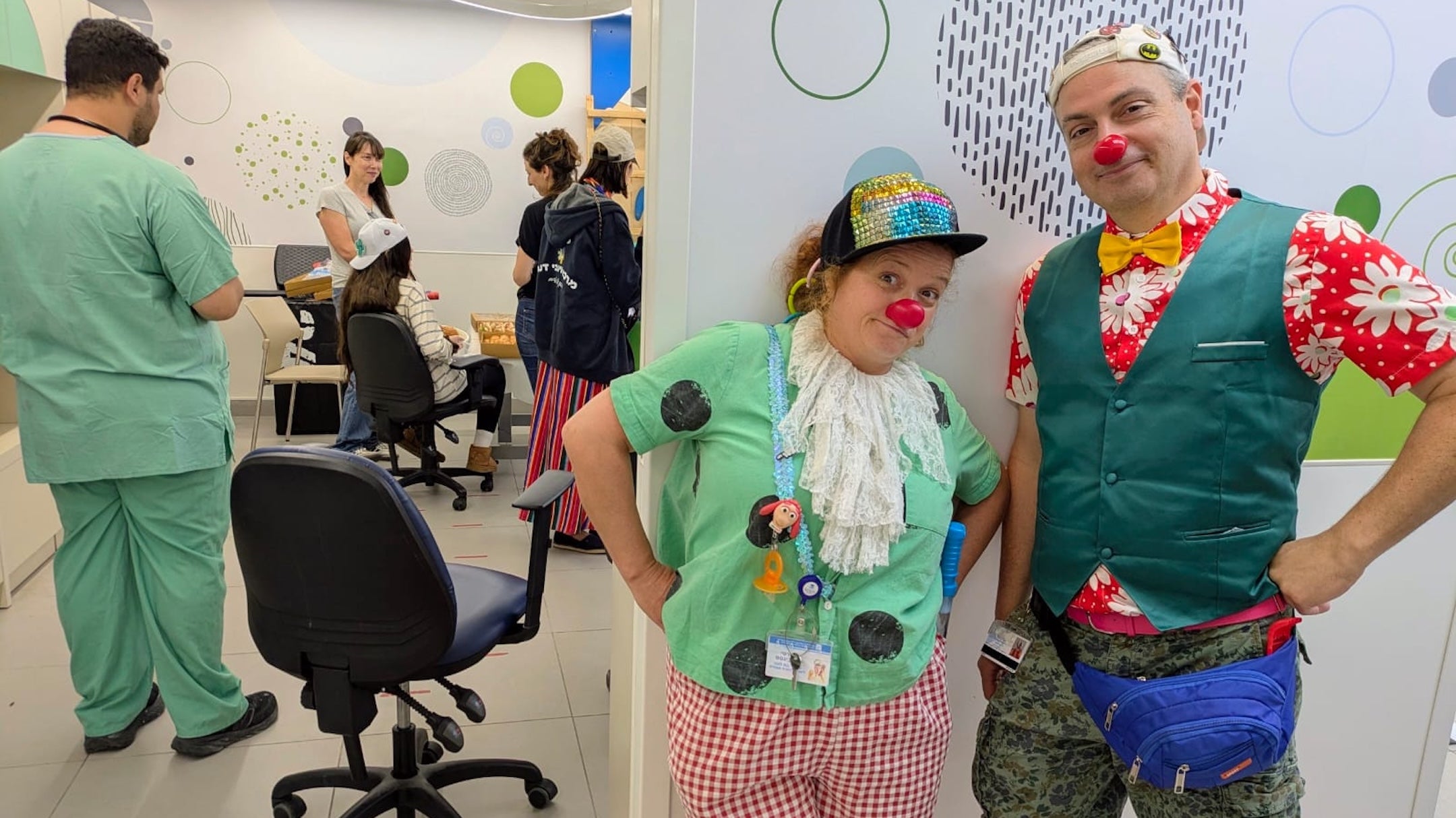
Decked out in a baroque lace cravat, disco-themed baseball cap and a pin that reads “Life is short and so am I,” Shorty is the alter ego of Shira Friedlander, one of seven Dream Doctors medical clowns assigned to Dana-Dwek Children’s Hospital at Tel Aviv Sourasky Medical Center, also known as Ichilov.
Israel has become a global leader of medical clowning over the past two and a half decades, with two main organizations and the world’s first full bachelor’s degree program in medical clowning, at Haifa University. In the last three years, since the Oct. 7, 2023, Hamas attack that has reshaped Israeli society, clowning has taken on a renewed role in supporting healing and resilience.
Simchat Halev operates a network of about 500 volunteer therapeutic clowns in hospitals, with a focus on entertainment, emotional relief and morale. Dream Doctors, founded in 2002, developed a more clinical model, placing about 100 salaried medical clowns in more than 30 hospitals, where they work as paraprofessionals with hospital teams and even take part in medical procedures. At Ichilov, that means the clowns can be brought into operating rooms, oncology wards and transplant units. The nonprofit has also pioneered medical clowning in rehabilitation, trauma care and adult wards.
Atay Citron, who founded the medical clowning degree program at Haifa University, wrote in 2014 that after observing medical clowns in Canada, the United States, New Zealand and Australia, and interviewing clown doctors from the Netherlands, Germany, Russia and Brazil, he had not found stories resembling the Israeli Dream Doctors’ “audacity and insane courage.” He described their ethos as one of independent spirit, brash humor, bold innovation, risk-taking and creativity, alongside formal training that emphasizes careful listening, hospital rules and cooperation with medical staff.
Medical clown David Barashi, known as Dush the Clown, interacts with a child as he receives medical care as part of the Dream Doctors Project at Hadassah Hospital in Jerusalem, June 24, 2013. (Uriel Sinai/Getty Images)
That difference was clear to Ines Rosner, who co-founded a German medical clowning organization and has traveled to Israel about eight times to learn from Israeli practitioners.
“In Israel, it’s common that you have an idea and you just do it,” she said. “In Germany, that’s not possible.”
While medical clowns are a normal presence inside Israeli hospitals, in Germany “most hospitals think of them as visitors who come in the afternoons and have some fun,” Rosner said. The pandemic made that status clear, she said, when clowns were among the first asked to leave hospitals.
Independent studies have found that medical clowning can reduce anxiety in children undergoing hospital procedures, with a 2024 review of 15 randomized trials involving 2,252 children also finding reductions in pain and crying time. One Israeli study found that children undergoing blood draws cried about two-thirds less when accompanied by a medical clown.
“It isn’t a nice-to-have,” Friedlander said. “It’s part of recovery. We’re part of a giant system.”
What that looked like, on an ordinary Wednesday morning spent shadowing Friedlander, was relentless, disarming and downright hilarious. She answered questions about medical clowning while breaking off every few sentences to do it: stopping a child entering the elevator to ask, “Wait, do you fart in elevators?” or sizing up a tall boy on crutches, his leg in a cast, and instructing him to “chop off a little more” as punishment for having “stolen all the tallness in the world.”
Friedlander said the freedom of clowning comes from letting go of the attempt to hold everything in the room at once — the illness, the family, the fear, the joke, and the potential responses to it.
“I hold on to what I’m doing right now, and that’s enough for this moment,” she said. “It takes a deep kind of trust that everything happening is exactly right for this instant. Then I feel very free, because my only obligation is to be present in the room and whatever comes out will come out.”
When that happens, she said, “wonderful things come out because the ego is put aside and two hearts meet and the world is blown wide open.”
Medical clowns come from mixed backgrounds, with some never having finished high school and others arriving from related professions — such as circus or theater — or different fields altogether. Friedlander had been in drama classes since childhood, but acting as a career “felt empty,” she said. At Haifa University’s medical clowning program, where courses include how to step into silliness, she discovered performance as medicine.
“I remember my jaw dropping,” she said. “It was like Mr. Bean falling from the sky. It checked all the boxes.”
Maor Gillerman, whose clown name is Udi-Lama, came to medical clowning after Oct. 7. A scriptwriter who had been active in the campaign for better conditions for Israeli screenwriters, Gillerman said his activism no longer seemed like the most useful place to put his energy after the attacks.
“Coming to the hospital is my favorite time of the week,” he said. “It feels like the most meaningful thing I do, even if I don’t always know what difference I’ve made.”
Smadar Harpak, whose clown name is Shemesh, is one of Dream Doctors’ most veteran medical clowns, with 17 years in the group. When someone is hospitalized, she said, the family and the patient “can’t think of anything at all except getting better,” and the role of the clown is to break that tunnel vision.
In 2015, Harpak helped create the Clownbulance, which is “like an ambulance, but for treating the soul, not the body,” she said. The vehicle takes seriously ill children, and others carrying trauma, out for a day of fun. Rosner is developing a German Clownbulance in Baden-Württemberg based on the Israeli version, after training with Harpak.
After children who had been taken hostage in Gaza on Oct. 7 were released, the Clownbulance took some of them on a jeep excursion.
“There are kids who have really lost faith in humanity,” Harpak said. “They can’t just be trapped in a hospital. I want them to go out, remember life outside, and just be normal for a day.”
Asked what, exactly, was normal about riding around with clowns in a Clownbulance, Harpak slipped back into Shemesh, put her hands on her hips, cocked her head to one side and asked, “Do I look normal to you?”
The model had also been tested in trauma settings before Oct. 7. Citron described a Dream Doctor at Barzilai Hospital entering a room of Sderot schoolchildren after a rocket exploded near their bus, ignoring a psychiatrist’s signal to leave and helping turn the encounter into play. The hospital later changed its protocol, putting medical clowns first in line to meet shell-shocked patients after a missile strike in Ashkelon.
But after Oct. 7, medical clowning took on a much larger role in Israel’s trauma wards. Rehabilitative clowning, a subfield developed in Israel with wounded soldiers before the war, became part of the emergency response, with clowns working around the clock with traumatized soldiers, civilians, evacuees and hostage families, and alongside psychiatrists, psychologists and therapists at an IDF rehabilitation center. One Dream Doctors clown said she had worked with more than 1,000 traumatized soldiers in the year after the attacks.
Harpak also organized an event bringing together former hostages and wounded soldiers in Ichilov’s rehabilitation ward, calling it a “full-circle moment” in which soldiers were able to say, “This is what we fought for.”
Harpak rejected the idea that certain moments are inappropriate for clowning.
“The clown can be present even in the most sensitive spaces,” she said, because the work begins with “choosing not to see any of them as a victim.”
“When I clown, I’m saying, this happened and what can I do about it?” she said. “I choose to emphasize the positive.”
Friedlander took it a step further. Medical staff, she said, have to focus on the part of the patient that is sick. The clown looks for the part that is still healthy.
“Whatever situation the patient is in, there is always a healthy side,” Friedlander said. “The clown’s job is to help a person look at things from a different place. When everything is stuck and clogged, finding and opening that part allows things to flow, to move.”
That also means accepting when a child is not in the mood. Friedlander said the clown persona gives her an “anchor” for the rejection.
“It’s not personal against Shorty,” she said. “The clown comes to say, you don’t have to play by any rules. You don’t have to please me, or play the game of, ‘OK, clown, be funny.’”
Gillerman described the same idea as a rare form of control inside the hospital.
“It’s not always about making the kid laugh,” he said. “It’s also about their freedom to choose. The clown is the only one a kid can tell, ‘Not right now.’ With the doctors and nurses, the child has no choice but to do what they say.”
“A clown’s superpower is paying close attention to feelings,” Friedlander said. “Everyone is a little angry that they’re in the hospital — some more, some less. The fact that I don’t dismiss any emotion gives it so much space, and that allows for a different kind of freedom.”
The same applies to the clown, she said. If she arrives at the hospital in a bad mood, and it lingers even after she puts on Shorty’s costume, she does not try to bury it.
“If the here and now is angry, then that’s what we’ll live in that moment,” she said. “I will try and bring it out in the best way for the connection I want to create with the person in front of me.”
Back in the lobby, the girl who had undergone the tonsil operation watched Shorty eat another bubble, then opened her mouth and did the same.
Her mother stared at her, astonished. She explained that her daughter had not eaten at all in two days. For Friedlander, it was a small but meaningful win. Through bubbles and play, the girl was practicing the motions of eating again.
“That’s exactly the idea. Just be a clown,” Shorty told the mother. “Bubbles are the best food for tonsils anyway.”
Reporting the stories that define our era. When history unfolds in real-time, the Jewish world turns to (JEWISH REVIEW). Your support ensures we can document the complexities of war and the resilience of Jewish communities with integrity.