

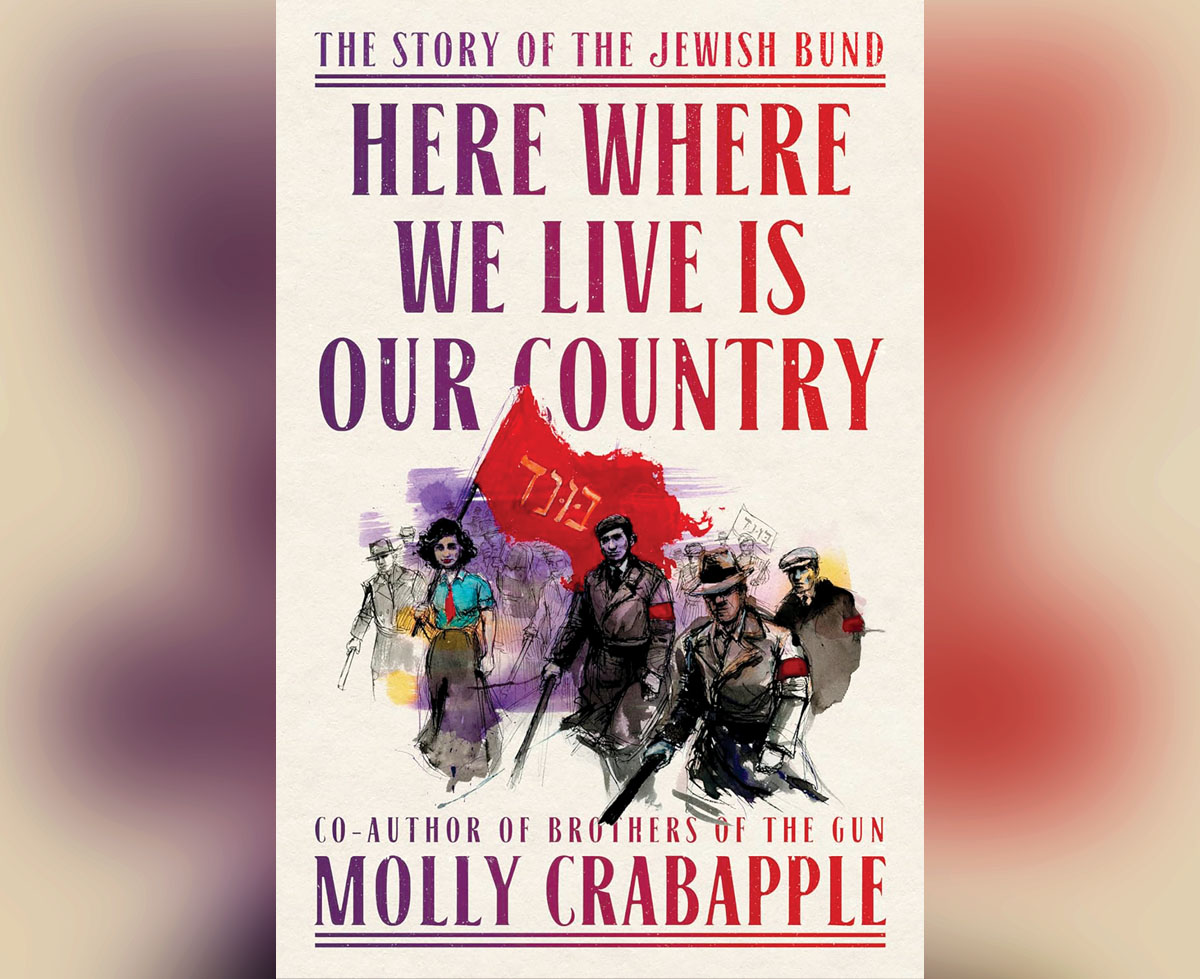
“Here Where We Live Is Our Country: The Story of the Jewish Bund” by Molly Crabapple. Random House, NY (2026)
Rummaging through her great-grandfather’s obscure past, Molly Crabapple transports herself back to the tumultuous world of Eastern European Jewry: a world of national awakenings, pogroms, emerging modernity, democratic ferment and revolutionary struggle. It was a whirlwind, whose centrifugal force yanked Jewish communities from their traditional moorings and hurled them into political life. But it was also a maelstrom that culminated in the barbaric destruction of the Warsaw ghetto and Yiddish civilization and the murder of two-thirds of Europe’s Jews.
Crabapple resurrects her love of Yiddishkeit from spectral haze to fully realized embodiment and does so with great verve, wit and pathos. Like a skilled novelist she breathes life into the minutiae of ghetto life — its struggles, victories, tragedies and defeats — time-travelling from her great-grandfather’s days in the old country to her awakening as a link in the chain of Jewish life. It is a work of immense scholarship, beautifully illustrated by the author. She taught herself Yiddish and used her immense linguistic and literary skills to pore over, it would seem, every existent source of Bundism and reanimate its beating heart.
She posits that the Bund’s secular, anti-clerical, anti-Zionist principles remain a living model for the struggle against authoritarianism, and a guide to Jewish survival. And she links the fight against antisemitism to the struggle against Zionism: “For leftist Jews longing for resources within our own past for combating the Zionist death cult, the Bund is a model.”
It is a work of great inversion and of ultimate betrayal.
As the great protest movement against exploitation and oppression, socialism became a natural node of attraction for many young Jewish intellectuals beginning in the late 19th century. But the most prominent socialists had little interest in Jewish emancipation per se. As intellectual heirs of the Enlightenment and the French Revolution, their vision of equal rights for the Jew extended no further than the freedom to assimilate and be accepted into the polity of the nation in which he resided. Of Jews as a collectivity, its dissolution was welcomed, as their survival retained no intrinsic value for the larger commonweal.
Were the Jews a nationality? For most socialists, Jews had a national past, but were ground first by repeated dispersion and then by feudalism into a caste wedged in the interstices of nations. Once emancipated and accorded political liberty under socialism, it was believed, the Jews would surely not reconstitute themselves into a nation, when offered the free choice of assimilation. Assimilation, freely chosen, would be the democratic solution to “the Jewish Question.”
The Bund, too, at its inception at the end of the 19th century, did not address itself to “the Jewish Question.” Its organizers saw themselves as Russian intellectuals who assumed the task of organizing the Jewish section of the Russian working class. They did not necessarily speak Yiddish as their primary language; some were even baptized and may not have initially identified as Jews. They originally wanted an association that would embrace all the Jewish workers within czarist Russia, without overtaxing ideological demands and obligations.
The Bund, however, could not long dodge the issue of the double oppression of the Jewish workers — exploited as all other workers, but also oppressed as an outcast nation. In practice, neutrality in the cause of assimilation meant not the elimination of all national particularities, but Russification. And this prospect singularly lacked appeal for Jewish workers.
Under pressure from below, from competing territorial-nationalist and Zionist sentiments percolating among both Jewish intellectuals and workers, the Bund was reluctantly compelled to seek a solution to the Jewish problem that addressed the issue of (Russian-) Jewish collective survival. It finally adopted a National Program (1903), recognizing Jewry, dispersed among other peoples within the czarist empire, as a national community, and called upon the socialist movement to fight for a social order that would assure the Jewish population of a future, liberated Russia the opportunity to carry on as a distinct community — to regulate its cultural affairs according to its needs. The Bund’s nationalism of “hereness” — doikayt in Yiddish — was an endorsement of a proto-identity politics in the form of Ashkenazi ethnosocialism.
The Bund’s national program met implacable hostility from their socialist opponents. For the Russian social democracy crowd, the Bund was nothing but “Zionists suffering from seasickness.”
This was a baseless slander. For the tendency to grasp the Jewish question locally and culturally, and not globally, also placed the Bund squarely in the anti-Zionist camp, as both Bundists and Zionists fully agreed. Bundism did not address itself to Jewish survival writ large, but to the narrowly defined aspirations, as they perceived it, of Jewish workers within the Russian Empire. It was also diametrically opposed to the thoroughly liberal Zionism of Herzl, who placed his hope for a conventional Jewish state — and his appeal to world powers — on the proposition that Zionism might also dissipate the revolutionary unrest of Jewish workers.
But Zionism also had a socialist wing, Poale Zion, absent except in cartoon form from Crabapple’s account, that also opposed Herzlian nationalism. They insisted that a homeland cannot be granted from on high by world powers: it must be a revolutionary act of Jewish creative ferment and activity from below culminating not in a conventional bourgeois state, but a Jewish socialist one. And it mounted a left-wing attack not only against liberal Zionism, but also against Bundist cultural nationalism. They, like the Bund, organized Jewish workers to defend their communities from pogromists. They, like the Bund, engaged in revolutionary activity, trade union organizing and electoral campaigns within the Russian Empire. And they, like the Bund, were to write a glorious chapter of Jewish pride and resistance against German armies in the ghettos, forests and concentration camps of Eastern Europe. They created what was to become the Israeli working class in the pre-state years and to fashion its key parties, social and cultural institutions, and self-defense organizations.
Whether Crabapple finds Poale Zion’s critique of Bundism meritorious or not, it is a dereliction of responsibility to have simply parodied it.
Like the Bund, Poale Zion demanded political autonomy with broad cultural jurisdiction for those nationalities whose needs could not be met territorially. But this was a stopgap for the Jewish people. The conditions of marginality, and the continued outsized presence of Jews in precarious middle-class and professional fields peripheral to the national economic centers, made Jews a convenient target of hatred by other oppressed people and a scapegoat for vulnerable ruling classes.
For Poale Zion, therefore, Zionism was the minimal program for a normal national, rooted existence — the precondition for the Jewish people’s participation as equals in the global struggle for a democratic and emancipated future. The Jewish people would finally be driven to Palestine, an underdeveloped land well suited for economic development.
Zionism, at least for socialist-Zionists, was not meant as a solution to the “Jewish Question,” if by “Jewish Question” is meant the reoccurring, shape-shifting problem of antisemitism. Then again, neither was the Bund’s proposed cultural autonomy. These were alternative programs for Jewish national survival — the right of any nation, hated or not.
Bundists rejected as utopian the ingathering and reconstitution of the Jewish nation in Palestine. Their own “nonutopian” program of national-cultural autonomy, on the other hand, was fully enacted by the Ukrainian Central Rada (1917-18). The Bund had straddled the idea of full Ukrainian independence, rightly fearing that the drive toward an independent Ukraine would splinter Jewish communities and subject them to outright persecution; that it would strengthen the power of Jew-hating reactionaries.
And that is exactly what occurred. Ultimately the Rada (and the ruling Bolsheviks) proved unable and unwilling to intervene when the autonomists partnered with the White armies during the Russian Civil War to unleash the bloodiest anti-Jewish massacres prior to the Holocaust.
What stronger rebuke could there be to the tragedy of Bundist illusions? “National-cultural autonomy” failed, horribly failed, the judgment of history, in the one grand national laboratory experiment where it was actually tested — a conclusion unpardonably glossed over by Crabapple and her fellow Bundist reenactors.
After the Bolsheviks took power, the social democratic Bund was forced to disband in 1920, and decamp to Poland leaving a small pro-Bolshevik Russian remnant that had capitulated to the increasingly authoritarian Communist Party. It was in Poland that the Bund fought its last heroic, doomed battles, culminating in a belated united front with labor Zionists. To the end, in the face of mounting Nazi bestiality, the Bund stubbornly held to its principles, insisting, all evidence to the contrary, that a workers’ revolution alone could save the Jews, and ruled out, in principle, organizing a mass emergency exodus to Palestine for being an unpardonable affront to the Arabs.
To the end, in the face of mounting Nazi bestiality, the Bund stubbornly held to its principles, insisting, all evidence to the contrary, that a workers’ revolution alone could save the Jews, and ruled out, in principle, organizing a mass emergency exodus to Palestine for being an unpardonable affront to the Arabs.
By the mid-1930s, Stalinism had extinguished what few embers of working-class autonomy the Bolsheviks still tolerated. German social democracy and its militias had ignominiously collapsed in the face of Nazi thuggery without offering any resistance. The downfall of Red Vienna, the citadel of Austrian socialism, followed soon after. The Spanish Republic was destroyed with the active connivance of the GPU (the Soviet secret police), whose Russian masters preferred a fascist victory to democratic socialism.
An ardent labor Zionist of the 1930s, R. E. Ashery, answered the Bund in frustration:
“As to the … crackpot solution that Jews, en masse, should join the revolutionary movement in the lands they reside in that they may be the beacon and light of the revolution, it seems the revolutionary theologians have formed a new incarnation for the hoary concept, Jews as a Chosen People. … The ‘revolutionaries’ preach a gospel of becoming the chosen cannon-fodder for the German, Polish, Romanian and Lithuanian brothers whose revolutionary growth is retarded or stunted. Meantime are the Jews gladly to let themselves be killed in pogroms by these future brothers?”
When principles harden into dogmas and dogmas become blinders, they cease to be a useful guide to action. To leave would have meant letting their tormentors win, and so this “right to stay” ossified into an inviolable principle that the Bund refused to relinquish even when its further insistence became pure folly.
Antek (Yitzhak) Zuckerman, a socialist-Zionist hero of the Jewish Combat Organization in Poland, walked away at the conclusion of the war in utter exasperation at the Bund’s “hereness,” which he damned as a “self-destructive delusion.” “Anyone could see that the Jews had no future without a state.”
Not for Molly Crabapple. For her, evidently, social justice has no future if the Jews do have a state. No sloppy, snidely unexamined antizionist and anti-Israel cliché remains untapped. And why shouldn’t they be invoked? These are the axiomatic beliefs of a modern leftist worldview — increasingly the worldview of a generation — where narrative coherency supplants factual correspondence. Absent this subtext, I suspect that this work, elegantly written as it is, would never have broken out of its academic niche to attain the mass appeal it has garnered. Ms. Crabapple is a creature of this party of the left. And she has paid her dues here in kind.
For Crabapple, evidently, social justice has no future if the Jews do have a state. No sloppy, snidely unexamined anti-Zionist and anti-Israel cliché remains untapped.
Zionism is allegedly criminogenic because it is a settler-colonial enterprise, supercharged by its alignment with American power. And because it is a settler-colonialism enterprise, it has a genocidal aim. The more that the genocidal beast is subsidized, and fattened, the more it, paradoxically, remains unsated.
Israel is the epicenter of a wider American vortex — the torchbearer and repository of all the crimes of Western civilization — a vortex that extracts and strips wealth from the rest of the world, a global imperium and the machine shop of social injustice. As long as the American-Israel nexus remains unbroken, and resources diverted to its defense, the longer fundamental social problem will remain unaddressed and addressable. That is why climate change, and Black Lives Matter, and police brutality, and the housing crisis, and health insurance, and wage stagnation and LGBTQ+ rights are interlocked. That is why AIPAC is the most monstrous of all lobbyists. That is why Gaza is a trade-union issue, a feminist and gay issue, a wealth disparity issue and income inequality issue, and above all, the omnibus social justice issue. That is why all local politics are anti-imperialist politics; why Gaza is the central issue for New York City politics and all the lesser city and municipality and village politics, and, above all, national politics.
This Manichean, apocalyptic worldview, it should be redundant to point out, is unlike any leftist worldview known to history. It hijacks the concerns of the left, the grievances of the left and the language of the left. And inverts them all. It creates a moral permission structure to ostracize and purge all those who stand in the way of social progress by failing to respect the “link” between it and its material dependency on the elimination of Israel. In its twisted but consistent logic, it further calumniates anyone who upholds the Israeli right to self-determination for being white supremacists, upholders of the present global structures of hierarchy and advantage.
Whereas 80 years ago leftists like Carey McWilliams saw antisemitism as a mask for privilege, the modern left considers fear of antisemitism to be the apprehension of a privileged elite. And it creates a ready-made, all-purpose scapegoat for present and future failures by would-be social reformers to implement their programs. “We can’t have Medicare for All because the necessary funds have been diverted to the child killers of the IDF.”
Most important, it elevates the most reactionary, fascist, theocratic, irredentist, misogynist and racist movements and regimes that plague the Middle East and the world to noble heroes of the anti-imperialist struggle, for having thrown a spanner in the machinery of global oppression. Progressive and freedom-loving are any movements that threaten to disrupt the world order, even if they do so with the intent of blocking or hurling backwards any gains of human rights or democracy. Condemned is any war against fascism, religious fanaticism and jihadi imperialism that operates within that order — even if it lays the predicate to future democratic openings — for upholding the status quo.
Toward the end of her book, as the remnants of the Bund and the Polish Socialist Party together survey the horror and destruction of the war, Ms. Crabapple relates a Polish socialist’s plea for reassurance and, if not for forgiveness, then for understanding; asking pleadingly of the Bundist, had we Polish comrades done enough? Had we done all we could do? And she imagines herself now, in the place of the Polish socialist, looking across the chasm of the “Gaza genocide,” and asking similarly for a reassuring absolution for her ineffective opposition to Israeli retaliation presumably from a representative of Hamas, now obscenely cast in the roll of the Bund. This perverse analogy between Gaza and the Warsaw Ghetto, between Hamas and the Jewish resistance fighters — this appropriation of Jewish tragedy and heroism — in service to Islamism is, lamentably, a feature and not a bug of contemporary socialism.
This perverse analogy between Gaza and the Warsaw Ghetto, between Hamas and the Jewish resistance fighters—this appropriation of Jewish tragedy and heroism—in service to Islamism is, lamentably, a feature and not a bug of contemporary socialism.
Here, where we live, is our country. Except if “we” live in Israel. There is much more to be said. Suffice to say, the Bund deserves better. These fearless secularists and democratic socialists, who stood up against religious obscurantism and defied mass authoritarians on both the right and left, who waged a doomed rearguard battle for the dignity of European Jewry, should never had their legacy tarnished and perverted to backhandedly justify Hamas’ atrocities of Oct. 7, 2023. But here we are.
Barry Finger has also written on the Gaza war for Fathom Journal.