

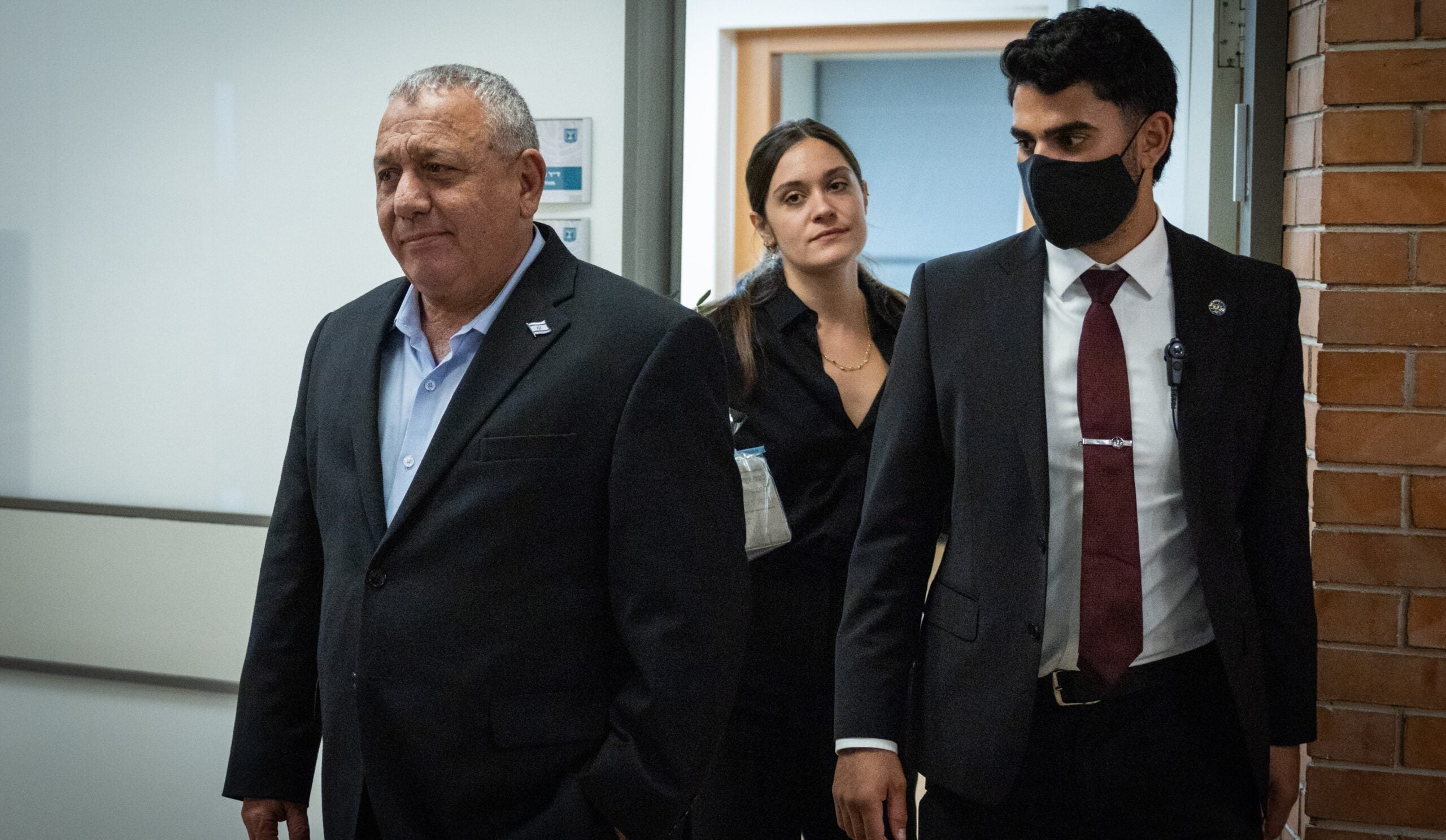
Gadi Eisenkot outlined three tracks he is pursuing to build a coalition, including a minority government that would need the outside support of Arab-led parties, saying that Prime Minister Benjamin Netanyahu was putting Israel “in a very dangerous place” with his anti-Arab rhetoric.
Each option Eisenkot presented Friday in a lengthy post on X could involve breaking a promise that at least one of the parties in the “change” bloc Eisenkot leads had made: not to rely on the Arab parties; not to join with Netanyahu; or not to work with the haredi Orthodox parties as long as they refuse to compromise on military service.
One of his partners, Avigdor Liberman, who leads the Yisrael Beytenu party, said the option of joining with the haredim was the likeliest.
Eisenkot, who leads the Yashar party, described an urgency to form a coalition spurred in part by Netanyahu’s relentless rhetoric targeting the Arab parties, which Eisenkot said was placing the Arab Israeli population at risk of attack. Forming a coalition under the conditions Eisenkot lays out would remove Netanyahu from his role as prime minister, depriving him of a powerful pulpit.
“We are in a very dangerous place. A place where the outgoing prime minister is acting in ways we have never seen before,” he said.
“Israeli society, our democracy, and our standing and position on the international stage are all approaching a point of no return,” he said. “The path from a violent campaign of delegitimization against 21% of the population and labeling them ‘supporters of terrorism’ to actual violence could also be short. The writing is on the wall.”
President Isaac Herzog last week gave Eisenkot the mandate to form a government within 28 days, after 67 members of the parliament, or Knesset – including the “change” bloc and the 19 Knesset members belonging to Arab-led parties – gave their nod to the former Israel Defense Forces. Netanyahu got the approval of 46 lawmakers, and seven abstained. If Eisenkot does not get a government together by Dec. 6, he can ask Herzog for a 14-day extension.
The first option Eisenkot raised was forming a government with the support of the ultra-Orthodox, or haredi, parties. Such a move would have been almost unthinkable until recently, given the longstanding and close alliance between Netanyahu and the haredi parties, as well as the central campaign promises of the anti-Netanyahu bloc to bring about fundamental changes to the state’s relationship with the ultra-Orthodox community, including mandatory military service – a position the haredi parties strongly oppose.
“Serious discussions are underway with the ultra-Orthodox parties, aimed at finding solutions and formulas that will strengthen the IDF, address security needs and preserve the status of those who study Torah, as we promised during the election campaign,” Eisenkot wrote in his post.
He stressed that the negotiations did not amount to “backing down on the issue of military service,” but rather involved formulating an arrangement based on the principles of his party’s “Service for All” framework, which would codify non-military service as an option for some sectors. All four parties in the change bloc ran on a platform of ending the vast exemptions from military service haredi Jews have enjoyed for decades.
The negotiations appear to have led one of the two ultra-Orthodox parties, United Torah Judaism, to refrain from recommending Netanyahu to the president as the candidate to form the next government. The other haredi party, Shas, which is considered more right-wing and closer to Netanyahu, has so far given no indication that it intends to cross political lines and join the anti-Netanyahu bloc. Without Shas, the bloc would have to settle for a minority government.
Liberman said in an interview with Channel 12 News on Friday evening, hours after Eisenkot’s post, that forming a government with the support of the ultra-Orthodox parties was “the only practical option.” He said he was convinced that a government supported by both haredi parties could be formed. According to Liberman, the bloc should be willing to “sacrifice” its pledge not to cooperate with the ultra-Orthodox and to fundamentally change the state’s relationship with their community in pursuit of its primary goal: “an end to Bibi’s rule.”
The second path outlined by Eisenkot was a unity government with Likud. Negotiating teams from the two parties met earlier this week. “As for the contacts with Likud, we are making sincere and genuine efforts on our part. Unfortunately, however, there is a wide gap between the Likud’s rhetoric and their action and actual willingness to move forward,” Eisenkot said. He nevertheless made clear that “I intend to give this track another chance.”
Eisenkot did not name the “gap,” but reports have said talks have foundered on Netanyahu’s role in a unity government. Netanyahu reportedly is insisting on serving as prime minister in the first part of a “rotation” agreement that would see the premiership rotated among bloc leaders.
Liberman ruled out sitting in a government with Netanyahu under any circumstances, including a rotation agreement in which Netanyahu would serve as prime minister second after Eisenkot. Another leader of the opposition bloc, Naftali Bennett of the B’Yachad party, held lengthy talks with Netanyahu in the Knesset this week, triggering a wave of speculation that he was advancing the possibility of a unity government. But Bennett would still need to convince the other parties in his bloc to join him in doing so, as his party isn’t large enough to secure a parliamentary majority with Netanyahu on his own.
The third option Eisenkot raised at the end of his post was the formation of a “national emergency government.” He clarified that he would pursue this track only if “the necessary conditions for the formation of a broad government through the channels I am leading do not materialize.”
Although he did not explicitly say so in his post, Eisenkot appears to be referring to the possibility of a minority government that would rely on the votes of the Arab-led parties to secure the parliamentary majority needed to form a government without actually including Arab ministers in the government itself.
But the proposal faces significant opposition within Eisenkot’s own bloc, potentially jeopardizing the entire initiative. Liberman stressed that he would “categorically” vote against a narrow government relying on the support of the Arab-led parties. Channel 12 News also reported that Bennett had told leaders of the opposition bloc that he opposed forming a government dependent on Arab-led parties.
One of the two parties, Ra’am, led by Mansour Abbas, served in a coalition under Bennett from 2021-2022. Bennett has praised Abbas as a worthy partner but has also argued that including Arab-led parties in the government after the deadly Hamas-led attacks of Oct. 7, 2023 is untenable. Netanyahu has seized on the radical statements of some members of the other Arab-led party, the Joint List, to depict both parties as supporting terrorism.
Liberman and Bennett both argued that relying on the Arab-led parties would give Netanyahu a massive boost ahead of future elections.
Eisenkot, however, signaled that he was prepared to put that opposition to the test. In his post, he stressed that “all members of Knesset will have to follow their conscience and decide whether a new government will be formed, or whether they are willing to drag the State of Israel into another election while Netanyahu remains prime minister of a transitional government.
“It would be foolish to think that we have the luxury of delaying and losing the window of opportunity that has opened up, a window that may never open again. What is at stake is Israel’s future,” Eisenkot said.
Count yourself in. Independent Jewish journalism runs on thousands of readers. Join them with a year-end gift. We can’t do it without you.


