

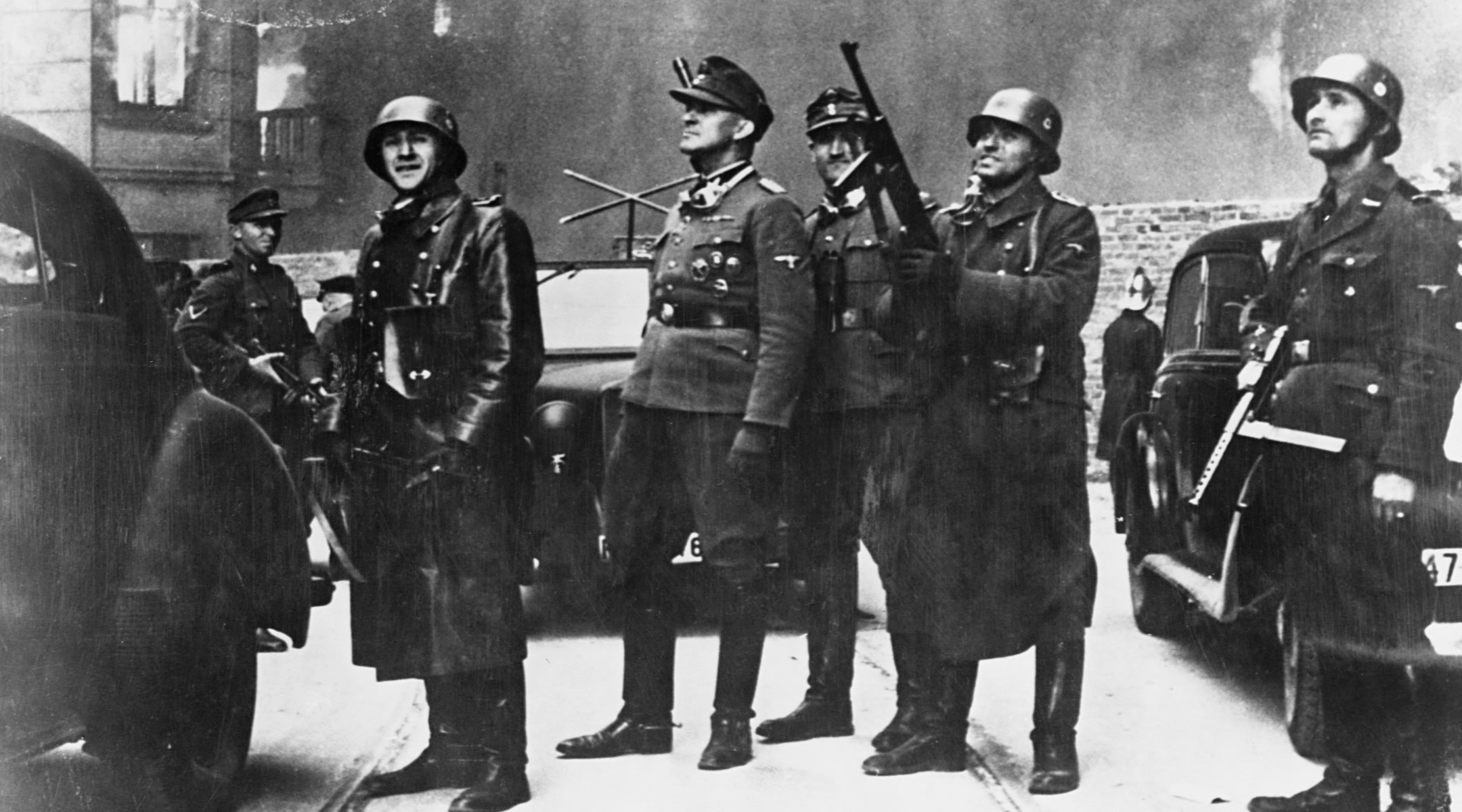
Jürgen Stroop, the Nazi commander who led the killing of more than 50,000 Jews, was sitting in a cell in Warsaw awaiting his own execution.
Before he met the gallows, Stroop described in unrepentant detail his ascent as a Nazi, his destruction of the Warsaw Ghetto and his daily prosecution of mass murder. He gave his account to Kazimierz Moczarski, the journalist, Polish resistance leader and veteran of the Warsaw Uprising who shared Stroop’s cell in Mokotów Prison for 255 days in 1949.
Though he is now remembered as a hero for fighting the Nazi occupation, Moczarski was villainized by Poland’s postwar Communist regime, which viewed his resistance group as a threat to their monopoly on power. His unlikely imprisonment alongside a former Nazi officer he’d once tried to assassinate gave Moczarski the chance to document Stroop’s confessions in an influential book, “Conversations with an Executioner.”
This book, despite being censored for years by the Polish government, proved revelatory about the psychology and motivations behind Nazi ideology. After decades of being translated into over 15 languages and adapted for the stage and screen, “Conversations with an Executioner” was published Tuesday for the first time in an uncensored English translation by Steerforth, an imprint of Pushkin Press.
The book’s champions say it’s about time.
“On the one hand, this book is a central historical source for this really important event in the modern history of the world,” Sean Casper Bye, the book’s English translator, told the Jewish Telegraphic Agency. “And at the same time, it’s one that has continually struggled to get fully into publication.”
The book’s revelations about Stroop, the rise of Nazism and the psychology of genocide is reaching English readers after a long deferral. Moczarski made many unsuccessful attempts to publish “Conversations with an Executioner” after his release, but found little interest from publishers in Communist Poland.
The book did not align with Communist ideological narratives about the Holocaust, which deemphasized tragedy in favor of total victory over the Nazis. And the government’s crackdown on Polish resistance members — which led to Moczarski’s imprisonment with Stroop — remained a taboo subject.
A serialized version of the book first appeared in the Polish magazine Odra from 1972 to 1974, and Moczarski died the following year at age 68. He never saw the first censored edition in 1977, which removed references to the reasons behind his own incarceration. Nor did he see the publication of “Conversations with an Executioner” as an uncensored book in 1992, after the fall of Communism, when it became a bestseller.
Now, the book has “canonical status” in Poland, said Bye. It has been included for years on required school reading lists, shaping how generations of Polish people remember the Holocaust.
Moczarski’s account also faced an uphill battle to reach English readers. During the Cold War, censorship, disrupted communication and closed archives in Eastern Europe made it difficult to publish books from Poland in English, said Bye. That lowered the focus on Eastern European sources and languages for years in Holocaust scholarship across English-speaking countries.
The new English translation was championed by Clare Bullock, the book’s editor in the United Kingdom, who has Polish Jewish heritage. She spent years pushing for it to appear in English at multiple publishing houses, said Bye.
Moczarski and Stroop’s fates were intertwined long before they shared a cell. During World War II, Moczarski joined the Home Army, the main Polish resistance force, where he worked for the Office of Information and Propaganda.
Identifying local Nazi officials and collaborators as targets, Moczarski and his associates assassinated Stroop’s predecessor, Franz Kutschera, nicknamed the “Butcher of Warsaw” for his mass executions of Polish civilians. They also made a failed attempt to kill Stroop, detailed by Moczarski in their cell.
Though he was not Jewish, Moczarski supported and liaised with the Jewish Fighting Organization, known in Polish as ŻOB. The Home Army provided ŻOB leaders with weapons and technical instructions for the 1943 Warsaw Ghetto Uprising, the largest Jewish revolt against the Nazis.
A year later, Moczarski fought in the Home Army’s citywide Warsaw Uprising. The Nazis also brutally crushed this revolt, which led to the deaths of over 160,000 Poles, including some 17,000 Polish Jews who took part in the fighting or were discovered in hiding.
Instead of being rewarded after the war, Moczarski was arrested in 1945 as the Communists consolidated their power in the aftermath of Nazi rule. The new regime baselessly declared the Home Army a quasi-fascist organization, claiming they had collaborated with the Nazis rather than fighting against them. Moczarski spent 11 years in prison, where, he would later recount, he endured 49 methods of torture.
His confinement with Stroop made for another form of torture, according to Bye, who said it was “symbolically equating him, a brave Polish patriot, with a Nazi war criminal.”
The men had a third cellmate: Gustav Schielke, a German former policeman turned low-ranking SS officer who resented the police’s subordination to the Nazis, but did not resist them. In prison, these enemies lived under a code that required equality and confidentiality for survival. They slept on the floor together on three pallets, and Moczarski spent nights huddled between Stroop and Schielke to stay warm.
Moczarski made it his mission to understand the war criminals.
“If I succeed, I have the chance — if only to a certain extent — to answer my own question,” he wrote. “What historical, psychological, sociological mechanism led some Germans to come together into a gang of mass murderers who governed the Reich and did their utmost to introduce their ‘Ordnung’ — their Order — in Europe and the world?”
He unraveled in Stroop an average German middle-class man of his time, with a low level of education, a drive to rise through military ranks, a reverence for order and obedience and a penchant for parroting Nazi ideology.
As his defenses wore down, Stroop gave Moczarski a day-by-day account of his orders to crush the Warsaw Ghetto Uprising in 1943. Over nearly a month, his forces battled Jewish guerilla fighters and eventually burned down the ghetto block by block. He referred to the operations as “neutralizing” Jews or “cleansing” the Warsaw Ghetto of “subhumans.”
When Moczarski asked Stroop whether he pitied the women fighters whom he captured and killed, he said the commander responded, after a long and “worked up” silence, with Nazi clichés.
“Finally, the general straightens up, smooths down the hair at his temples and replies, in a chanting rhythm,” Moczarski wrote. “‘Anyone wishing to be a true man in those days, meaning a strong one, had to act as I did. Gelobt sei was hart macht!’” The German phrase by Nietzsche, meaning “Praised be what hardens,” was taken from Nazi propaganda.
In this portrait of Stroop, Bye saw a man who was motivated primarily by moving up the Nazi Party hierarchy. While Stroop repeated Nazi tropes and adapted his beliefs accordingly — upon becoming an SS officer, he broke with the Roman Catholic Church and declared himself “Gottgläubig,” a Nazi religious term — much of his testimony amounted to a boastful account of personal victories.
“This was a type of Nazi,” said Bye. “Not everybody was a completely 100% committed idealogue. There were lots of people who were just ambitious and unscrupulous, and that was part of the engine that kept the Nazi machine going.”
The idea that the Holocaust could have been willingly committed by everyday, career-minded people, not just Nazi ideologues and sadists, has been echoed in other landmark works of scholarship and culture, from Hannah Arendt’s 1963 “Eichmann in Jerusalem” to the 2023 film “The Zone of Interest.”
“Conversations with an Executioner” has been challenged as an authentic document, since Moczarski had no materials to take notes in the cell, yet recounted years of dialogue in vivid detail. Moczarski claimed that he honed an exceptional memory in prison and could write the book in his mind. After being released in 1956, he verified facts by obtaining Stroop’s reports from the Polish Commission for Researching Nazi War Crimes and information from the U.S. Pentagon archives.
The limitations of the book as a firsthand account also make it a precious resource, said Bye. Stroop’s destruction of the Warsaw Ghetto was so effective that “Conversations with an Executioner” provided a rare surviving window into what occurred.
Bye said that voices like Moczarski’s are becoming ever more crucial as the last generation of survivors die out and the Holocaust fades from living memory. He hopes the new English translation will give readers a counterweight to current-day narratives about the Holocaust, emerging in politics and elsewhere, that mold the past to fit ideological messages.
“There are so many people who have a vested interest in getting us to look at the Holocaust in a particular way, who want to instrumentalize the Holocaust as this hugely emotionally weighty event for their own purposes,” he said. “One of the ways that we can keep in touch with the reality of the Holocaust is by going back to primary sources like this — going back to the people who did see it with their own eyes and who wrote about it themselves.”
Reporting the stories that define our era. When history unfolds in real-time, the Jewish world turns to (JR). Your support ensures we can document the complexities of war and the resilience of Jewish communities with integrity.