
BIRMINGHAM – Michigan U.S. Senate candidate Abdul El-Sayed said he wished he could retract his past comments regarding a synagogue attack, speaking with the Jewish Telegraphic Agency minutes after he issued his second apology in as many days to the Jewish community in the Wolverine State.
“If I had the opportunity to take it back, I would take it all the way back,” he said.
“There is never a justification for a terrorist act, period,” El-Sayed added. “What I was trying to say is that there is a broader question of the responsibility I think all of us have to bring down violence wherever we see it and however we see it.”
He added, “I understand and heard that people felt like it was justifying the attack, and I didn’t intend to justify it.”
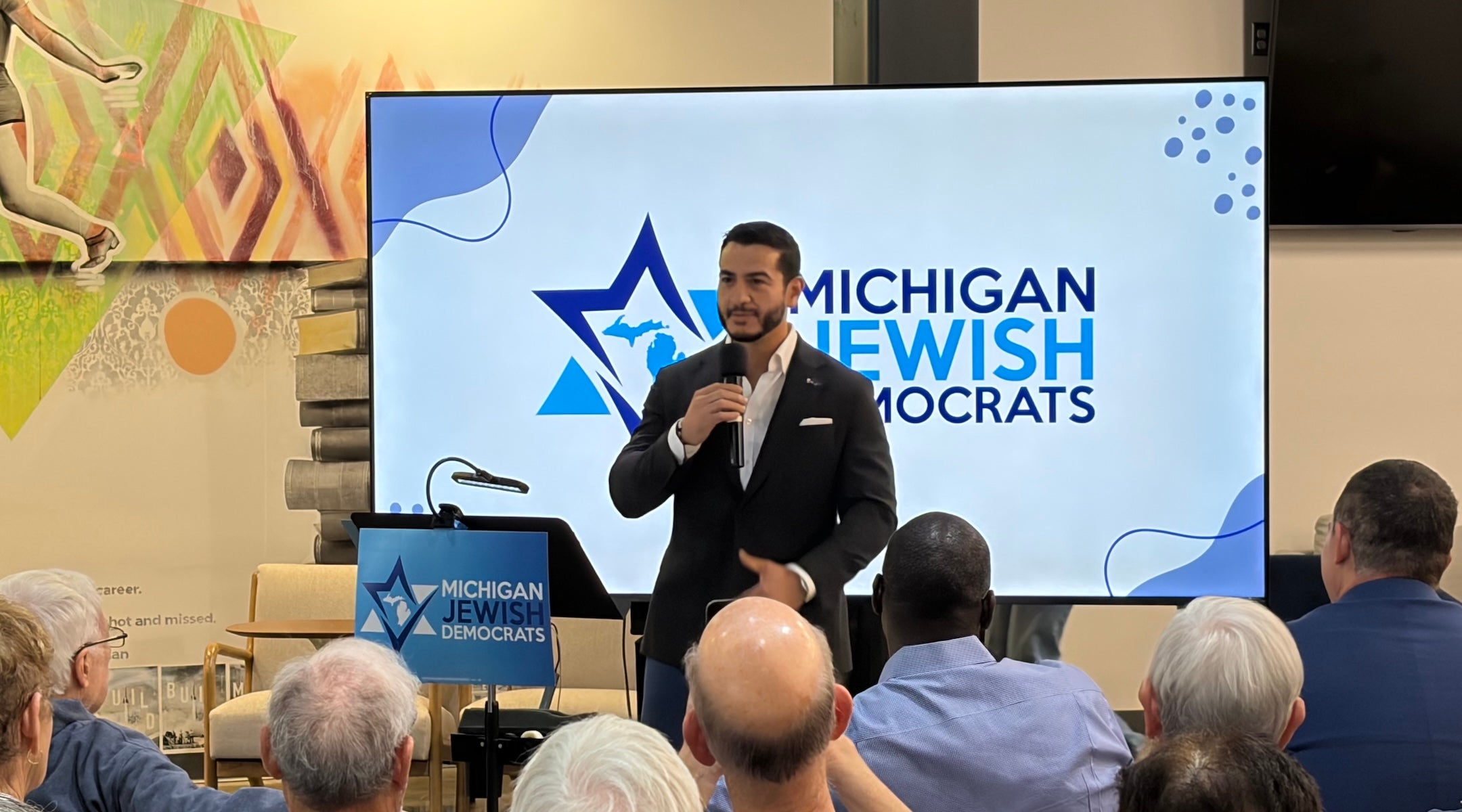
El-Sayed addressed around 300 Michigan Jewish Democrats at the caucus’s annual “Summer Simcha” fundraiser in suburban Detroit on Sunday, one day after he spoke to the caucus at the state Democratic nominating convention. At both events, he sought forgiveness for his earlier comments that had linked the March attack at Temple Israel, in West Bloomfield Township, to Israel’s war in Lebanon.
In his Sunday speech he referenced the Jewish “value of tikkun olam, to repair the world,” and he affirmed the synagogue preschool had been “attacked by a terrorist.” To the gathered Jewish Democrats, the candidate added he hoped to “earn your trust.”
His outreach to Jewish voters will soon become even more pronounced. The campaign intends to hire a Jewish liaison and is in the midst of an interview process for the role, which includes talking with Jewish community leaders, a person familiar with the campaign told (JEWISH REVIEW).
With El-Sayed’s narrow primary victory, and Michigan’s increasing centrality in the fight for control of the Senate, the state’s approximately 100,000 Jewish voters — the majority of whom have historically voted Democrat — find themselves under the microscope as they weigh voting for a candidate who supports zeroing out all aid to Israel. Following his Summer Simcha speech, El-Sayed stayed to speak with a long line of Jews who came up to share their concerns.
Asked later what he’s heard from the Jews who speak to him, he told (JEWISH REVIEW), “I hear a lot about safety, and folks want to know that they’re going to be safe.”
He added, “The prerequisite of Jewish safety is never in question to me, and I just want to make that very, very clear.”

The event, at which (JEWISH REVIEW) was the only media outlet given permission to attend, underscored the tension that has become increasingly difficult for Jewish Democrats, in Michigan and beyond, to reconcile: whether party candidates have earned the vote of their Jewish constituents when those candidates won’t commit to supporting Israel’s existence as a Jewish state, or haven’t taken what community members feel is a strong enough stance against antisemitism.
El-Sayed’s Jewish liaison will likely have their work cut out for them. In both of his spoken apologies this weekend, the candidate had insisted the main problem was with the timing of his attempt to apply “context” to the situation, not with the substance of what he said. Yet many Jews then and now objected to the idea that bringing up Israel’s war in Lebanon was appropriate context when discussing a synagogue attack.
Rabbi Paul Yedwab, a member of Temple Israel’s clergy who was not in attendance at the event, declined to comment to (JEWISH REVIEW) on El-Sayed’s apologies, citing the synagogue board’s recent reaffirmation of a federal law prohibiting houses of worship from commenting on electoral politics.
Asked about which “context” he had been referring to in his apologies, El-Sayed told (JEWISH REVIEW) he meant “violence in all of its forms, in all circumstances.”
El-Sayed shared the room with some party figures who have sharply opposed him, and who the state’s Jewish Democrats hold in high esteem. The caucus event honored state Attorney General Dana Nessel, who is Jewish and who has had public disagreements with El-Sayed over his handling of Jewish communal issues.

In her own speech, Nessel acknowledged that Jews were being forced into a “stark choice” thanks to “members of our own party who seek the destruction of Israel as a Jewish state and place the Jewish diaspora in jeopardy.”
Yet the attorney general stressed that the election was bigger than Israel, and, invoking Purim’s Queen Esther, urged Jewish voters to put their own feelings of personal safety aside.
“We have a moral imperative to place the needs of the world above even our own self-interest and, yes, even our own survival,” she told the crowd.
Nessel said that other societal concerns – climate change, artificial intelligence, the threat of nuclear warfare – loom larger than support for Israel alone and would worsen under continued GOP rule. “What is defending the historic homeland of our ancestors and demanding that candidates acknowledge its right to exist, if the planet upon which it rests is no longer inhabitable?” she asked.
“I think it’s so easy for people to lash out at what they perceive are direct attacks on their faith, on their cultural beliefs, on their historical ancestry,” Nessel told (JEWISH REVIEW) following her speech. “It’s very easy for people to be mad and to say, ‘I reject that.’ I just hope that people will consider that there are many other factors at play.”
Even among caucus leadership, though, there were deep divisions over the right Jewish approach to take in the election.

“I’m a Mike Rogers supporter,” Troy Zukowski-Serlin, a Kalamazoo-based member of the Michigan Jewish Democrats board, told (JEWISH REVIEW) on Sunday before El-Sayed’s speech. Despite his board position, Zukowski-Serlin said nothing would change his mind about voting for the Republican candidate: “It’s signed, sealed and delivered with me.”
His wife Michelle, who attended the event wearing a dress with an Israeli flag imprint, said she would be writing in Nessel, “my hero,” on the ballot.
Jewish Michigan state Sen. Jeremy Moss, who is running for Congress in a heavily Jewish suburban Detroit district and whose own disagreements with El-Sayed have spilled into public view, told (JEWISH REVIEW) that the event was “a step in the right direction” for the candidate.
“It has lingered in the Jewish community for the last six months,” Moss said, of El-Sayed’s initial comments about the Temple Israel attack in his district. “And I appreciate that this is something that he recognized there needed to be a reckoning with, and amends toward.”
Some Jewish communal leaders in attendance, though, said he wasn’t there yet.

“He is moving, and I’m hopeful about that. And it’s making me feel more secure in his leadership,” Rabbi Josh Whinston of Temple Beth Emeth, a Reform synagogue in Ann Arbor, told (JEWISH REVIEW). “There’s still work to do.”
Whinston said he would also like to see El-Sayed address other comments he has made, including having referred to the Israeli government as “bloodthirsty.” Such language, the rabbi said, “puts us in harm’s way.”
The event’s organizers were also skeptical that El-Sayed had changed many minds.
“I think that people are pretty well set in what they want to do,” Joan Lowenstein, another caucus board member, told (JEWISH REVIEW). “But I think they still want to hear words that make them feel that someone else is thinking about what they’re concerned about.”
Liz Fried, of Ann Arbor, was one of the attendees who went up to speak to El-Sayed afterwards. She told him that her children were soon to fly to Israel, and asked if he would support funding for the Iron Dome defensive system.
He wouldn’t, she recalled to (JEWISH REVIEW) — a position he has held in public.
“I was upset,” Fried said. “He doesn’t care about the safety of my children.”
As the Year Turns, Support the Journalism You Trust. (JEWISH REVIEW) covers the stories shaping Jewish life around the world — with the depth this moment calls for. As you reflect on the year ahead, consider a gift that keeps independent Jewish journalism strong.