
The far-right Alternative for Germany’s victory in the northeastern state of Mecklenburg-Western Pomerania, its second in the region in as many weeks, underscores the growing popularity of the anti-immigration, nationalist party at the expense of the country’s political center.
The center-right Christian Democratic Union, German Chancellor Friedrich Merz’s party, had its worst result in any state or federal election with just 4.9% of the vote, falling short of the 5% minimum needed to enter the legislature. It’s the first time in history the party was shut out of a state parliament.
Merz himself admitted the result was a “disaster” for the CDU, saying he would remain chancellor and press on with his economic reform agenda.
The AfD won 38.2%, according to preliminary results in the sparsely populated state on the Baltic Sea, home to some 1.6 million people. The AfD’s result on Sunday more than doubled its 16.7% share in the state’s last election in 2021.
The party’s rise in the east signals it is breaching the consensus of Germany’s liberal, multicultural order and meticulously built barriers against the far right since the Nazi era. Two weeks ago, the AfD crushed its opponents in Saxony-Anhalt, sending shockwaves through Europe.
At the same time, the socialist Left Party swept to victory on Sunday in Berlin, challenging centrist coalitions from the other side of the political spectrum. Such coalitions have long dominated the country but are now fighting to keep alienated voters amid economic stagnation and global instability.
In Mecklenburg-Western Pomerania, the AfD was followed closely by the center-left Social Democrats (SPD) with 35.5% of the vote. The SPD outperformed opinion polls under the leadership of state premier Manuela Schwesig, who cast herself as a bulwark against the AfD while promising to strengthen the economy, education and social services. The Left Party trailed with 6.5% and the Greens with 5.7%.
Despite winning the largest share of votes, the AfD could struggle to form a government without an outright majority in Mecklenburg-Western Pomerania. Other large parties have refused to work with the AfD, which advocates for deporting refugees, opposing multiculturalism, protecting “German identity,” abolishing current public broadcasting and ending sanctions on Russia. The SPD could form a left-leaning coalition with the Left Party and the Greens.
In Saxony-Anhalt, the AfD also fell short of a majority with almost 44% of the vote, but has a greater chance of forming a government. The party is currently negotiating to govern with the Sahra Wagenknecht Alliance (BSW), a populist party with left-wing and right-wing positions that won 5.3% of the vote.
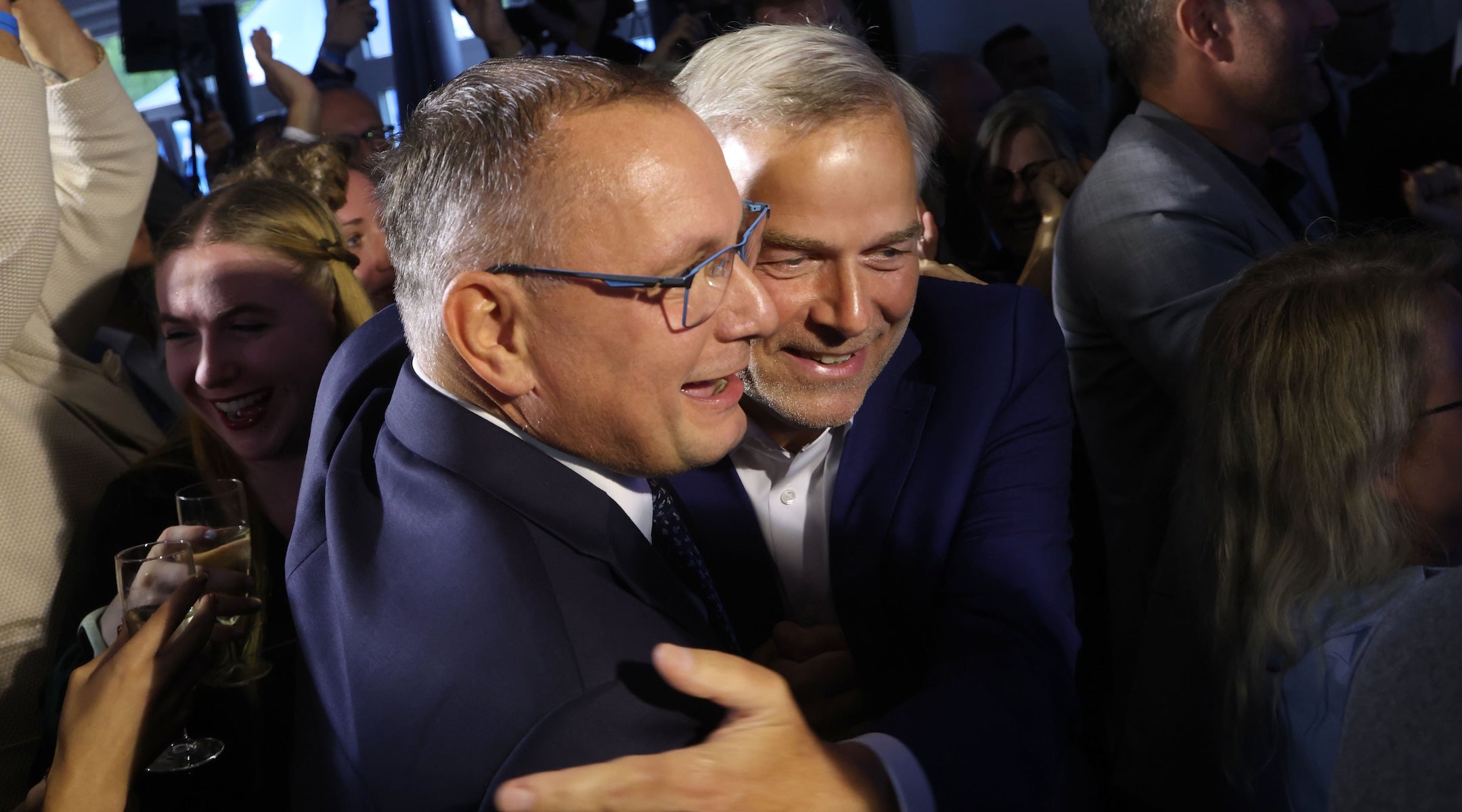
Leif-Erik Holm, the AfD’s candidate for state premier in Mecklenburg-Western Pomerania, said on election night that his party had a “mandate to govern.” He later acknowledged to the public broadcaster NDR that the AfD is ultimately unlikely to be part of a governing coalition, but said he expected the other parties to be “open to dialogue.”
Alice Weidel, the AfD’s national co-chair, celebrated the Mecklenburg-Western Pomerania result in an interview with the broadcaster ZDF.
“We are the strongest force and have reached the mainstream of the population, and we are the new people’s party in Germany,” said Weidel.
As the Year Turns, Support the Journalism You Trust. JR covers the stories shaping Jewish life around the world — with the depth this moment calls for. As you reflect on the year ahead, consider a gift that keeps independent Jewish journalism strong.