

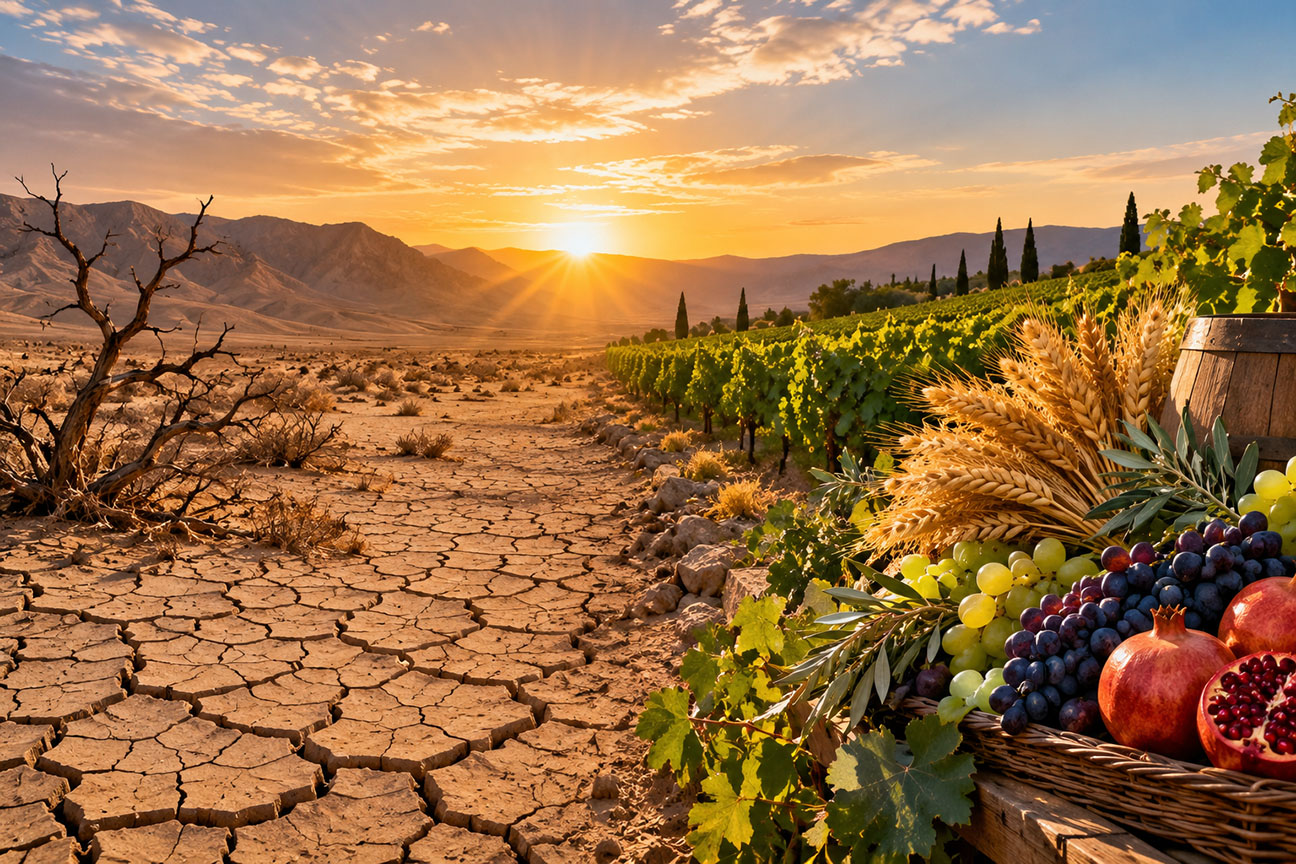
Sukkot contains an inner contradiction.
All the pilgrimage festivals have an agricultural and historical aspect. Pesach is both the beginning of the barley harvest and the commemoration of the Exodus from Egypt. The festival of Shavuot begins the wheat and fruit harvest and commemorates the giving of the Torah.
There are many symbolic connections between the agricultural and historical elements in these holidays. For example, much like the first crops celebrated on Pesach and Shavuot, the Exodus and the revelation at Sinai mark dramatic new beginnings.
But with Sukkot, the agricultural and historical elements diverge. It is the harvest festival, when the fruits of a long year’s labor come home and the storehouses fill with the season’s bounty. No wonder Sukkot is called “the time of our joy” in the holiday liturgy.
Yet the historical aspect of Sukkot is the exact opposite. It commemorates the 40 years in the desert, a “great and terrible wilderness,” desolate and uninhabited.
The two settings at the center of Sukkot could not be more different: the barren desert and the overflowing harvest. Unquestionably, this dramatic tension is intentional. Multiple commentaries consider its meaning.
Maimonides sees this contrast as underlining the importance of gratitude. He explains:
The moral lesson… is this: a person should remember his hard times even in his days of prosperity. This will lead him to thank God again and again, and to live a modest, humble life. That is why … on Sukkot we leave our houses to dwell in booths, as desert-dwellers do when they lack comfort.
On Sukkot, we remember the difficult past to better appreciate what God has given us.
A second element mentioned by Maimonides is highlighted by the Rashbam. Success can go to one’s head; the sukkah keeps us grounded. It is natural for people to believe that “My own power and the might of my own hand made me all this wealth.” We must not forget that our entrance into the land was a gift from God; we too were once homeless and desperate.
A third approach goes in a very different direction. Maimonides and the Rashbam embrace the season’s abundance, but see the sukkah as a reminder to avoid ingratitude and hubris. The Malbim, on the other hand, sees the lesson of the sukkah as anti-materialistic at its core:
The view that this means “actual booths” is meant to keep later generations from growing proud at harvest time, when their houses are full of good things, and from coming to see this world as their true home and ultimate purpose. They are to know and take to heart, “for I settled the children of Israel in booths,” so as to awaken them to the fact that this world is a guesthouse, a temporary dwelling. And so they leave a permanent home for a temporary one, which is what the sukkah alludes to…
At harvest, we might look at all the bounty and imagine this is our goal. So we remind ourselves that this world is only a way station on the path to the next.
Some take this idea a step further. Rabbi Norman Lamm sees Sukkot as a continuation of Yom Kippur, and argues “that just as we can get along on this one day without food or drink or washing or sex or shoes, so must we learn for the rest of the year not to be enslaved to our passions or wants or needs – so on Sukkot do we learn that it is, after all, possible to do without our well-built apartments, our beautiful homes, our well-appointed chambers…”
All of these readings treat the harvest as a spiritual danger. Wealth can lead to ingratitude, arrogance, or materialism; this is why we must remember the years in the desert. I would argue that Sukkot aims to accomplish something else entirely. Abundance not only corrupts us; it blinds us to what we actually have. By bringing the harvest and the desert together, Sukkot comes to instruct those who have everything how to enjoy anything.
To understand how it does so, one must first note a larger theme running through the rituals of Sukkot: the importance of the simple and unadorned.
Three rituals illustrate this idea. The Talmud defines the sukkah as a dirat arai, a transient home. It is the flimsiest of buildings, so simple it doesn’t require four walls.
Among the Four Species, the most unremarkable is the aravah, the willow branch. Unlike the etrog, the date palm, and the myrtle, the willow tree produces no fruit and has no fragrance. Yet in the Temple, the aravah was the most prominent of the four. Each day, the Kohanim placed large willow branches around the altar as the people circled in prayer. On the seventh day of the holiday, known as Hoshanah Rabbah, the people circled it seven times.
Another ritual called Nisukh HaMayim, the water libation, took place on Sukkot. Ordinarily, along with most sacrifices, wine was poured on the altar. Wine is a far more luxurious beverage than water. Yet on Sukkot, water takes center stage. And the people celebrated all night in the Temple as they drew the water.
Taken together, the three rituals underline a theme of simplicity; on Sukkot, less is more.
Next, one must recognize that Judaism sees physical pleasure as positive. God wants us to love His world. The Jerusalem Talmud records the following lesson:
Rabbi Ḥizqiah and Rabbi Cohen said in the name of Rav: Every person will have to justify himself for everything his eye saw and which he did not eat. Rabbi Eleazar took note of this statement and saved coins from which he ate every kind (of vegetable) once a year.
The joys of this world are a divine gift. Rabbi Samson Raphael Hirsch told his students that he planned to visit the Alps because he wanted to have an answer ready for when God would ultimately ask him, “So, Shimshon, did you see My Alps?”
But here’s the final point: we often lose sight of how to enjoy life. Abundance itself gets in the way. Ironically, those living in the desert were better able to delight in the simple pleasures of life than we are.
The Midrash already notes that the more we have, the more we want:
A person does not leave the world having achieved even half of his desire; rather, if he has one hundred he wishes to turn them into two hundred. If he has two hundred, he wishes to turn them into four hundred.
Economists have found that this is true of the developed world. Richard Easterlin, in several academic papers, has pointed out a paradox: even as societies give people more and more comforts, they are no happier than before. One example he gave is that “from 1958 to 1987…income in Japan grew fivefold, but researchers could find no corresponding increase in happiness.” In fact, sometimes rising incomes make a society less happy.
Some point to what is called the “hedonic treadmill” as the culprit. They assume that somehow we become habituated to pleasures and stop enjoying them. In other words, after we eat steak, a hot dog is no longer enjoyable.
But that is incorrect. We never forget how to enjoy anything; we just bury that enjoyment under ambition and envy. As Daniel Kahneman pointed out, the real issue behind our diminishing pleasure is a “satisfaction treadmill.” As people receive more, their aspirations rise, and they pay less attention to what they have.
The developed world, which has a far better standard of living than any generation before it, is filled with grievances. It should be expected. When you have abundance, joy and happiness actually become more difficult.
During times of rising prosperity, we forget to take pleasure in what we have. Instead, we spend our time searching for new and exotic luxuries while continually looking over our shoulder to see what everyone else has.
Ironically, deprivation highlights how to appreciate life. My late mother was a survivor of Auschwitz. One of her favorite sayings was, “Hunger is the best cook.” She said that the army rations soldiers gave her right after she was liberated from Auschwitz were the best meal she had ever eaten in her life, one that no chef anywhere could ever re-create. The overwhelming hunger she experienced at the time brought out the best in that awfully bland meal. What she learned then was that with the right outlook, any piece of food can be enormously tasty.
And that is why on Sukkot we return to the desert. We need to be grateful, aware of how much more we have than previous generations. But more importantly, we need to remember how in the desert, the small and simple loom very large. A bit of shade is precious, the gentle beauty of a willow signals an oasis nearby, and a drop of water is incomparably sweet. One need not journey to the Alps to see the hand of God; on Sukkot, we rediscover the humble pleasures we take for granted and learn again to delight in the ordinary.
And Sukkot is a time when we recognize that every meal is truly the best-tasting food on earth.