
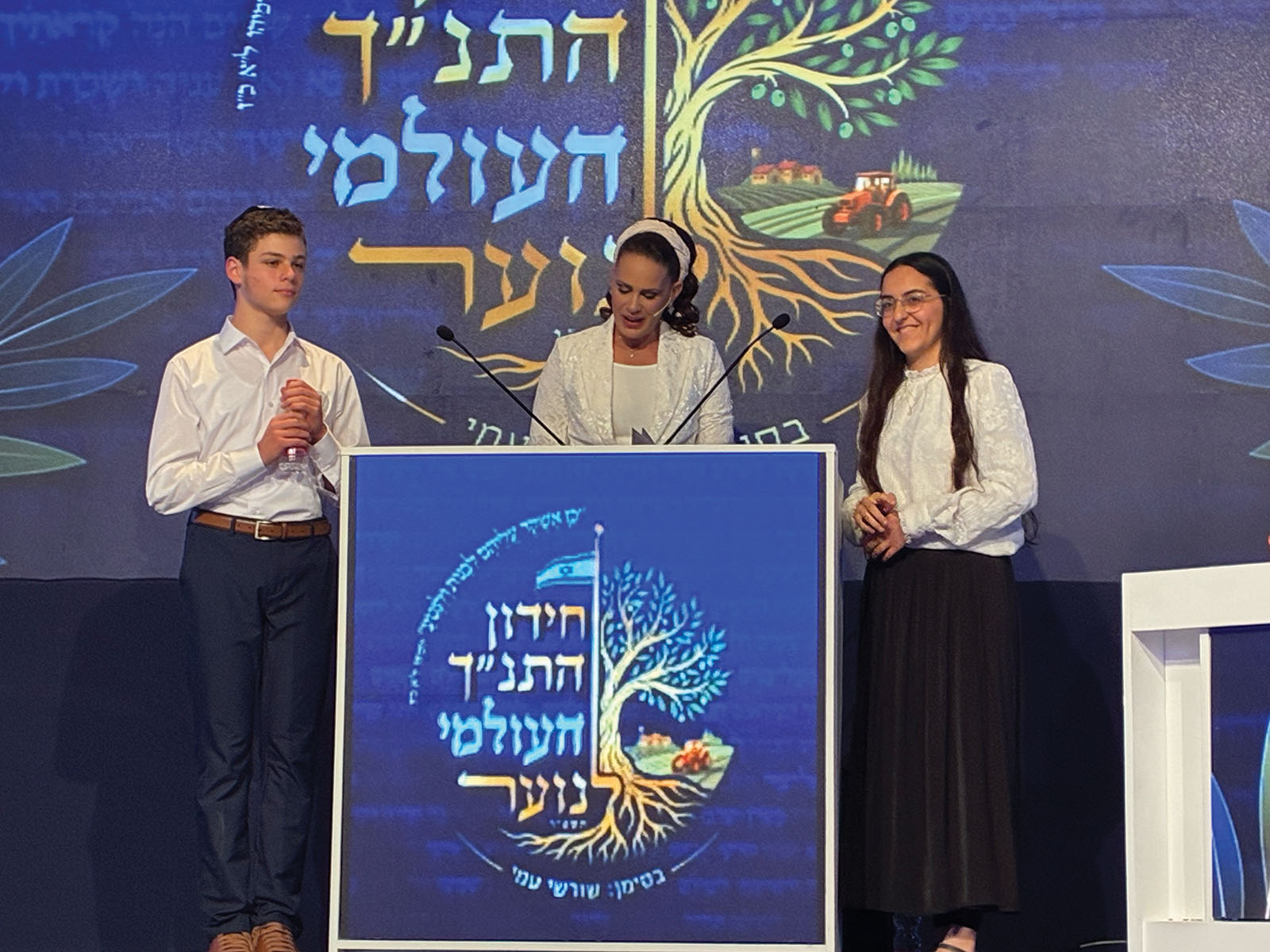
Fifteen-year-old Jack (Akiva) Shrier of YULA High School in Los Angeles earned second place at this year’s Chidon HaTanach in Israel— a Bible contest considered one of Israel’s most prestigious academic competitions. The contest has been held in Jerusalem since 1958 on Yom Ha’atzmaut. This year, due to the war, the event was pre-recorded and will be broadcast on April 22.
While Israeli contestants usually dominate the top places, this year American contestants claimed three of the top four spots. An Israeli contestant won first place. Joshua Applebaum placed third and Hadassa Esther Richt placed fourth.
Abigail K. Shrier, Jack’s mother, who accompanied him to Israel for the contest, spoke with the Journal by phone and described how extraordinary the win was for the American contestants. “This second place is the highest that an American has won in 13 years,” she said.
Jack’s father, Zach Shrier, who owns a financial planning business in Los Angeles, spent many hours preparing his son for the competition. For him, seeing his son compete felt like closing a circle.
“When I learned about Chidon Hatanach, I was in college. I had a friend who was the U.S. champion back in 1994, and I felt disappointed that nobody had ever told me about this when I was in high school because I would have loved the experience,” he said. “I had it in the back of my mind that maybe my kids would want to do it. But then of course life gets busy and I forgot all about it.”
He recalled that old dream when his twin sons, Jack and Raphael (Rafi), returned home from Camp Stone in Pennsylvania in 2021. They told their parents that their counselor had participated in the Bible contest and that they wanted to do so as well.
“I said, ‘Wow, I can’t believe it. I always was sort of hoping you were going to say that,’” recalled Zach.
The twins started competing the following year, in 2022, and quickly stood out. That year, Raphael placed first and Jack second in the sixth-grade division. The following year, Jack took third place in the national finals, while Raphael placed fifth.
Their younger sister Dafna came in second place last year in the sixth-grade division.
Sponsored by the Jewish Agency for Israel, the U.S. National Bible Contest is open to Jewish students in grades six through eleven and tests detailed knowledge of multiple books of the Bible. Each year, roughly 700 students begin the process, with about 300 advancing to the national finals in New York. From there, just four students—three high schoolers and one middle schooler—are selected to represent the United States on the international stage, a one-time opportunity that many participants prepare for rigorously.
Last year, Jack won first place in the U.S. National Chidon HaTanach, earning the title of national champion and securing his spot as one of the American representatives at this year’s international competition in Israel. His twin brother, Raphael, placed fourth in the nation, making him eligible to compete again.
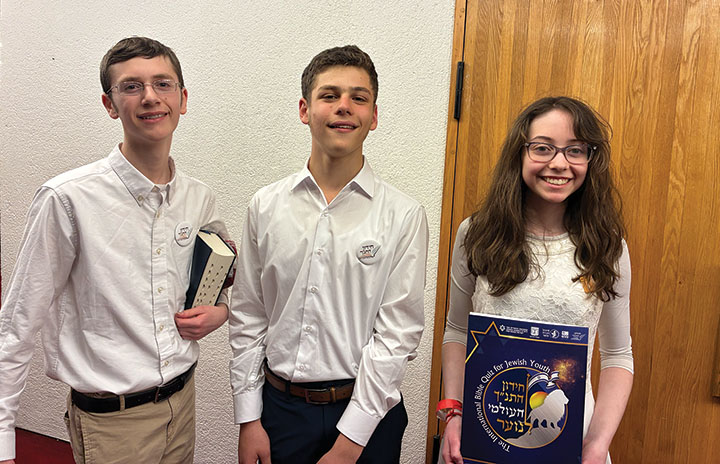
The competition has long attracted viewers in Israel and around the world who enjoy testing their Bible knowledge against some of the most challenging questions in the field. Some of the questions asked this year were: Which biblical figure cut off a tree trunk and carried it on his shoulder and instructed others to do the same? (Judge Abimelech) and: In which location were the threshing floors of Israel raided by the Philistines? (Keilah, in 1 Samuel).
To come this far, Jack and Raphael prepared before and after school and on weekends, often testing each other. Along the way, they gained not only knowledge but also friends from around the world who share a love of Torah.
“For years my dream has been to get to the final two in the chidon,” Jack told The Journal. “[My win] made me realize that all my work had paid off, and that the five hours a day of study really wasn’t just for a place in a competition, but a way for my teachers to recognize that their help had paid off, too. Winning then wasn’t just a place but an expression of all the family friends and teachers who helped me along the way.”