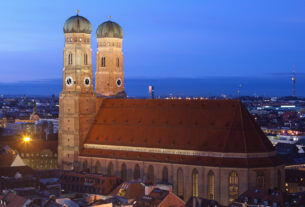

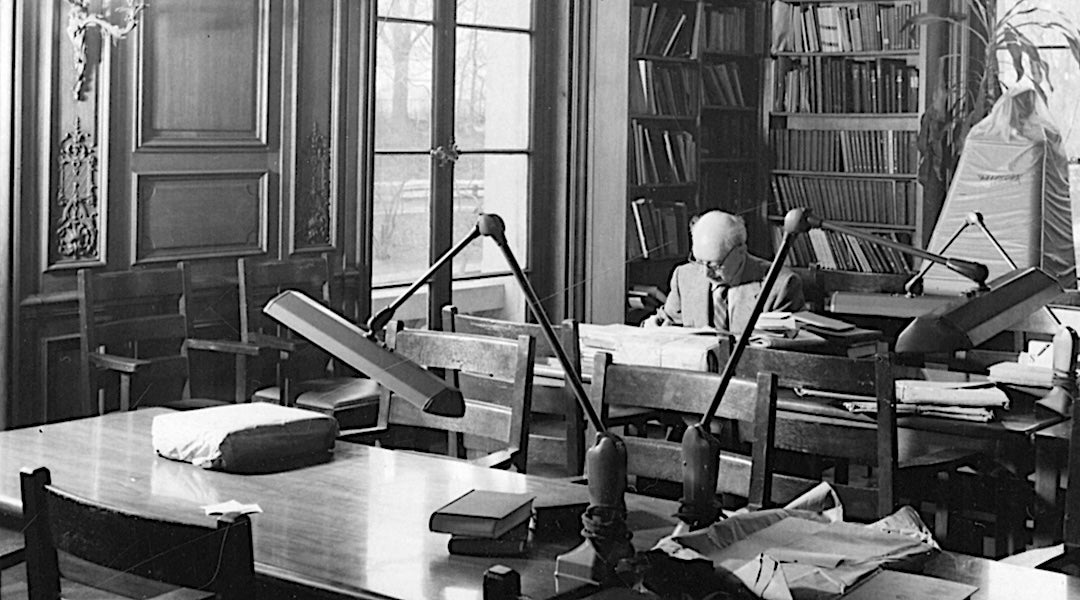
When YIVO was founded in Vilna in 1925, its mission was to study a living people.
The Yidisher Visnshaftlekher Institut was meant to be a national university for Jews scattered across Eastern Europe and, increasingly, the world. Its scholars studied Yiddish language and literature, but also Jewish sociology, psychology, history and contemporary life. YIVO was interested in how Jews actually lived — and in helping them navigate modernity.
When the Nazis destroyed much of that world, YIVO’s surviving caretakers were forced to ponder why and how to keep their efforts going in a new world haunted by unimaginable loss.
Their efforts are explored in Kalman Weiser’s new history, “Yiddish Scholarship Comes to America: The YIVO Institute at 100.” After World War II, a relocated and heartsick YIVO had to become a guardian of a nearly vanished culture, a rescuer of its texts and artifacts and an institution that could somehow make that culture meaningful to Jews who were rapidly shedding Yiddish and embracing a distinctly American, English-speaking identity — all simultaneously.
The challenge, writes Weiser, was “cultivating a relationship with the largest segment of American Jewry that, even if it spoke or understood Yiddish, did not share YIVO’s valorization of Yiddish and of social science about the recent past and present as a means to better Jewish life.”
To tell this story, Weiser, the Silber Family Professor of Modern Jewish Studies at York University in Toronto, focuses on the transitional years from 1940 to 1970, drawing on archives and oral histories.
He also brings YIVO’s story up to the present, when some younger Jews are reaching back to Yiddish as an alternative to religious or Israel-centered models of Jewish identity. In that sense, YIVO’s project has acquired a new urgency: how to make a usable past out of a culture that history nearly erased.
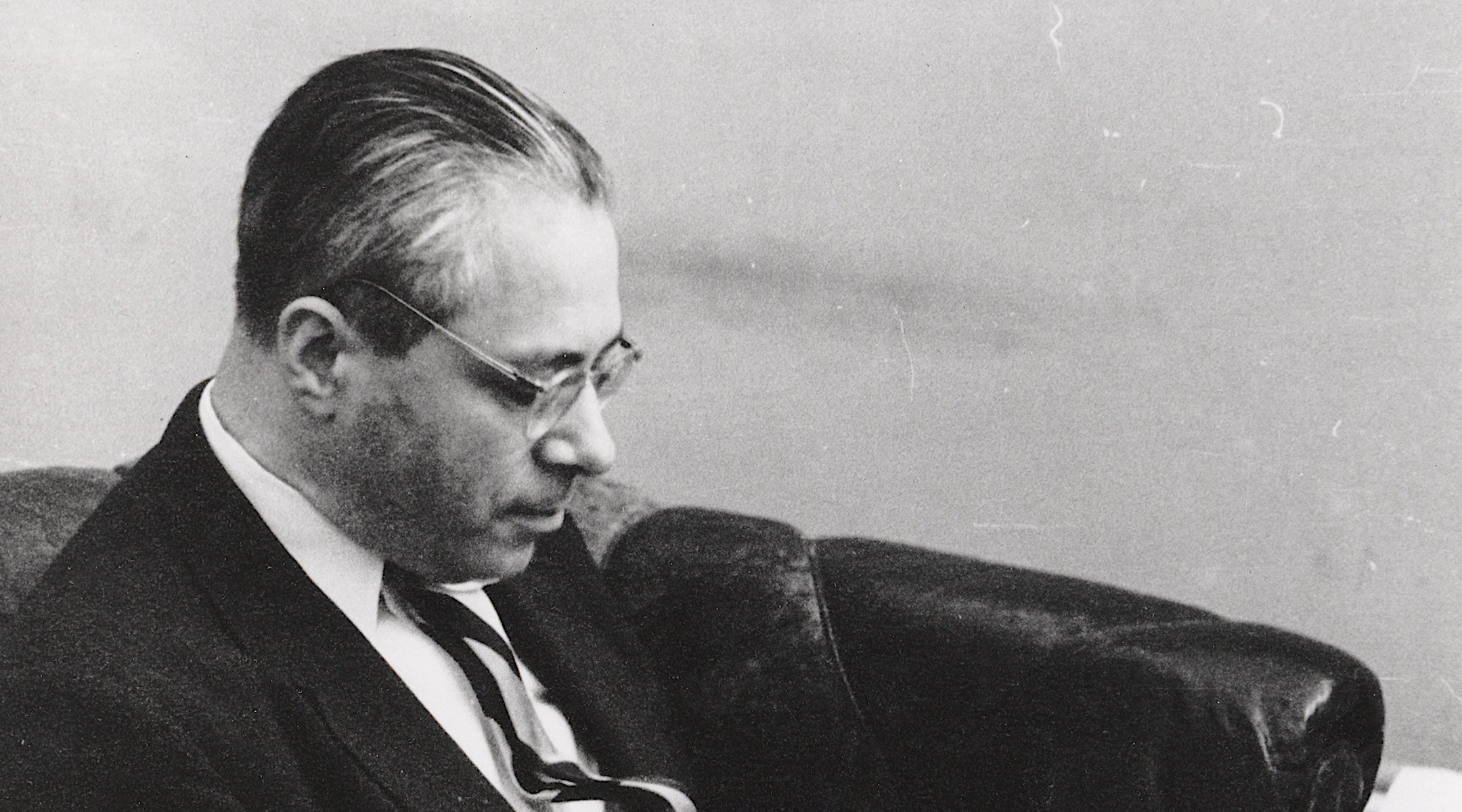
In a book rich with the biographies of scholars and refugees, poets and partisans, the protagonist is Max Weinreich, one of YIVO’s founders and its leading administrator. The Latvian-born, German-trained linguist was stranded in Copenhagen in 1939 when World War II began. He was cut off from a Lithuania that would suffer Soviet annexation and Nazi occupation. He eventually reached New York with his son Uriel, and immediately began building the American branch into the new center of YIVO.
He was the driving force behind a transformation that began even before the full dimensions of the Holocaust were understood. “By late ’39, some people said this is a calamity and we need to bring YIVO to New York,” Weiser told me in a recent public conversation hosted by YIVO. “They didn’t know the extent of the calamity, but they were using words like ‘khurbn’ — destruction.” They understood, however, that Eastern European Jewish life might never recover.
Weinreich increasingly argued that American Jews would have to assume the burden of world Jewish leadership. The United States had the world’s wealthiest, most secure and now largest Jewish population. The Jewish community in what would soon become Israel, meanwhile, had elevated Hebrew as the Jewish national tongue, often sidelining Yiddish and its speakers in the process.
YIVO’s small but famously argumentative staff disagreed on the primary mission. Some wanted to preserve and document the world that had disappeared. Others insisted that the institute had to address the English-speaking generations growing up in America, even if Yiddish itself was losing ground.
At the same time, they undertook an extraordinary campaign to recover YIVO’s collections — rare books and manuscripts, artworks and letters, and ephemera like children’s notebooks, student newspapers and theater posters.
The Nazis had looted Jewish libraries and archives across Europe, including YIVO’s holdings in Vilna. Some materials were shipped to Germany for Nazi antisemitic “research”; others were hidden in Vilna and elsewhere. After the war, YIVO worked to retrieve crate after crate of material buried in bunkers, concealed inside a Lithuanian church, or stored in the Offenbach Depot in Germany by the U.S. Army “Monuments Men,” famed for their relentless efforts to salvage works stolen by the Nazis.
The process raised a question that remains difficult to answer even today: Who owns the cultural heritage of a transnational people that has been largely destroyed?
“Do they go back to the countries they originated in? Do they go back to a Jewish community if a Jewish community is functioning there?” Weiser said. “Do they go to the United States, and to whom? Do they go to the Yishuv [the pre-state Jewish community in Palestine]?”
The retrieval efforts have extended well into the 21st century.
And where those treasures would be stored in New York reflected the institute’s changing mission.
During the war, YIVO moved into a former Jewish Theological Seminary building on 123rd Street, near Columbia University. In the mid-1950s, when that neighborhood was redeveloped, YIVO moved again, this time to a Vanderbilt mansion on Fifth Avenue.
The uptown locations, a few miles but a world away from the Yiddish speakers still living on the Lower East Side, symbolized YIVO’s increasing integration into the American Jewish establishment.
That led, said Weiser, to “complaints, you can imagine, of YIVO abandoning the folk, abandoning its constituency, moving uptown to be among the prestigious Jewish English-speaking institutions.”
At the same time, a new generation was figuring out how YIVO could remain relevant.
The most important figure in that transition may have been Uriel Weinreich, Max’s son, who became the first professor of Yiddish at Columbia University, the author of a popular college Yiddish textbook, and a major figure in American linguistics before dying in 1967 at age 40. His father died less than two years later.
If Max Weinreich represented the European Jewish intellectual trying to rebuild his destroyed world, Weiser argues, Uriel represented a generation that understood America on its own terms.
“The European generation, for the most part, could not fully acclimate to America,” Weiser said. “They were trying to impose Eastern European visions on American Jewry.”
Uriel’s generation helped bring Yiddish scholarship into American universities. YIVO trained or nurtured scholars including Joshua Fishman, Dan Miron, Ruth Wisse and Lucy Dawidowicz, helping to lay some of the foundations for what became the academic field of Jewish studies.
But there was a cost. The more that Jewish scholarship became part of American academia, the less that YIVO was seen as the center of the field.
And Yiddish itself was increasingly marginal to American Jewish life.
In the 1950s, YIVO leaders even debated dropping “Yiddish” from the institute’s name because they feared the word had become a liability. Yidisher Visnshaftlekher Institut can be translated as either the Yiddish Scientific Institute or the Jewish Scientific Institute.
“People hear Yiddish, they want to run the other way,” Weiser said, paraphrasing the objections of the vanguard. “They don’t take us seriously.” Eventually they settled on the YIVO Institute for Jewish Research.
Yet Max Weinreich’s vision — a belief that American Jews needed access to Yiddish even if they would never become Yiddish speakers — continued to hold sway. Weinreich was a proponent of what Weiser calls Diaspora Nationalism: a secular Jewish identity that transcended the countries where Jews lived and that was held together by a common language. It was a reflection, of course, of Weinreich’s own Jewishness and YIVO’s tendency to overlook Orthodox Yiddish speakers and their religious “nurishkeit,” or foolishness.
Skeptical that nonreligious Jews could sustain their Jewishness without a shared language of their own, Weinreich believed that “more than Yiddish needs American Jewry, American Jewry needs Yiddish because it’s the key to understanding itself,” Weiser said.
The terms of this conviction proved surprisingly durable. While Weinreich considered himself a Labor Zionist and came to understand that there was no future for Jews in Eastern Europe, he “clung to a vision of Jewish national cultural autonomy in the Diaspora,” writes Weiser.
Today you can find a revival of this idea among some young Jews. Disillusioned with Israel, they see in Yiddish and the culture of Eastern European Jewry a progressive alternative to Israel around which they can build a Jewish identity. Earlier this year, Molly Crabapple’s “Here Where We Live Is Our Country: The Story of the Jewish Bund,” a celebration of the socialist, anti-Zionist Bund, debuted at number four on the New York Times bestseller list. Although the Bund’s vision for national-cultural autonomy wherever Jews happened to live was crushed by Nazism, many readers and reviewers found the book inspirational.
Budding “Diasporism” can sometimes lead to conflict with an older guard at YIVO that considers itself very much Zionist. Weiser recounts how in 2024, in the wake of the Oct. 7 attacks, YIVO sponsored a lecture series about the relationship between Nazi and Hamas ideology. It caused a rift, pitting Yiddishists critical of Israel and the war in Gaza against leaders of YIVO who insisted that Yiddishkeyt is a call to understand and empathize with the challenges facing Jews, wherever they live.
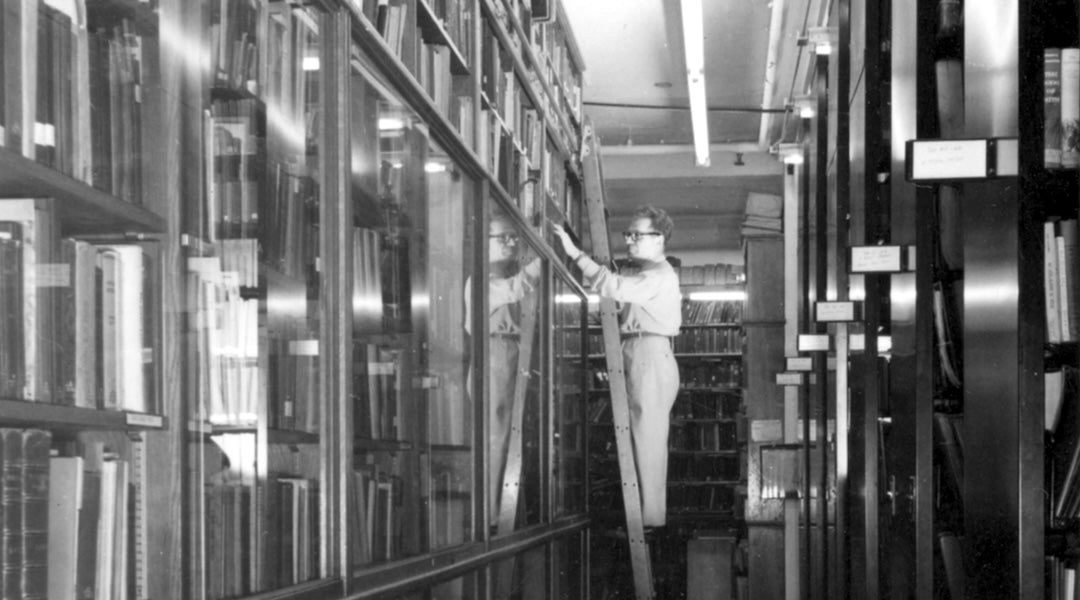
By that time, YIVO and its vast collections had found a new home at the Center for Jewish History on 16th Street, moving in 1999 into a well-appointed building shared with the American Jewish Historical Society, the Leo Baeck Institute, the American Sephardi Federation and the Yeshiva University Museum. Its Yiddish-language courses, live and online literary events (nearly always in English), cultural programs and archives are accessed by a graying crowd, a crop of scholars like Weiser and the young Jews (and more than a few non-Jews) drawn to Yiddish culture.
YIVO has become a key player, joined by the Yiddish Book Center in Massachusetts and various Jewish studies programs, in the translation of forgotten or out-of-print Yiddish books, celebrations of Yiddish culture and the revival, starting in the late 1970s, of klezmer music. Even as the number of speakers of Yiddish as a first language has grown — thanks to a fecund haredi Orthodox community — YIVO is very much in the translation business, conducting its business in English and interpreting secular Yiddish culture for Jews whose knowledge of the language may be limited to a few words and phrases.
A century after its founding, YIVO remains both an archive of a vanished world and an argument for its continuing relevance.
“YIVO has to reinvent itself periodically while maintaining a certain loyalty to its core values,” Weiser said. “And that’s a challenge.”
As the Year Turns, Support the Journalism You Trust. JR covers the stories shaping Jewish life around the world — with the depth this moment calls for. As you reflect on the year ahead, consider a gift that keeps independent Jewish journalism strong.