

(J. The Jewish News of Northern California via (JR))
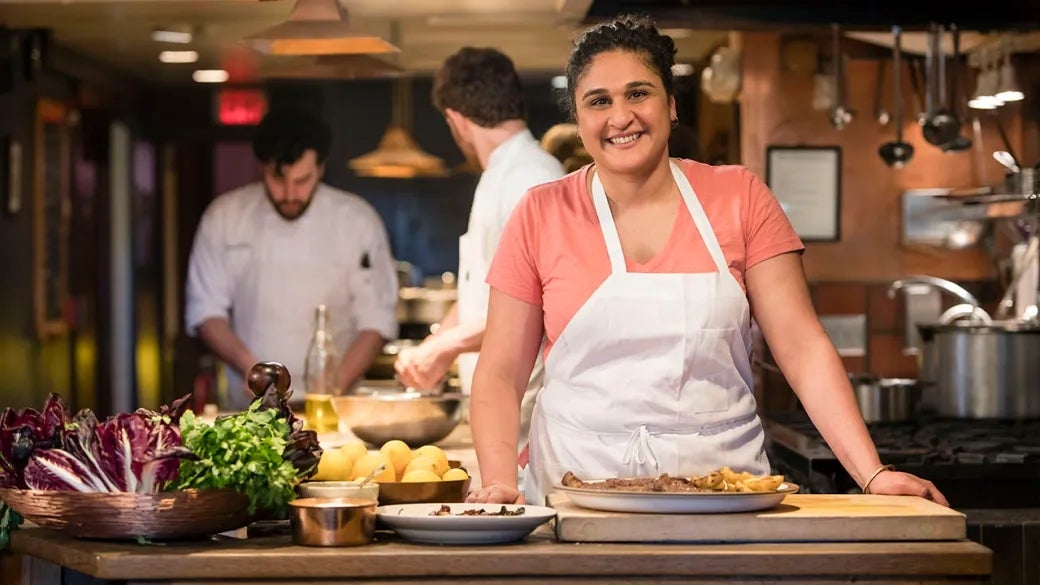
When celebrity chef and Bay Area food ambassador Samin Nosrat appeared this week at San Francisco’s JCC alongside two Israeli chefs, it was nearly three years since she pledged not to buy or promote Israeli food.
The Chez Panisse alum and author of 2017’s smash hit “Salt Fat Acid Heat” joined Israeli chefs Itamar Srulovich and Sarit Packer, the couple behind a beloved London restaurant, to discuss their latest cookbook, “Honey & Co. Daily: Easy Food for Your Everyday Pleasure.”
In promoting the event, Nosrat urged people to join her in the JCCSF’s sukkah to enjoy bites from Loquat, a Jewish bakery in the Hayes Valley neighborhood of San Francisco that she calls her favorite. The celebration of Jewish and Israeli food culture came two days shy of the third anniversary of the Oct. 7 Hamas attack on Israel.
Nosrat was among those who signed the Hospitality for Humanity pledge in 2023, which, in accordance with the boycott, divestment and sanctions movement, committed signers to “not purchasing, using, or promoting Israeli agricultural or food products … so long as Israel continues its system of apartheid, occupation, settler colonialism, and genocide.” Israel rejects the genocide charge.
The boycott drew signatures from more than 1,100 people across the industry. When the New York Times covered the saga in November 2023, it listed Nosrat as one of its most prominent supporters.
The pledge targets Israeli products, not Israeli people, and Srulovich and Packer are longtime friends of Nosrat’s.
Nosrat did not return several requests for comment, nor has she publicly disavowed the boycott, which has scrambled Israeli and Jewish food businesses’ relationship with other Middle Eastern cuisines. New York magazine depicted this tension in August in its Habibi City series, which proposed that Israel’s war in Gaza had ushered in a golden era for Southwest Asian and North African restaurants, at the peril of cuisines considered Jewish or Israeli.
Bay Area restaurants have felt the pressure, too. Guy Eshel, the Israeli owner of Sababa — a popular pita eatery in San Francisco’s Financial District — told J. that he recently sold his shop, citing the dual pressures of a struggling downtown and anti-Israel sentiment. Mica Talmor, an Israeli chef who ran Oakland’s Pomella until last year, said that stress related to Oct. 7 and its aftermath contributed to the restaurant’s closure.
In the years since signing the boycott pledge, Nosrat, a first-generation Iranian American raised by a Muslim mother and Baha’i father, revealed a family secret: Her paternal ancestors were Jewish.
She found out by accident. Nosrat had gone looking for her estranged father’s will as he lay on his deathbed. The search returned a hidden YouTube channel with hours of her father “ranting.”
In those recordings, “he revealed we had Jewish ancestry, which had always been kept from us,” she told podcast host Sam Fragoso last year while promoting her new book, “Good Things.” “I was like, this is so cool, this is amazing. Like, there’s just things where I’m like, wow, I wish I had known this about myself.”
Rabbi Tarlan Rabizadeh, who oversees the Maas Center for Jewish Journeys at the American Jewish University in Los Angeles, said she has seen many Iranian students discover they have Jewish roots.
“It’s not easy being a minority religion in a majority Muslim community,” Rabizadeh said. “So a lot of people either hid their Judaism or converted, and then their great- great-grandkids didn’t find out until someone revealed it on their deathbed.”
Religion was central to the Nosrat family story. In the mid-1970s, as the pressure in Iran intensified, Nosrat’s parents fled to escape the persecution of Baha’is.
Her father’s death, combined with her own depression, the lingering effects of the Covid pandemic and a growing self-doubt following the success of “Salt, Fat, Acid, Heat,” triggered a personal excavation.
“So many people at this point in time are deeply searching for a sense of meaning and sort of trying to answer for themselves this question of ‘what is a good life?’” Nosrat told Fragoso.
She found answers in Jewish teaching, and one 20th-century rabbi in particular. A friend slipped her a copy of Rabbi Abraham Joshua Heschel’s 1951 book “The Sabbath.” Heschel, a Poland-born American rabbi, was one of the foremost Jewish voices of the Civil Rights Era and marched alongside the Rev. Martin Luther King Jr. in Selma, Alabama.
Nosrat was taken by Heschel’s description of “Judaism being a religion not of things, but basically of time.”
“A huge practice in that is the carving out of this sabbath. I think he calls it a cathedral in time,” Nosrat told Fragoso. “I have tried to figure out what I am doing with my life and why. The answer … has ultimately been about figuring out a way to maximize or value my time the best I possibly can, and to share this message of how important time is for all of us.”
Whether that search has changed how she views the boycott, Nosrat hasn’t said.
Historian Arash Azizi, a lecturer at Yale University who is writing a book on the relationship between Israel and Iran, said the discovery of Jewish roots tends to have a more profound effect on people than finding out they are, say, from some other region in the world.
“It’s because Jewish belonging is a much more contentious issue than, let’s say, Italian belonging,” Azizi said. “Jews are a small population relatively, but the Jewish identity is central to politics in the U.S. and other places. So, it’s not surprising at all that declaring Jewish identity would be a bigger deal.”
Azizi said he has been “disturbed” by how the war in Gaza has forced people — particularly those in the public eye — to take a position unlike with any other global event.
“This is the be all and end all for so many people, and it speaks to the monochromatic nature of culture wars in America,” Azizi said. “Americans think they’re talking about the world, but it’s always about themselves. The Israeli-Palestinian conflict is used as a cudgel in these parochial culture wars.”
For Talmor, the event with Nostrat reaffirms her view that food should not be politicized to the point of excluding people.
“Criticizing a government is one thing. Shutting out its people, its artists, its farmers and its chefs is another,” she said. “I’d rather see chefs sit at the same table and talk than draw lines around who gets a seat.”
Aliza Sokolow, an Emmy-winning food stylist based in Los Angeles, said she supported Nosrat’s effort to “come and learn,” despite her Israel boycott pledge.
“I’m going to reach out and invite her to Shabbat next time she’s in town,” Sokolow said.
This story was first reported by J. The Jewish News of Northern California and is reprinted with permission.
As the Year Turns, Support the Journalism You Trust. (JR) covers the stories shaping Jewish life around the world — with the depth this moment calls for. As you reflect on the year ahead, consider a gift that keeps independent Jewish journalism strong.