

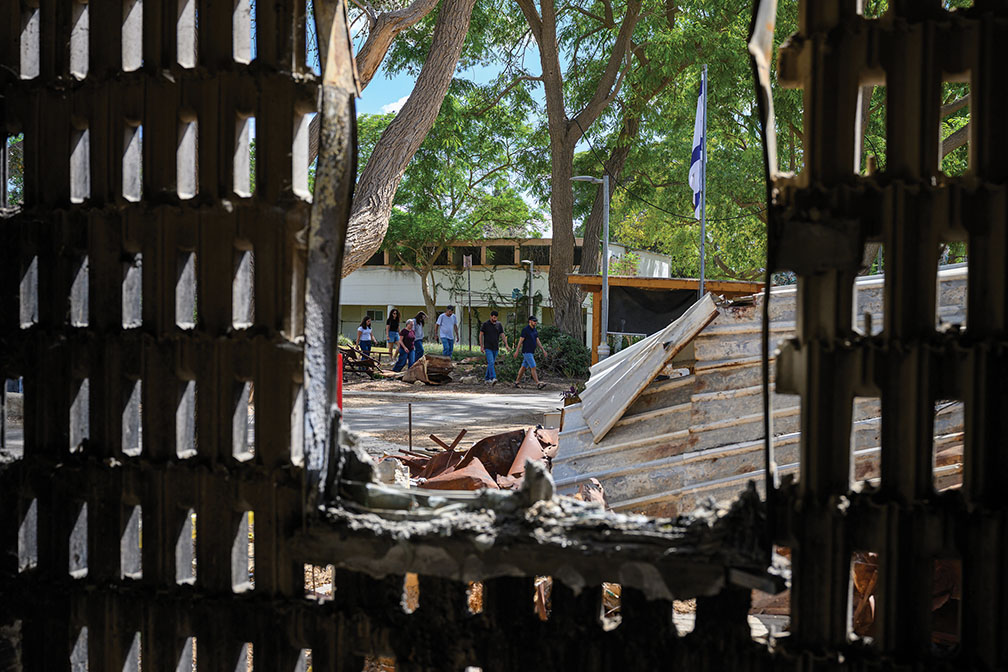
Last week, I stood at the edge of Kibbutz Nir Oz and looked across a few fields to Gaza. Before Oct. 7, 2023, about 400 people lived here. That morning, 47 were murdered and 76 were taken into Gaza, nearly a third of the community in a few hours. We walked past burned homes now kept as memorials, with new houses rising beside them. I was one of 250 Americans on the trip, and I could not stop thinking about the families on both sides of those fields.
The next day, I listened to Israeli scientists describe how they are blending biology with AI and engineering. By the week’s end, I believed the grief and the invention spring from the same source, a deep will to survive. That will has made Israel one of the most innovative countries in the world. It also takes a heavy toll on the people who carry it. Survival alone isn’t resilience. Lasting resilience also depends on investing in people’s inner capacity to handle stress and trauma, in Israel and here at home.
Yad Vashem, Jerusalem’s Holocaust memorial, helped me understand where that will comes from. In the 1930s and early 1940s, as persecution turned into genocide, most countries closed their doors to Jewish refugees. Many Israelis carry that memory as a scar, and with it a resolve never again to depend on others for their survival.
That resolve shows in how the country builds. Chaim Weizmann, a chemist who became Israel’s first president, founded his institute in 1934, 14 years before the state existed. At AION Labs, four pharmaceutical rivals, AstraZeneca, Merck, Pfizer and Teva, share a venture studio that builds AI startups for drug discovery, because its structure protects each partner’s interests. In 15 years at the World Bank Group, I rarely saw a country turn pressure into progress so consistently.
But living under constant threat also wears people down. Chronic stress affects the prefrontal cortex, which governs judgment and self-control, and narrows attention to the next danger. In my work with leaders, I have seen capable people burn out, and the families, teams and institutions around them struggle too.
The war that followed October 7 has also brought immense loss of life and suffering to Palestinians in Gaza. Their grief is real and belongs in any honest account of this place. It is a layered conflict, with histories, fears and losses that do not fit neatly on two sides of a line. At the Nova festival site, a survivor told us he is alive because a Bedouin Arab man hid him and 12 others beneath the floor of a farm building, at great risk to himself. Courage like that is resilience too.
For years I have supported Gurudev Sri Sri Ravi Shankar’s Track II diplomacy. In 2015, he met FARC leaders in Havana and urged them to embrace nonviolence. Weeks later, they declared a unilateral ceasefire, an early step toward Colombia’s 2016 peace agreement. That work taught me that healing begins when people feel their loss has truly been seen, and when they feel settled enough to sit across from someone different without fear.
That inner steadiness can be cultivated. In a 2020 Yale study, students who learned SKY Breath Meditation reported less stress and depression and more positive emotion and social connection. Calmer minds also consider a wider range of ideas and take the risks innovation requires.
I still think about those fields between Nir Oz and Gaza. On a map, they are a few miles apart. In fear, grief and mistrust, the distance is far greater, and closing it will be the work of the people who live there. Israel has shown what determined people can build under pressure. The harder task, there and everywhere, is helping people carry that pressure without being broken by it. That work can begin with something as simple as a breath. I hope it ends with the families on both sides of those fields able to look across them and see each other.
The author traveled as a guest of Israel’s Ministry of Foreign Affairs, which paid for the trip.
Dr. Ajay Tejasvi is a leadership strategist and president of Shankara Inc. He leads the TLEX Institute in North America, which offers leadership and resilience programs built on SKY Breath Meditation. He spent fifteen years at the World Bank Group and currently works on Gurudev Sri Sri Ravi Shankar’s peacebuilding and resilience initiatives.