

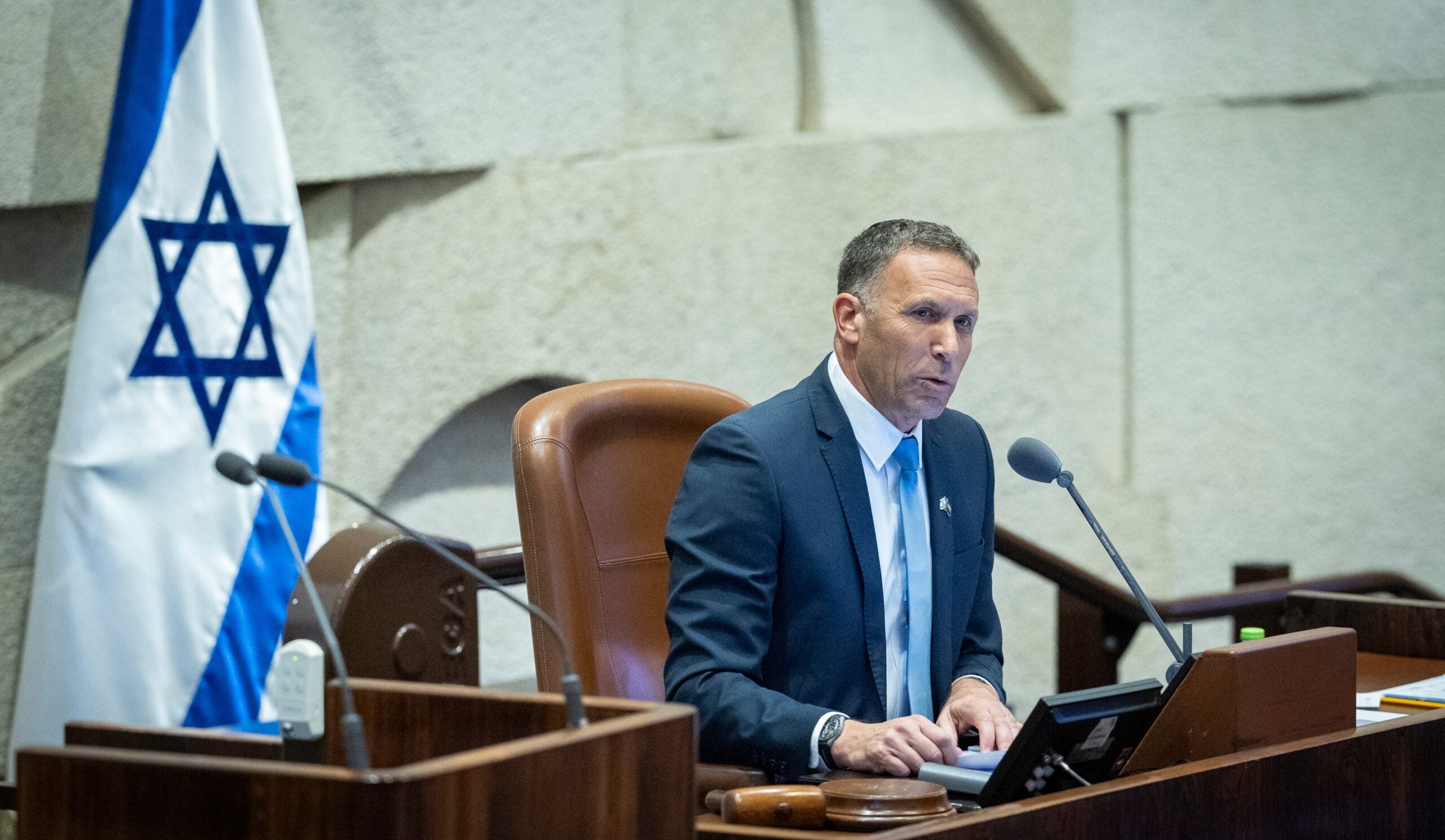
Israeli parliament members elected Matan Kahana of Gadi Eisenkot’s opposition Yashar party to be the next speaker of the Knesset, in a 66-52 vote on Tuesday that portends clashes with Prime Minister Benjamin Netanyahu.
Kahana will serve as speaker of the 26th Knesset, defeating Ofir Katz from Netanyahu’s Likud Party.
A Knesset speaker belonging to the bloc actively seeking the prime minister’s ouster is rare. Last week, Eisenkot got the mandate to form a new government, although he has yet to do so.
Installing his ally Kahana in the powerful speaker’s seat will allow Eisenkot to engineer legislative maneuvers that will undercut Netanyahu’s agenda, at least during the three-to-five remaining weeks Eisenkot has to form a coalition.
One key Eisenkot priority is passing legislation to establish a commission of inquiry into the failures surrounding the Oct. 7, 2023, Hamas raids, the worst attack in Israel’s history. Netanyahu, who was prime minister on that day, has until now resisted setting up such an inquiry.
Kahana secured the speaker role on Tuesday with the support of the 48 Knesset members of Eisenkot’s bloc, which includes the Yashar, B’Yachad, Yisrael Beyteinu and Democrats parties. The Arab-majority Ra’am and Joint List parties also voted for Kahana, with just one of their collective 19 members absent.
Eisenkot has insisted that Arab parties must have equal say in the Knesset, even if they are not part of the coalition. The Netanyahu bloc’s resistance to any empowerment for the Arab parties – even in the face of their unprecedented success in the Oct. 27 election – fueled much of the vitriol in the debate prior to the vote.
Kahana immediately sounded a conciliatory note toward the Arab Knesset members who voted for him, a signal of the markedly different tone Eisenkot plans to take in contrast to Netanyahu.
“The Knesset is the home of all of Israel’s citizens,” Kahana said in his first address as speaker on Tuesday evening. “I intend to be the speaker for everyone – regardless of religion, race or gender.”
He stressed that “it is possible to hold opposing views while still maintaining respect for state institutions and for those who think differently.” Kahana, 54, has served in the Knesset in multiple parties off and on since 2019.
After hours of filibustering from the Netanyahu bloc, the vote was able to take place when the two camps struck a deal, according to Israel’s Channel 12: Eisenkot’s bloc agreed to delay votes to repeal bills advanced in the previous Knesset until next week.
Eisenkot has promised that he would put together a coalition based on four guiding principles: recognition of Israel as a Jewish and democratic state; embracing the values set forth in Israel’s Declaration of Independence; requiring military or civil service for all; and commitment to dismantling Hamas while recognizing the group as a terrorist organization.
Although the Arab-majority parties supported Kahana’s appointment as Knesset speaker on Tuesday, Eisenkot’s path toward forming a government with their involvement would be a formidable task. The leader of Ra’am, Mansour Abbas, has repeatedly condemned the Oct. 7 attack but has not recognized Hamas as a terror organization. Nor has the Joint List, which includes members who are aligned with Palestinian nationalist ideologies.
As for Netanyahu’s bloc, 52 out of the possible 53 Knesset members voted on Tuesday for the Likud’s candidate for speaker, despite fears that certain ultra-Orthodox parties might abstain. Only the Likud’s Nir Barkat was absent from the session – reportedly on a private trip to India to clear his head, according to Israeli journalist Uri Misgav.
Barkat and Netanyahu have had a fraught relationship, ever since Barkat allegedly held consultations about potentially replacing Netanyahu in the days following the Oct. 7 attacks, as originally reported by Channel 12’s Amit Segal.
Chief among the bills that Eisenkot’s bloc plans to repeal is the Netanyahu coalition’s judicial overhaul law, which has sought to shift the balance of power by increasing the influence of politicians on judicial appointments.
Kahana expressed his hope on Tuesday evening “that the incoming government will work to implement all necessary improvements to the system of checks and balances among the three branches of government – and will do so with broad consensus.” He also pledged that the Knesset would “unequivocally abide by the rulings of the courts.”
“The eyes of Israeli citizens are upon us, yet in recent years, we have caused them to lower their gaze in embarrassment,” Kahana added, noting that the social media era has fueled a surge in extreme discourse. “It is our responsibility to change and fix this.”
Count yourself in. Independent Jewish journalism runs on thousands of readers. Join them with a year-end gift. We can’t do it without you.


