

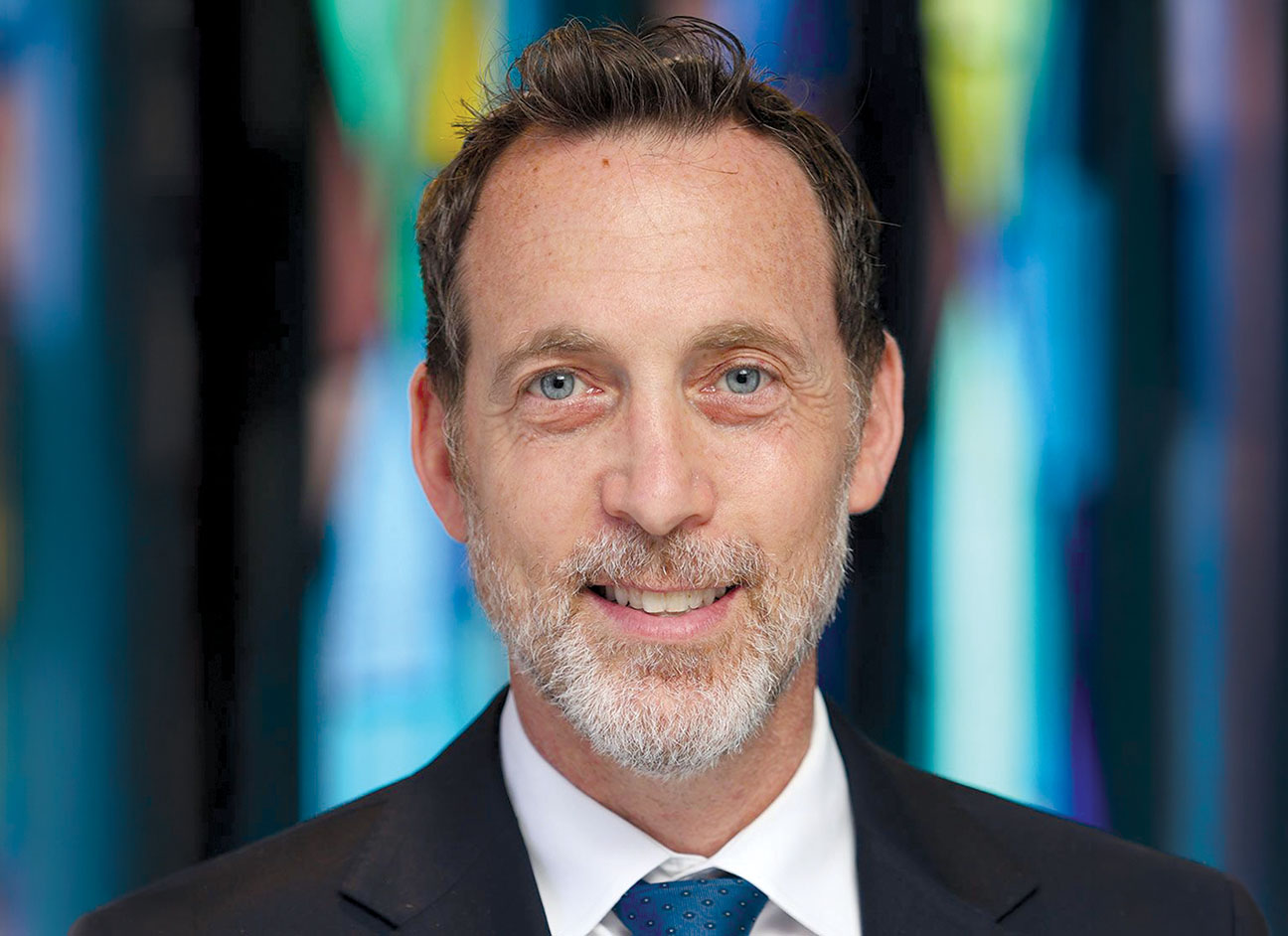
In the first part of his profile, Rabbi Avi Taff of Sinai Temple told The Journal how, during the summer, his 14-year-old daughter Eliana declared that she wanted to make aliyah. She had been recruited by Maccabi Haifa to be part of their basketball academy. Within days she announced her desire to move to Israel.“Eliana’s athletic skills and commitment to Israel form a perfect combination,” her proud father, whose family has a decades-long history of aliyah, said.
How often do they speak? “Ev-v-v-very day,” he said, elongating the word. The mere thought of his middle child being educated in the Jewish state caused him to swell with pride. “That your daughter would be mature enough to make this kind of decision,” he smiled. “It hasn’t been easy,” he said. “Eliana is working through it.”
One of the hardest things he’s ever done, the rabbi said, “was walking away from Eliana when I was leaving Israel the last time after a four-day visit. I stayed ‘til Thursday night, had to be back in the office on Friday, had a bar mitzvah on Saturday, I had a welcome-back event for the school on Sunday and a wedding Sunday night.”
But Eliana was following in her father’s footsteps. Rabbi Taff’s parents were not thrilled, at first, when the oldest of their three sons announced he was making aliyah. “I said to my parents, ‘What did you expect? You taught me to love Israel. You shared the beauty of the land and the people.’”
Eliana is “the latest iteration, my daughter, on her own, at 14, deciding she wants to be there. As hard as it is to not be with her, I am so proud of her,” said Rabbi Taff.
As for the future, “we said we are going to take it semester-by-semester. Nothing’s in stone. If she decides to come back, I am proud of her for giving it a try. We will see how things go, and we’ll keep evaluating.”
Where did the Taff family’s love of Israel come from? “My dad is from Albany, N.Y.,” he said. “I think there’s something in the water in Albany because I know a lot of Albanians who ended up making aliyah.” His father’s whole side of the family (one by one — first, his sister, then his brother, then his parents) moved to Israel. “My dad studied for the rabbinate after they came to Israel. He was a cantor first, then he became a rabbi.”
The Taff family moved to Israel for three years when he was in the first grade. “That was the beginning of the love story. My mom is in her final year of teaching as Head of School in Chicago.”
What lies ahead for Rabbi Taff? “I mean, we plan and God laughs,” he said. “So I don’t really know. My plan is to continue to teach and to foster a deep love of Israel.”
The conversation returned to Rabbi Taff’s students. “My job has evolved,” he said. “I started four years ago solely as the associate rabbi. When I came here, Sinai Academy was looking for a school rabbi. I had been a school rabbi at Valley Beth Shalom for 13 years. I was asked if I would be open to that position here. I really had missed teaching the range, from pre-school through eighth grade. I also do adult education classes. We call them learning circles, including a dads’ learning circle.”
How have kids changed over his 17 years in the classroom? “We are still feeling the effects of COVID,” he said. “In this generation, we are seeing a lot more anxiety among children.”
What can be done to counter this? He quoted from the Talmud. “We educate each child according to his or her way. We try to find the best way to meet the needs of each student.
“Going back to my daughter, Eliana, that is how my wife [Amy] and I decided to let her have the opportunity to go to Israel. We said if our only hesitation is that we are going to miss her, is it right for us to stand in her way from following her dream? It’s her derek, her way. It’s the same with the kids we teach here at Sinai. We want to reach our kids where they are.” While he doesn’t like to generalize, he said “every child, every soul, is unique. They have different ways of learning, different ways of exploring the world.”
What is Rabbi Taff’s favorite responsibility? He paused to think before answering. “So tough,” he said. “I really do look forward to coming to work every day.” After a lengthy hesitation, “I would say my – and our – responsibility here is to foster a deep sense of Jewish commitment and identity to the Jewish people and to Israel. In essence, that is what I love – helping people find their connection.”
As for Rabbi Taff’s long-range perspective, “I dream of one day returning to Israel,” he said. “I am at a point with the current state of the world, specifically of Israel, that I believe we need more North American Jews to move to Israel.
“For Israel to continue to exist as a Jewish state for all Jews – the hatred of us is so open. I also believe that we need Jews of different backgrounds to move to Israel for it to continue to be a democracy, a state for all Jews, not just for the ultra-Orthodox segment.”
Rabbi Taff noted an increase in aliyah in the last three years, since Oct.7, especially from the United States. “We have seen stronger people finding a connection to Israel,” he said. “We are seeing people more interested in exploring their Jewish identities, we are seeing a resurgence of American Jews who consider themselves secular or nonpracticing.”
At Sinai Temple, the number of conversion candidates has grown. “I will say to them, ‘Oct. 7 was not that long ago. The Beit Din, the court of Jewish law, will ask you, ‘Do you agree to bind your destiny to that of the Jewish people?’
“I can’t tell you how many people said ‘Oct. 7 made me want to be a Jew even more than before.’” The rabbi smiled broadly. He was glad to see that young professionals are choosing Judaism. “I say to them ‘If you are saying that now, we can go directly to the mikvah. I don’t need any more reassurance you are dedicated to your Jewish life.’”